
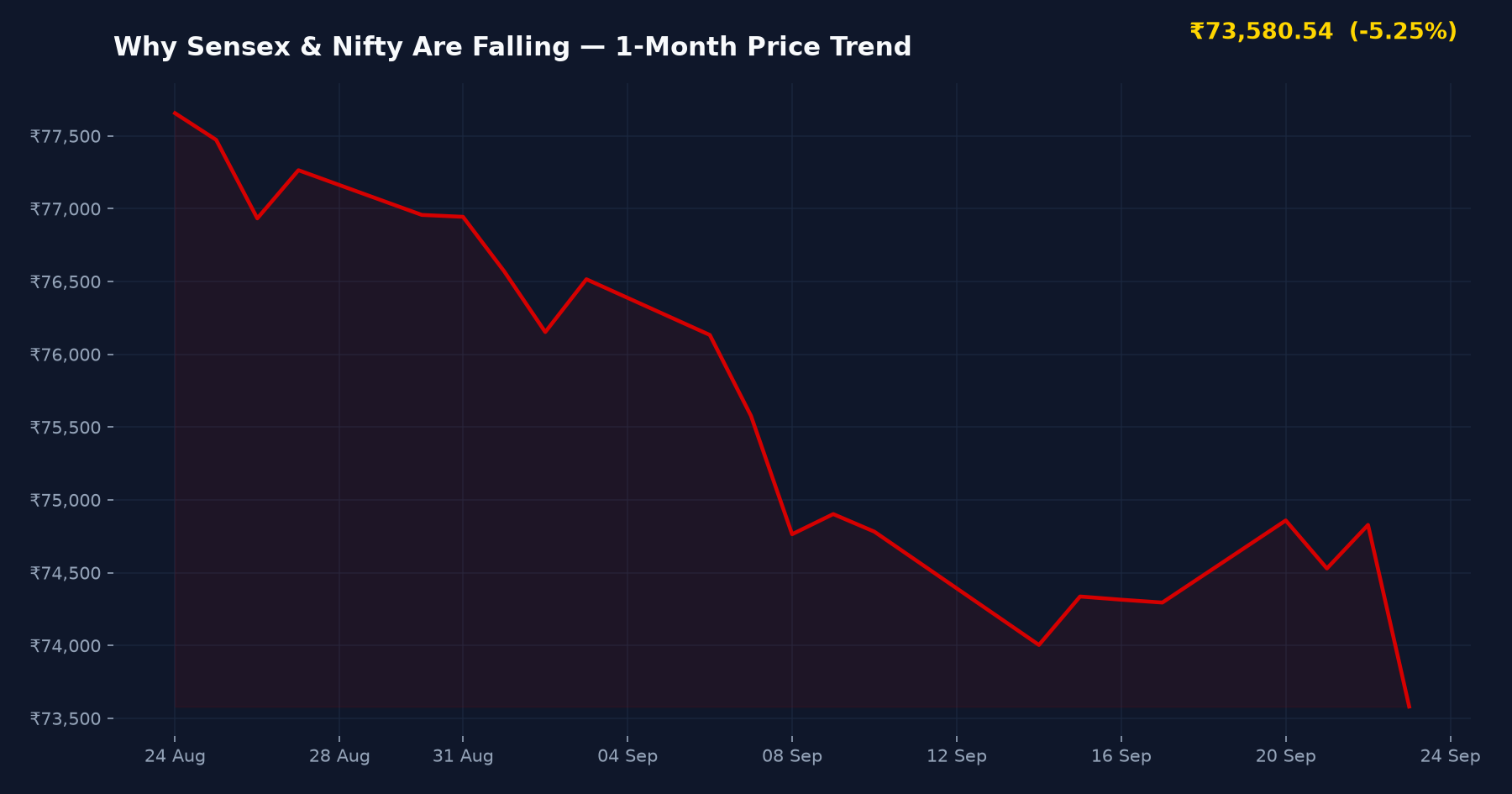
MUMBAI / NEW DELHI, SEPTEMBER 25, 2026 — During trading on Friday, September 25, 2026, domestic equity benchmarks experienced severe downward pressure, with the Sensex and Nifty facing extended selling momentum following weeks of macro volatility driven by surging crude oil prices above $100 per barrel and elevated global bond yields.
According to market reports tracked across Moneycontrol and Livemint, the recent market correction has wiped off significant value from peak levels, compounding investor caution. On Thursday, September 24, 2026, the Sensex settled 1,250 points lower, with the Nifty breaching key psychological supports to end below 23,100. Analysts attribute the ongoing bearish wave to foreign institutional investor (FII) outflows, persistent inflationary pressures stemming from crude energy costs, and tightening liquidity conditions globally.
SENSEX
INDEX
▼ ₹932.46 (-1.25%)
Day Range: ₹73,477.77 – ₹73,968.05
52W Range: ₹71,545.81 – ₹86,159.02
● Real-Time Feed
Key Macroeconomic Triggers Behind the Market Correction
Financial data compiled from institutional research desks at Motilal Oswal and ICICIdirect highlight three core pillars triggering the recent equity pullback:
- Crude Oil Price Surge: Brent crude trading firmly above $100 per barrel poses a direct threat to India’s current account deficit (CAD), import bill, and corporate operating margins, particularly across aviation, paints, and manufacturing sectors.
- Global Bond Yields: Elevated US Treasury yields and domestic sovereign yields continue to draw capital away from emerging market equities toward fixed-income alternatives.
- Sectoral Rotation and IT Selling: Heavy selling pressure in information technology and high-beta cyclical counters has dragged indices lower from recent record valuations.
Key Market Timeline & Milestone Calendar
| Market Event / Milestone | Exact Calendar Date |
|---|---|
| Sharp Market Selloff & Nifty Breach | September 24, 2026 |
| Intraday Volatility & Value Buying Session | September 25, 2026 |
| GIFT Nifty Cues & Asian Market Review | September 25, 2026 |
Sectoral Impact and Investor Sentiment
Retail investor discussions across platforms like Reddit r/IndianStockMarket and ValuePickr indicate heightened anxiety regarding portfolio drawdowns. However, long-term institutional participants view the correction as a healthy normalization of stretched price-to-earnings (P/E) multiples. Value buying emerged at lower levels during Friday’s session, helping Sensex claw back initial intraday losses before settling near key support bands.
Bull vs. Bear Market Catalysts
Bullish Catalysts
- Robust domestic macroeconomic fundamentals and strong corporate balance sheets.
- Consistent SIP (Systematic Investment Plan) inflows from domestic retail mutual funds providing structural market support.
- Opportunistic value buying by institutional investors during sharp market dips.
Bearish Risks
- Crude oil remaining above $100/bbl, threatening fiscal deficit targets and import inflation.
- Persistent FII capital outflows in response to global monetary tightening and high US yields.
- Elevated valuation multiples in mid-cap and small-cap segments leaving little margin for earnings disappointment.
Analyst Investment Assessment
Suitable For: Long-term investors focusing on staggered accumulation rather than lump-sum deployment.
Risk Level: High — Volatility remains elevated due to global crude price shocks and FII sell-offs.
Key Watch Point: Crude oil price trajectory and foreign institutional fund flow data.
Frequently Asked Questions
Why are the Sensex and Nifty falling sharply in September 2026?
The primary drivers behind the market correction include crude oil prices surging past $100 per barrel, rising global bond yields, and aggressive foreign institutional investor (FII) outflows following record domestic index valuations.
How does crude oil trading above $100 impact Indian equity markets?
Crude oil prices above $100 inflate India’s import bill, widen the current account deficit, exert pressure on the rupee, and compress profit margins across manufacturing, transportation, and consumer goods companies.
Should retail investors buy the dip during this market correction?
Long-term investors can utilize staggered deployment strategies via systematic investment plans (SIPs) to accumulate fundamentally strong blue-chip stocks, while strictly avoiding over-leveraged mid-cap and small-cap segments until macroeconomic stability returns.
SEBI Compliance & Statutory Disclaimer
The information and analysis presented on IPO Bulletin (ipobulletin.com) are for informational and educational purposes only and do not constitute financial, investment, or legal advice. Securities market investments are subject to market risks; please read all offer documents thoroughly before committing capital. Always consult a SEBI-registered investment advisor before making financial decisions.
Sources cross-checked for this article: The Hindu, Moneycontrol, Livemint, BSE India filings