Editorial Note: Independent primary market intelligence. Not SEBI-registered investment advice. Verify all figures with the offer document (RHP) before bidding.
Informational content only, not investment advice. Figures are taken from public filings and market trackers named in the article; please verify with the offer document (RHP) before investing.
MUMBAI / NEW DELHI, OCTOBER 28, 2026 — Flexible packaging manufacturer Vedant Poly Fabs Limited has formalized the price band for its upcoming initial public offering at ₹88 to ₹94 per equity share. The ₹56.68 Crore public issue is scheduled to open for subscription on Monday, November 2, 2026, and conclude on Wednesday, November 4, 2026, on the NSE SME platform, according to regulatory offer filings submitted ahead of launch.
Live Update
Live IPO Lifecycle Update: Vedant Poly Fabs Limited (Listing Day)
Milestone: Listing debut today (09 Nov 2026)
Total subscription reached 0.00x the shares on offer by 10:30 AM across all bidder categories.
Total Sub: 0.00xQIB: 0.00xNII: 0.00xIssue Price: ₹94
: Listing Day updated (Total: 0.00x)
: Awaiting Listing updated (Total: 1.85x)
: Closing Day updated (Total: 0.87x)
: Subscription Update updated (Total: 0.39x)
Key Takeaways at a Glance
Issue & Valuation Snapshot: Vedant Poly Fabs IPO is a book-built offer seeking to raise ₹56.68 Crore within a fixed price band of ₹88 to ₹94 per equity share.
Structure & Dilution: The issue combines a Fresh Issue of 54.26 lakh shares (₹51.01 Crore) and an Offer for Sale (OFS) of 6.04 lakh shares (₹5.67 Crore).
Bidding Timeline: Public bidding runs from November 2 to November 4, 2026, with an application market lot of 1,200 equity shares on the NSE SME platform.
The book-building process for Vedant Poly Fabs Limited will open on November 2, 2026, giving non-institutional and retail participants a three-day application window. Investors tracking primary market schedules on our open and upcoming IPO calendar can review the confirmed operational dates below:
Pending official announcement upon RHP filing / SEBI clearance
Vedant Poly Fabs IPO Price Band, Capital Structure & Lot Economics
The capital structure of the issue aggregates to 60,30,000 equity shares. The fresh capital component comprises 54,26,400 equity shares amounting to ₹51.01 Crore, which directly enters the corporate balance sheet to support corporate operations. The secondary component represents an Offer for Sale (OFS)—a mechanism where existing promoters or early investors sell their holdings without proceeds accruing to the operating entity—of 6,03,600 shares valued at ₹5.67 Crore.
Affinity Global Capital Market Private Limited is acting as the sole Book Running Lead Manager to manage the book-building and syndication process. As with SME exchange frameworks overseen by the Securities and Exchange Board of India (SEBI), mandatory application ticket sizes are configured above standard mainboard limits to reflect the institutional profile of the SME segment.
As of Wednesday, October 28, 2026, GMP data is pending initial price discovery across primary tracking platforms (Chittorgarh & IPOWatch). Unofficial grey market forward quotations generally begin recording volume after anchor allotment confirmations and official Red Herring Prospectus (RHP) dispatch. Market watchers can monitor the latest premium trends and dealer quotes via our live IPO Grey Market Premium (GMP) tracker.
Grey market activities remain unorganized, non-exchange mechanisms subject to localized dealer interest. Investors are advised that absence of early quotes simply mirrors the scheduled multi-day gap ahead of the November 2 subscription launch.
Business Model & Operational Overview: Vedant Poly Fabs
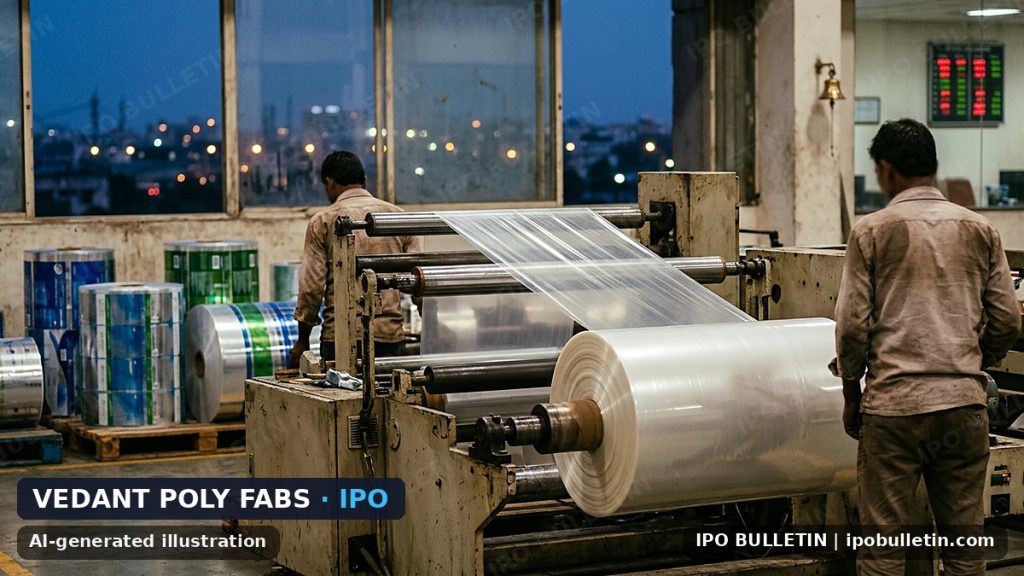
Established in 2018, Vedant Poly Fabs Limited operates as a manufacturer of flexible packaging materials built around a business-to-business (B2B) operating model. Situated in Barasat, West Bengal, the company supplies critical packaging infrastructure tailored to industrial processors and consumer product distributors across domestic markets.
The company’s core product matrix centers on advanced polymer engineering, including:
Multilayer Low-Density (LD) Films: Engineered for tensile strength and puncture resistance across industrial wrapping and logistics.
Barrier & Shrink Films: Specialized moisture, light, and gas isolation solutions deployed in perishable food and chemical supply chains.
Printed Plastic Films & Laminates: High-speed automated packaging reels customized for consumer-facing goods.
Liquid Packaging Substrates: Certified containment layers tailored specifically for wholesale milk and edible oil distribution.
Analytical Risk Assessment: Growth triggers vs. Operating Risks
Evaluating capital allocation into SME manufacturing issues requires weighing structural sector demand alongside inherent operating dependencies.
Key Operational triggers
FMCG & Dairy Packaging Tailwinds: Non-discretionary consumer consumption in milk, edible oils, and packaged foods creates recurring baseline volume demand for specialized barrier films.
Predominant Fresh Capital Allocation: With ₹51.01 Crore of the total ₹56.68 Crore issue raised as fresh issue equity, the capital inflow directly finances operational scaling rather than serving predominantly as promoter exits.
Regional Manufacturing Positioning: Operating out of West Bengal provides logistics and freight cost efficiencies across eastern and northeastern industrial corridors.
Key Operational Risks
Polymer Raw Material Price Volatility: Low-density polyethylene (LDPE) and allied plastic resins are crude-oil derivatives; sharp international price swings directly impact gross margins if cost increases cannot be passed on.
Regulatory & Environmental Oversight: Single-use plastic regulations and extended producer responsibility (EPR) mandates set by state and central pollution boards require continuous technological compliance.
NSE SME Trading Liquidity: The mandatory application and secondary trading lot constraint (1,200 shares) creates narrower trading liquidity relative to mainboard listed equities.
What to Check Before Applying
Use of Fresh Proceeds: Check the explicit deployment schedule for the ₹51.01 Crore fresh capital across debt repayment, machinery purchases, and working capital.
Customer Concentration Profile: Verify from the RHP what percentage of total revenue originates from the top 5 and top 10 dairy and packaging clients.
Working Capital Intensity: Examine trade receivable turnover and inventory holding periods common to B2B packaging converters.
Post-Issue Promoter Shareholding: Review the remaining equity stake held by the promoters following the execution of the 6.04 lakh share Offer for Sale.
Once bidding concludes, applicants can check their allotment allotment status through our dedicated IPO allotment status verification hub using Application Number, PAN, or DP Client ID.
Frequently Asked Questions
What are the opening and closing dates for the Vedant Poly Fabs IPO?
The Vedant Poly Fabs IPO officially opens for bidding on Monday, November 2, 2026, and closes on Wednesday, November 4, 2026. The issue operates on the NSE SME platform through an electronic book-building mechanism.
What is the price band and minimum retail investment required?
The price band is fixed at ₹88 to ₹94 per share with a market lot size of 1,200 shares. Individual retail applicants bidding for the minimum prescribed application size of 2 lots (2,400 shares) require an outlay of ₹2,25,600 at the upper price band.
What is the Grey Market Premium (GMP) for Vedant Poly Fabs IPO?
GMP data is pending initial price discovery across primary tracking platforms (Chittorgarh & IPOWatch). Unofficial forward quotes typically establish initial reference trades closer to the issue opening date following the release of complete regulatory filings.
The information and analysis presented on IPO Bulletin (ipobulletin.com) are for informational and educational purposes only and do not constitute financial, investment, or legal advice. Securities market investments are subject to market risks; please read all offer documents (DRHP/RHP) thoroughly before committing capital. Grey Market Premium (GMP) figures are unofficial, unregulated street estimates. Always consult a SEBI-registered investment advisor before making financial decisions.
Sources referenced: SEBI, NSE India filings, Chittorgarh, IPOWatch, IPO Central.
The Red Herring Prospectus, or RHP, is the offer document filed with the Registrar of Companies before an IPO opens. It is based on the earlier draft, the DRHP, updated for SEBI’s observations and for the latest financial results. The…
Subscription, also written as times subscribed, tells you how many shares investors have applied for compared with how many shares are on offer. It is calculated by dividing the number of shares bid for by the number of shares offered.…
A price band is the range, with a lower limit (floor) and an upper limit (cap), within which investors may bid for shares in a book-built IPO. The company and its lead managers announce the band in the price band…
An offer for sale, or OFS, is the part of an IPO in which existing shareholders sell some of their shares to the public. The company itself receives no money from this part, because the proceeds go to the shareholders…
The National Stock Exchange is one of India’s two main stock exchanges. Its SME platform is NSE Emerge, and Nifty 50 is its main index.
The basis of allotment is the method and result by which shares are distributed among applicants after an IPO closes. It is finalised by the registrar to the issue in consultation with the stock exchange, and the exchange approves it…
ASBA stands for Application Supported by Blocked Amount. It is the method every IPO investor in India uses to pay for an application. Instead of sending a cheque or a demand draft to the company, you authorise your own bank…
The listing date is the day on which a company’s shares start trading on the stock exchange after its IPO. Before this day the shares exist only as an allotment in the registrar’s records and, after the credit step, in…
A lead manager, formally called a Book Running Lead Manager or BRLM, is the merchant banker or investment bank that manages the IPO process for the company. It must be registered with SEBI. Its work includes due diligence on the…
A price band is the range, with a lower limit (floor) and an upper limit (cap), within which investors may bid for shares in a book-built IPO. The company and its lead managers announce the band in the price band…
The National Stock Exchange is one of India’s two main stock exchanges. Its SME platform is NSE Emerge, and Nifty 50 is its main index.
Subscription, also written as times subscribed, tells you how many shares investors have applied for compared with how many shares are on offer. It is calculated by dividing the number of shares bid for by the number of shares offered.…
A fresh issue is the part of an IPO in which the company creates and sells new shares, so the money raised goes to the company itself. Because new shares are added, the total number of shares outstanding rises, and…
An offer for sale, or OFS, is the part of an IPO in which existing shareholders sell some of their shares to the public. The company itself receives no money from this part, because the proceeds go to the shareholders…
The Red Herring Prospectus, or RHP, is the offer document filed with the Registrar of Companies before an IPO opens. It is based on the earlier draft, the DRHP, updated for SEBI’s observations and for the latest financial results. The…
The Securities and Exchange Board of India is the market regulator. It writes the IPO rules and reviews every offer document before an issue.
The lot size is the smallest number of shares you can apply for in an IPO, and every application must be a whole multiple of it. The company and its lead managers set the lot size so that one lot…
A High Net-worth Individual is an investor who bids above Rs 2 lakh. In an IPO such bids fall in the non-institutional category.
The grey market is an unofficial, unregulated market in which IPO shares or applications are traded before the shares are listed on an exchange. Participants buy and sell the right to receive allotted shares, or the application itself, at a…
Subscription, also written as times subscribed, tells you how many shares investors have applied for compared with how many shares are on offer. It is calculated by dividing the number of shares bid for by the number of shares offered.…
A Qualified Institutional Buyer, or QIB, is a large professional investor that SEBI recognises as having the knowledge and financial strength to invest in securities without the extra protection given to small investors. The category includes mutual funds, insurance companies,…
The Red Herring Prospectus, or RHP, is the offer document filed with the Registrar of Companies before an IPO opens. It is based on the earlier draft, the DRHP, updated for SEBI’s observations and for the latest financial results. The…
The Securities and Exchange Board of India is the market regulator. It writes the IPO rules and reviews every offer document before an issue.
The National Stock Exchange is one of India’s two main stock exchanges. Its SME platform is NSE Emerge, and Nifty 50 is its main index.
An offer for sale, or OFS, is the part of an IPO in which existing shareholders sell some of their shares to the public. The company itself receives no money from this part, because the proceeds go to the shareholders…
A price band is the range, with a lower limit (floor) and an upper limit (cap), within which investors may bid for shares in a book-built IPO. The company and its lead managers announce the band in the price band…
A fresh issue is the part of an IPO in which the company creates and sells new shares, so the money raised goes to the company itself. Because new shares are added, the total number of shares outstanding rises, and…
A bid is an investor’s offer to buy a specified number of shares in an IPO at a price within the announced price band. In a book-built issue, you submit a bid through your broker, your bank’s net banking or…
The grey market premium, usually shortened to GMP, is the extra price at which an IPO share is quoted in the unofficial grey market before it lists, shown as a premium over the issue price. Dealers in this market trade…
Subscription, also written as times subscribed, tells you how many shares investors have applied for compared with how many shares are on offer. It is calculated by dividing the number of shares bid for by the number of shares offered.…
A Qualified Institutional Buyer, or QIB, is a large professional investor that SEBI recognises as having the knowledge and financial strength to invest in securities without the extra protection given to small investors. The category includes mutual funds, insurance companies,…
The Red Herring Prospectus, or RHP, is the offer document filed with the Registrar of Companies before an IPO opens. It is based on the earlier draft, the DRHP, updated for SEBI’s observations and for the latest financial results. The…
The Securities and Exchange Board of India is the market regulator. It writes the IPO rules and reviews every offer document before an issue.
An offer for sale, or OFS, is the part of an IPO in which existing shareholders sell some of their shares to the public. The company itself receives no money from this part, because the proceeds go to the shareholders…
The National Stock Exchange is one of India’s two main stock exchanges. Its SME platform is NSE Emerge, and Nifty 50 is its main index.
A prospectus is the legal document in which a company invites the public to subscribe to its shares or debentures and discloses the information investors need to decide. In India the Companies Act 2013 and SEBI regulations require it to…
The grey market is an unofficial, unregulated market in which IPO shares or applications are traded before the shares are listed on an exchange. Participants buy and sell the right to receive allotted shares, or the application itself, at a…
A fresh issue is the part of an IPO in which the company creates and sells new shares, so the money raised goes to the company itself. Because new shares are added, the total number of shares outstanding rises, and…
Allotment is the step after an IPO closes in which the company decides who receives shares and how many. Once bidding ends, the registrar prepares the basis of allotment, which explains how the shares were shared between categories and applicants.…
Allotment is the step after an IPO closes in which the company decides who receives shares and how many. Once bidding ends, the registrar prepares the basis of allotment, which explains how the shares were shared between categories and applicants.…
Subscription, also written as times subscribed, tells you how many shares investors have applied for compared with how many shares are on offer. It is calculated by dividing the number of shares bid for by the number of shares offered.…
A Qualified Institutional Buyer, or QIB, is a large professional investor that SEBI recognises as having the knowledge and financial strength to invest in securities without the extra protection given to small investors. The category includes mutual funds, insurance companies,…
The Red Herring Prospectus, or RHP, is the offer document filed with the Registrar of Companies before an IPO opens. It is based on the earlier draft, the DRHP, updated for SEBI’s observations and for the latest financial results. The…
An offer for sale, or OFS, is the part of an IPO in which existing shareholders sell some of their shares to the public. The company itself receives no money from this part, because the proceeds go to the shareholders…
The National Stock Exchange is one of India’s two main stock exchanges. Its SME platform is NSE Emerge, and Nifty 50 is its main index.
A price band is the range, with a lower limit (floor) and an upper limit (cap), within which investors may bid for shares in a book-built IPO. The company and its lead managers announce the band in the price band…
The grey market premium, usually shortened to GMP, is the extra price at which an IPO share is quoted in the unofficial grey market before it lists, shown as a premium over the issue price. Dealers in this market trade…
The Securities and Exchange Board of India is the market regulator. It writes the IPO rules and reviews every offer document before an issue.
The grey market is an unofficial, unregulated market in which IPO shares or applications are traded before the shares are listed on an exchange. Participants buy and sell the right to receive allotted shares, or the application itself, at a…
Allotment is the step after an IPO closes in which the company decides who receives shares and how many. Once bidding ends, the registrar prepares the basis of allotment, which explains how the shares were shared between categories and applicants.…
Subscription, also written as times subscribed, tells you how many shares investors have applied for compared with how many shares are on offer. It is calculated by dividing the number of shares bid for by the number of shares offered.…
A Qualified Institutional Buyer, or QIB, is a large professional investor that SEBI recognises as having the knowledge and financial strength to invest in securities without the extra protection given to small investors. The category includes mutual funds, insurance companies,…
An offer for sale, or OFS, is the part of an IPO in which existing shareholders sell some of their shares to the public. The company itself receives no money from this part, because the proceeds go to the shareholders…
The Red Herring Prospectus, or RHP, is the offer document filed with the Registrar of Companies before an IPO opens. It is based on the earlier draft, the DRHP, updated for SEBI’s observations and for the latest financial results. The…
The National Stock Exchange is one of India’s two main stock exchanges. Its SME platform is NSE Emerge, and Nifty 50 is its main index.
A price band is the range, with a lower limit (floor) and an upper limit (cap), within which investors may bid for shares in a book-built IPO. The company and its lead managers announce the band in the price band…
The Draft Red Herring Prospectus, or DRHP, is the first detailed offer document that a company files with SEBI when it plans to go public. It is prepared by the lead managers and describes the business, the industry, the management…
The Securities and Exchange Board of India is the market regulator. It writes the IPO rules and reviews every offer document before an issue.
The Registrar of Companies registers companies and holds their filings. Offer documents are filed with it before an IPO opens.
Allotment is the step after an IPO closes in which the company decides who receives shares and how many. Once bidding ends, the registrar prepares the basis of allotment, which explains how the shares were shared between categories and applicants.…
Subscription, also written as times subscribed, tells you how many shares investors have applied for compared with how many shares are on offer. It is calculated by dividing the number of shares bid for by the number of shares offered.…
A Qualified Institutional Buyer, or QIB, is a large professional investor that SEBI recognises as having the knowledge and financial strength to invest in securities without the extra protection given to small investors. The category includes mutual funds, insurance companies,…
The Red Herring Prospectus, or RHP, is the offer document filed with the Registrar of Companies before an IPO opens. It is based on the earlier draft, the DRHP, updated for SEBI’s observations and for the latest financial results. The…
An offer for sale, or OFS, is the part of an IPO in which existing shareholders sell some of their shares to the public. The company itself receives no money from this part, because the proceeds go to the shareholders…
The lot size is the smallest number of shares you can apply for in an IPO, and every application must be a whole multiple of it. The company and its lead managers set the lot size so that one lot…
The grey market premium, usually shortened to GMP, is the extra price at which an IPO share is quoted in the unofficial grey market before it lists, shown as a premium over the issue price. Dealers in this market trade…
The Securities and Exchange Board of India is the market regulator. It writes the IPO rules and reviews every offer document before an issue.
A prospectus is the legal document in which a company invites the public to subscribe to its shares or debentures and discloses the information investors need to decide. In India the Companies Act 2013 and SEBI regulations require it to…
The Draft Red Herring Prospectus, or DRHP, is the first detailed offer document that a company files with SEBI when it plans to go public. It is prepared by the lead managers and describes the business, the industry, the management…
Allotment is the step after an IPO closes in which the company decides who receives shares and how many. Once bidding ends, the registrar prepares the basis of allotment, which explains how the shares were shared between categories and applicants.…
Subscription, also written as times subscribed, tells you how many shares investors have applied for compared with how many shares are on offer. It is calculated by dividing the number of shares bid for by the number of shares offered.…
A Qualified Institutional Buyer, or QIB, is a large professional investor that SEBI recognises as having the knowledge and financial strength to invest in securities without the extra protection given to small investors. The category includes mutual funds, insurance companies,…
The Red Herring Prospectus, or RHP, is the offer document filed with the Registrar of Companies before an IPO opens. It is based on the earlier draft, the DRHP, updated for SEBI's observations and for the latest financial results. The…
The National Stock Exchange is one of India's two main stock exchanges. Its SME platform is NSE Emerge, and Nifty 50 is its main index.
The Securities and Exchange Board of India is the market regulator. It writes the IPO rules and reviews every offer document before an issue.
A bid is an investor's offer to buy a specified number of shares in an IPO at a price within the announced price band. In a book-built issue, you submit a bid through your broker, your bank's net banking or…
A price band is the range, with a lower limit (floor) and an upper limit (cap), within which investors may bid for shares in a book-built IPO. The company and its lead managers announce the band in the price band…
An offer for sale, or OFS, is the part of an IPO in which existing shareholders sell some of their shares to the public. The company itself receives no money from this part, because the proceeds go to the shareholders…
The registrar to the issue, often just called the IPO registrar, is the SEBI-registered agency that handles the administrative backbone of an IPO after the bidding closes. It collects and validates the applications received from the exchanges and banks, matches…
Subscription, also written as times subscribed, tells you how many shares investors have applied for compared with how many shares are on offer. It is calculated by dividing the number of shares bid for by the number of shares offered.…
A Qualified Institutional Buyer, or QIB, is a large professional investor that SEBI recognises as having the knowledge and financial strength to invest in securities without the extra protection given to small investors. The category includes mutual funds, insurance companies,…
Allotment is the step after an IPO closes in which the company decides who receives shares and how many. Once bidding ends, the registrar prepares the basis of allotment, which explains how the shares were shared between categories and applicants.…
The Red Herring Prospectus, or RHP, is the offer document filed with the Registrar of Companies before an IPO opens. It is based on the earlier draft, the DRHP, updated for SEBI's observations and for the latest financial results. The…
A price band is the range, with a lower limit (floor) and an upper limit (cap), within which investors may bid for shares in a book-built IPO. The company and its lead managers announce the band in the price band…
An offer for sale, or OFS, is the part of an IPO in which existing shareholders sell some of their shares to the public. The company itself receives no money from this part, because the proceeds go to the shareholders…
The National Stock Exchange is one of India's two main stock exchanges. Its SME platform is NSE Emerge, and Nifty 50 is its main index.
The basis of allotment is the method and result by which shares are distributed among applicants after an IPO closes. It is finalised by the registrar to the issue in consultation with the stock exchange, and the exchange approves it…
The Securities and Exchange Board of India is the market regulator. It writes the IPO rules and reviews every offer document before an issue.
ASBA stands for Application Supported by Blocked Amount. It is the method every IPO investor in India uses to pay for an application. Instead of sending a cheque or a demand draft to the company, you authorise your own bank…
SEBI Regulatory Compliance & Risk Disclosure: IPO Bulletin is a financial publishing and data analysis portal. It is not registered as an Investment Adviser (IA) or Research Analyst (RA) with SEBI. Content published here is solely for educational and research purposes. Grey Market Premium (GMP) data is unofficial and informal. Equity investments in initial public offerings carry risk of capital loss. Always consult a certified financial advisor.
Community Policy: IPO Bulletin is an informational research desk. Comments offering stock tips, buy/sell targets, price calls, or Telegram/WhatsApp solicitations are prohibited and removed immediately. Keep discussions grounded in regulatory filings.
Join the Discussion
Only registered readers can post comments to keep discussions insightful and free of scam tips. Passwordless email login takes less than 30 seconds.
No comments yet on this analysis. Be the first reader to share your perspective!
The Morning Brief: Free Dalal Street Intelligence
Get every day's primary market filings, grey market shifts, and allotment links delivered straight to your inbox every morning.
IPOBulletin
Reader Sign In / Sign Up
Passwordless email login. Enter your email to receive a secure 6-digit login code.
Enter Verification Code
We sent a 6-digit code to your email. Valid for 10 minutes.

💬 Reader Discussions & Insights
Only registered readers can post comments to keep discussions insightful and free of scam tips. Passwordless email login takes less than 30 seconds.
No comments yet on this analysis. Be the first reader to share your perspective!