
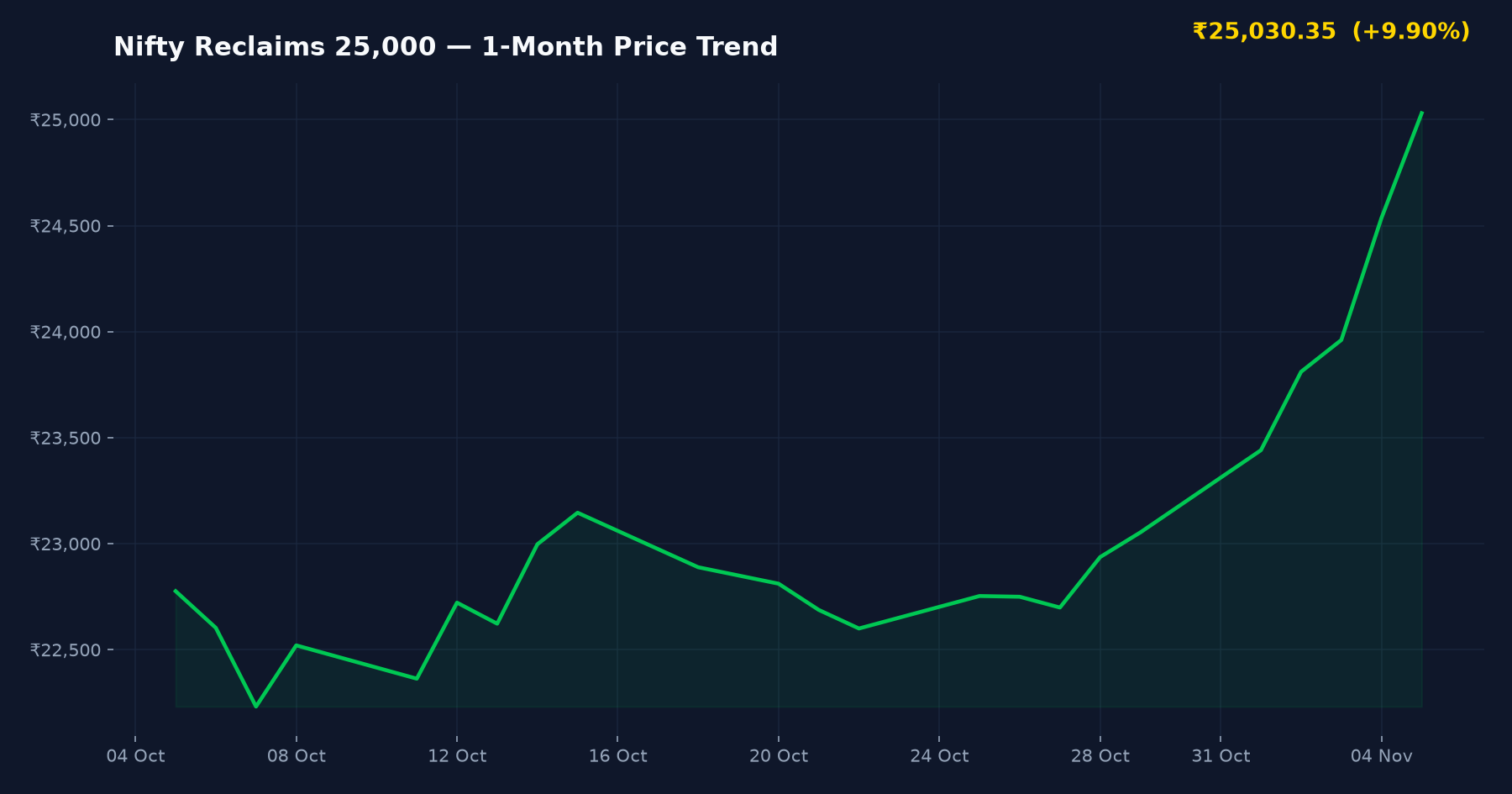
MUMBAI / NEW DELHI, NOVEMBER 08, 2026 — As of Friday, November 06, 2026, November 08, 2026, benchmark Indian equity indices held ground as the Nifty 50 reclaimed the psychological 25,000 threshold on a seven-session winning run. The sustained rally, underpinned by resilient corporate earnings prints and steady domestic macroeconomic indicators, has shifted investor focus to key technical breakout candidates—including ITC, ICICI Bank, State Bank of India (SBI), Mahindra & Mahindra (M&M), and Force Motors—ahead of the annual festive Muhurat trading window on the BSE and NSE India.
Key Takeaways at a Glance
- Benchmark Index Trajectory: Nifty 50 crossed above 25,000 following seven straight sessions of accumulation, reversing mid-autumn consolidation.
- triggers & Earnings Support: Resilient quarterly balance sheets across banking and automotive heavyweights have anchored institutional liquidity.
- Festive Session Context: Institutional market desks are highlighting multi-week price breakouts across defensive FMCG, private banking, and commercial vehicle counters.
NIFTY 50
INDEX
▲ +₹493.75 (+2.01%)
Day Range: ₹24,388.05 – ₹25,030.35
52W Range: ₹22,179.90 – ₹26,373.20
● Real-Time Feed
Market Schedule & Milestone Timeline for November 2026
The festive trading cycle reflects a confluence of corporate earnings releases, central bank liquidity updates, and dedicated special trading sessions. Tracking these milestones provides structure to broader portfolio tracking on the Indian market indices dashboard.
| Event / Market Milestone | Exact Calendar Date |
|---|---|
| Seven-Session Rally Culmination (Nifty 25,000 Reclaimed) | November 08, 2026 |
| Exchange Muhurat Trading Special Session | November 2026 (Scheduled Diwali Window) |
| Corporate Q2 Earnings Concluding Window | Mid-November 2026 |
Technical Breakout Structures: Stocks in Market Focus
Muhurat trading—the customary one-hour symbolic trading session held by Indian exchanges on Diwali to mark the commencement of the new traditional Hindu financial year, Samvat—frequently experiences selective positioning. According to technical trading desks across major domestic brokerages including Motilal Oswal and ICICIdirect, institutional flows have gravitated toward balance sheets with clean continuation patterns.
| Entity / Focus Stock | Sector / Domain | Primary Technical Structure |
|---|---|---|
| ITC Limited | FMCG / Diversified | Multi-week range breakout above resistance |
| ICICI Bank | Private Banking | Higher-high formation on above-average volumes |
| State Bank of India (SBI) | Public Sector Banking | Sustained support at 50-day moving average |
| Mahindra & Mahindra (M&M) | Automotive / Utility Vehicles | Bullish flag continuation pattern |
| Force Motors | Commercial Automotive | Cup-and-handle base breakout |
Macro Factors and Q2 Earnings Driving Secondary Market Breadth
The backdrop to the current rally extends beyond cyclical festival optimism. Market participants point to a sequence of macroeconomic triggers that have shielded Indian equities from episodic global volatility.
Banking Asset Quality and Credit Growth Expansion
Large-cap commercial banks continue to record stable net interest margins (NIMs) alongside low gross non-performing asset (GNPA) ratios. The asset expansion seen in lenders like ICICI Bank and SBI demonstrates that urban and rural retail loan demand remains intact. Institutional investors are monitoring whether corporate capex cycles will accelerate credit uptake further into the second half of the fiscal year.
Automotive Order Books and Rural Consumption
In the automotive space, firms such as M&M and Force Motors have benefited from elevated order backlogs in premium sport utility vehicles (SUVs) and commercial transport fleets. Enhanced rural purchasing power, aided by favorable agricultural yields, has provided fundamental support to commercial vehicle operators. Meanwhile, primary market participants have noted how liquidity generated across the recent IPO listing performance tracker continues to rotate back into established blue-chip equities.
Market Framework: Upside triggers vs. Downside Risks
- Upside triggers:
- Sustained domestic institutional investor (DII) systematic inflows neutralizing episodic foreign institutional investor (FII) outflows.
- Broadening market breadth, with mid-cap and sector indices participating in fresh multi-week highs alongside the Nifty 50.
- Healthy pipeline in primary issues, as mapped on the live IPO calendar and primary market schedule, driving broader market engagement.
- Downside Risks:
- Elevated valuation multiples in mid-cap segments, leaving narrow margin of safety if earnings decelerate.
- Global interest rate trajectories and currency fluctuations impacting input costs and foreign portfolio allocations.
- Crude oil price spikes that could exert pressure on trade deficits and corporate operating margins.
What to Check Before Participating in Muhurat Trading
- Verify trading hours: Muhurat trading is a condensed one-hour session with specific pre-open matching timelines set by NSE and BSE.
- Check order types: Market orders during low-liquidity illiquid counters can face execution slippage; limit orders are standard practice.
- Review corporate fundamentals: Ensure breakout candidates are backed by audited Q2 operational metrics rather than pure speculative momentum.
- Assess valuation metrics: Compare price-to-earnings (P/E) and price-to-book (P/B) ratios against historical five-year medians on screener platforms.
Frequently Asked Questions
What is the significance of the Muhurat trading session on NSE and BSE?
Muhurat trading is a designated one-hour special trading window conducted on Diwali evening to mark the beginning of the traditional Hindu accounting year, Samvat. Market participants view the session as auspicious, historically using the window for long-term portfolio additions and token ceremonial investments.
Which technical levels are traders watching for the Nifty 50 above 25,000?
Following the reclaim of 25,000, market technicians identify the 24,800–24,850 zone as immediate support on pullbacks, anchored by the short-term 20-day exponential moving average. On the upside, resistance is monitored around the 25,250–25,300 band, where previous consolidation clusters were established.
How do corporate earnings influence stock selection during festive trading?
Stocks showing technical strength alongside verified earnings growth typically exhibit more resilient price retention. Large-cap counters with robust Return on Equity (RoE) and stable debt-to-equity ratios tend to see greater institutional sponsorship compared to momentum-only small-cap alternatives.
SEBI Compliance & Statutory Disclaimer
The information and analysis presented on IPO Bulletin (ipobulletin.com) are for informational and educational purposes only and do not constitute financial, investment, or legal advice. Securities market investments are subject to market risks; please read all offer documents and regulatory disclosures thoroughly before committing capital. Technical levels and third-party brokerage mentions represent observed market commentary and not specific buy or sell calls. Always consult a SEBI-registered investment advisor before making financial decisions.
Sources referenced: Economic Times, NSE India, BSE India, Motilal Oswal Research, ICICIdirect, Screener.in.
Reusing this article or its images? Credit IPO Bulletin and link to https://ipobulletin.com/news/nifty-reclaims-muhurat-trading-setups/. Content licence.