
MUMBAI / NEW DELHI, OCTOBER 17, 2026 — During the week ending October 16, 2026, the Indian IT sector witnessed an extraordinary rally, with the Nifty IT index soaring by 11.7%. This marked its most significant weekly gain since 2008, primarily driven by unexpectedly strong quarterly results from key players such as HCLTech. Concurrently, the Indian rupee demonstrated notable strength, closing below the 95-mark against the US dollar for the first time in 38 days, reflecting the Reserve Bank of India’s effective policy measures.
MUMBAI / NEW DELHI, NOVEMBER 06, 2026 — During early trading on Friday, November 06, 2026, the GIFT Nifty index dropped over 100 points, signaling a weak opening for the benchmark Nifty 50 and BSE Sensex. The downward pressure followed acute risk-off sentiment across Asian bourses, where South Korea’s Kospi plunged 9% to trigger trading circuit breakers amid an intense selloff across global technology equities.
Key Takeaways at a Glance
- Opening Bias: GIFT Nifty slipped 100 points on Friday morning, pointing to an immediate gap-down start for domestic equities.
- Regional Pressure: Tech equities led a regional selloff, dragging South Korea’s Kospi down 9% and halting broader Asian trading momentum.
- Macro Context: Indian benchmarks face elevated intraday volatility after earlier gains seen on November 05, driven by shifting global cues and currency movements.
NIFTY 50
INDEX
▲ +₹725.80 (+3.05%)
Day Range: ₹24,296.30 – ₹24,579.90
52W Range: ₹22,179.90 – ₹26,373.20
● Real-Time Feed
Global Pre-Market Trajectory and Asian triggers Timeline
Tracking data from early morning trade indicates that institutional capital rotated out of high-beta technology holdings overnight. According to market flow observations compiled across domestic brokerage research desks, foreign portfolio flows showed caution following steep declines in the US tech complex and key East Asian semiconductor suppliers.
| Market triggers / Regional Event | Exact Calendar Date |
|---|---|
| GIFT Nifty Morning Gap-Down (Down 100 pts) | November 06, 2026 |
| GIFT Nifty 370-pt Surge Post-Crude Decline | November 05, 2026 |
| GIFT Nifty 50-pt Pullback on US Election Volatility | November 04, 2026 |
| GIFT Nifty 200-pt Advance on Asian Weakness Absorption | November 02, 2026 |
How International Risk Sentiment Shapes Domestic Indian Benchmarks
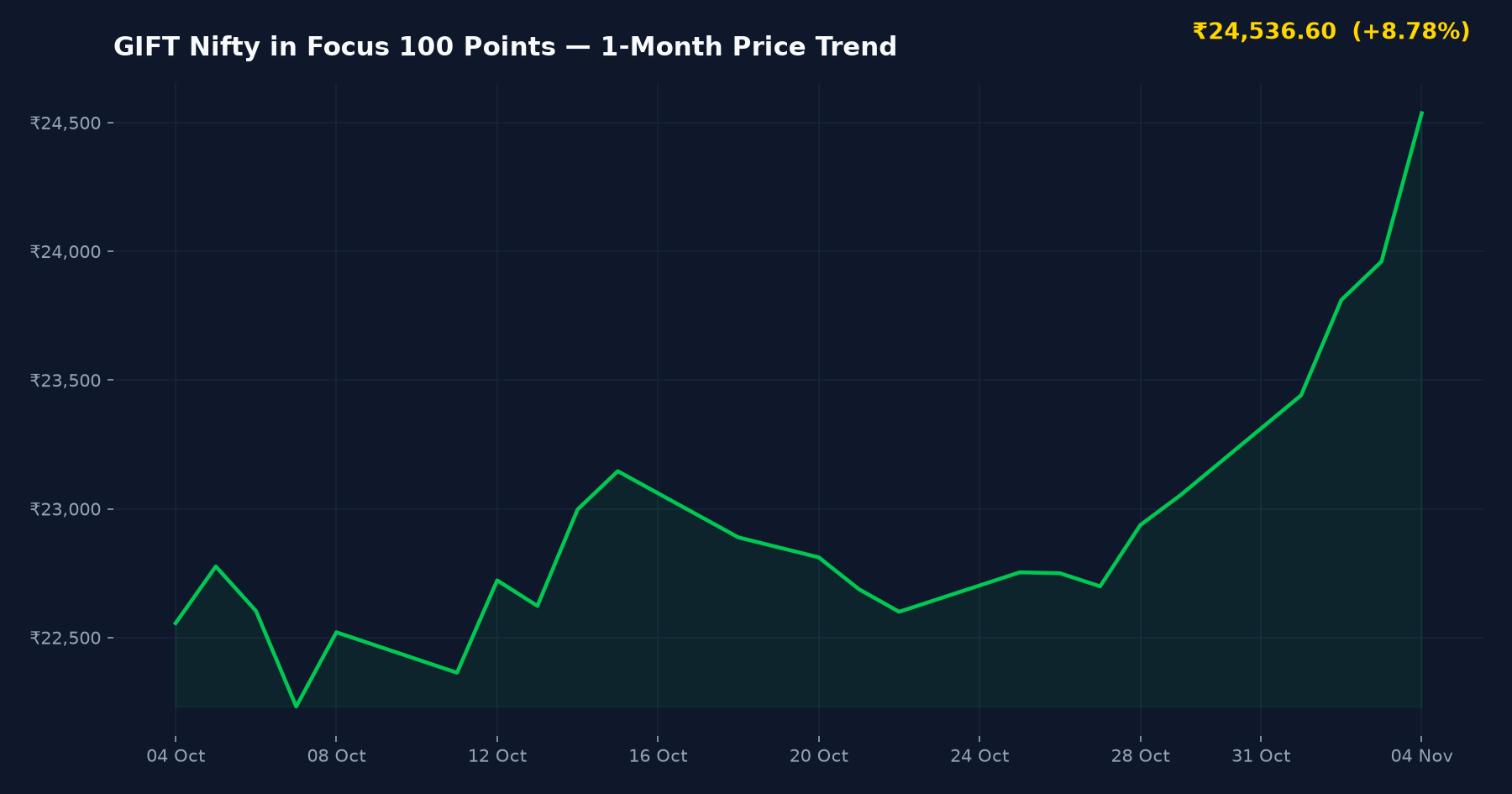
The early session fall in GIFT Nifty comes on the heels of intense turbulence across Asian tech centers. South Korea’s Kospi index triggered an emergency circuit breaker halt following an intraday crash of 9%. Investors monitoring the Indian market indices dashboard should note that sudden shocks across regional peers often translate into higher volatility index readings and cautious positioning among Qualified Institutional Buyers (QIBs).
Primary exchange flows documented by NSE India and BSE India over earlier sessions demonstrated responsive intraday shifts to overseas macro triggers, particularly crude oil movements and currency variations. While the domestic corporate earnings pipeline continues to report Q2 FY27 operational scorecards, secondary market momentum remains tethered to global liquidity and rate expectations.
Market Framework: Bullish Support Factors vs Bearish Pressures
Market participants balancing risk exposure during volatile gap-down sessions evaluate structural support against external tail-risks:
Structural Support Drivers
- Resilient Domestic Inflows: Continued retail systematic investments and domestic institutional participation provide underlying liquidity against foreign portfolio outflows.
- Primary Market Appetite: Investors continue monitoring active issuances on the open IPO subscription tracker, illustrating selective liquidity in equity capital markets.
- Energy Price Dynamics: Prior corrections in benchmark Brent crude prices help mitigate domestic imported inflation pressures.
Near-Term Downside Risks
- Global Tech Valuations: Heavy selling across semiconductor and computing heavyweights in Asia introduces contagion risk to domestic export-oriented IT services firms.
- Currency Volatility: Broad-based strengthening in the US Dollar puts pressure on emerging market currencies, creating headwinds for sustained foreign equity inflows.
- Secondary Market Multiples: Elevated trailing price-to-earnings ratios across select mid-cap and small-cap segments leave them vulnerable to swift valuation adjustments.
What to Check During Volatile Market Openings
- Verify actual cash-market opening levels on BSE and NSE rather than relying exclusively on pre-market derivative indications.
- Check institutional participation metrics including Foreign Portfolio Investors (FPI) and Domestic Institutional Investors (DII) net provisional figures.
- Review sectoral breadth across defensives (FMCG, Pharma) versus cyclicals and high-beta IT stocks.
- Track ongoing primary market updates via the live IPO calendar and primary market schedule to gauge corporate capital-raising health.
Frequently Asked Questions
What does the 100-point drop in GIFT Nifty mean for intraday trading?
A 100-point decline in GIFT Nifty contracts signals an expected gap-down opening for the benchmark Nifty 50 at the 09:15 AM IST opening bell. It indicates that institutional and offshore market participants are pricing in adverse overseas developments before regular domestic trading commences.
Why did Asian markets like the Kospi plunge 9% on November 06, 2026?
The sharp decline across Asian indices was triggered by heavy institutional selling in technology and semiconductor equities following overnight weakness in US tech indices. The aggressive drawdown triggered automated volatility halts and circuit breakers in South Korea’s Kospi index.
How do global market selloffs impact ongoing primary market IPO listings?
Severe volatility in secondary markets can temporarily soften unofficial grey market sentiment and tighten institutional bidding margins for new offerings. Investors track these shifts through tools like the recent IPO listing performance tracker to observe post-listing performance trends during turbulent trading environments.
SEBI Compliance & Statutory Disclaimer
The information and analysis presented on IPO Bulletin (ipobulletin.com) are for informational and educational purposes only and do not constitute financial, investment, or legal advice. Securities market investments are subject to market risks; please read all offer documents (DRHP/RHP) thoroughly before committing capital. Grey Market Premium (GMP) figures are unofficial, unregulated street estimates. Always consult a SEBI-registered investment advisor before making financial decisions.
Sources referenced: Livemint, Moneycontrol, Business Standard, NSE India, BSE India
- : /* IPO Bulletin Responsive Reading & Viewport Protection */ html, body { overflow-x: hidden !important; max-width: 100vw !important; widt…
Key Takeaways at a Glance
- Issue & Valuation Snapshot: Nifty IT index recorded an 11.7% weekly surge, its highest since 2008, propelled by strong Q3 results from IT majors like HCLTech.
- Timeline & Lot Economics: The rally occurred during the week ending October 16, 2026, coinciding with the rupee closing below ₹95 for the first time in 38 days.
- Filing & Market Context: The surge was reported by financial intelligence platforms including Economic Times, Moneycontrol, and Livemint, highlighting a shift in market sentiment for the IT sector.
Nifty IT
NSE: CNXIT
▲ +₹1,204.30 (+3.92%)
Day Range: ₹30,904.10 – ₹32,015.65
52W Range: ₹25,699.10 – ₹40,301.40
● Real-Time Feed
Key Market Metrics & Performance Overview
| Parameter | Verified Detail |
|---|---|
| Nifty IT Weekly Gain | 11.7% |
| Period of Rally | Week ending October 16, 2026 |
| Last Similar Rally | Since 2008 |
| Rupee Performance | Below ₹95 (first time in 38 days) |
Nifty IT’s Historic Surge: Drivers and Market Context
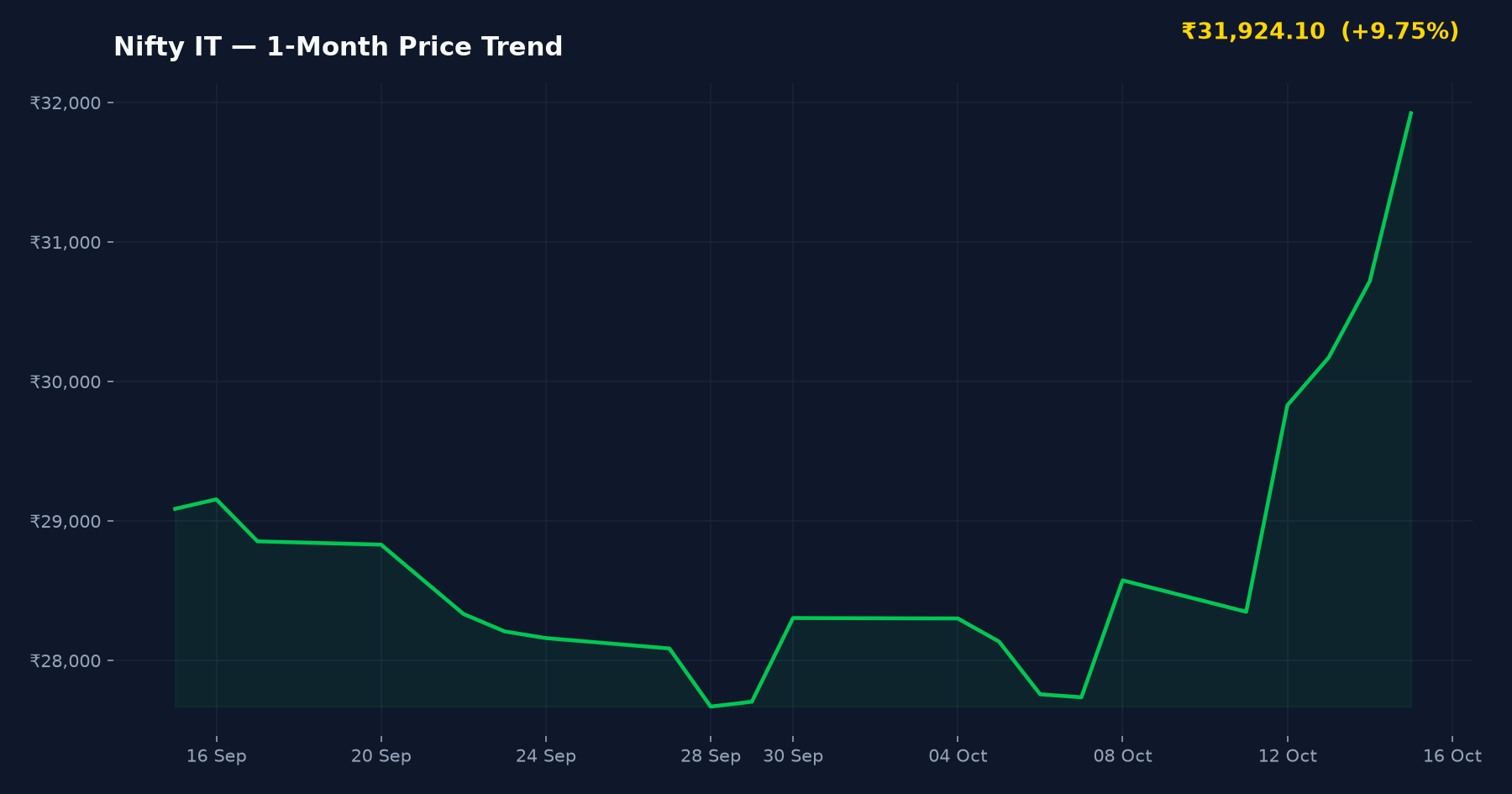
The Indian IT sector, represented by the Nifty IT index, experienced a remarkable upturn, recording an 11.7% gain in the week ending October 16, 2026. This surge marks the sector’s most significant weekly rally in 18 years, a testament to renewed investor confidence. The primary catalyst for this robust performance was the release of unexpectedly strong quarterly results from major IT companies, notably HCLTech. These results likely surpassed market expectations, indicating resilience and potential growth within the sector despite broader global uncertainties. According to reports from the Economic Times and Moneycontrol, this rally occurred even as semiconductor stock prices in other Asian markets were experiencing declines, highlighting the specific strengths and drivers within the Indian IT landscape.
Impact of Rupee Strength on IT Sector Dynamics
Adding another layer to the market’s dynamics, the Indian rupee demonstrated significant strength, closing below the ₹95-mark against the US dollar for the first time in 38 days. This appreciation is attributed to effective measures implemented by the Reserve Bank of India (RBI). While a stronger rupee typically presents a headwind for export-oriented sectors like IT, as it reduces rupee realizations from dollar-denominated contracts, the Nifty IT’s concurrent rally suggests that strong operational performance and demand for IT services have outweighed currency concerns. Investors appear to be focusing on the fundamental strengths and order book visibility of these companies, as noted in analyses across Livemint and other financial publications. For a broader view of market movements, investors can refer to the Indian market indices dashboard.
Broader Market Sentiment and Global Cues
The Nifty IT’s performance contributed positively to the overall market sentiment, with the broader Nifty 50 index also showing signs of potential extension towards higher levels, as discussed by market analysts on Moneycontrol. The rally in Indian IT stocks, juxtaposed against a backdrop of falling semiconductor stocks in Asia, indicates a decoupling of fortunes driven by specific sector-level catalysts. This suggests that while global economic conditions remain a factor, the Indian IT sector’s unique value proposition and execution capabilities are currently being prioritized by investors. The market’s reaction to these earnings signals a potential shift in perception regarding the sector’s near-term growth trajectory.
Nifty IT Outlook: Growth Catalysts vs. Potential Headwinds
The recent surge in the Nifty IT index has brought the sector back into focus, prompting a re-evaluation of its future prospects. Understanding the underlying catalysts and potential risks is crucial for investors tracking this segment.
Growth Catalysts for Indian IT
- Robust Quarterly Earnings: Strong Q3 results from bellwether companies like HCLTech have demonstrated better-than-expected performance, indicating healthy demand for digital transformation services and efficient project execution.
- Digital Transformation Demand: Global enterprises continue to invest heavily in digital initiatives, cloud adoption, and cybersecurity, providing a steady pipeline of projects for Indian IT service providers.
- Cost Efficiencies & Innovation: Indian IT firms are leveraging automation and AI to enhance productivity and deliver cost-effective solutions, maintaining competitiveness in a dynamic global market. Investors can track the performance of these companies and others on our recent IPO listing performance tracker.
Key Risks and Challenges
- Global Economic Slowdown: A prolonged slowdown in key markets like the US and Europe could impact client spending and project deferrals, affecting revenue growth.
- Currency Volatility: While the rupee’s recent strength is a broader market positive, a sustained appreciation could erode profit margins for IT exporters if not adequately hedged.
- Wage Inflation & Talent Attrition: The competitive landscape for skilled IT talent continues to drive wage inflation, potentially impacting profitability if not managed effectively.
- Geopolitical Risks: Global geopolitical tensions can lead to increased caution in spending by international clients, affecting the sector’s growth trajectory.
Frequently Asked Questions
What drove the Nifty IT index’s significant weekly rally?
The Nifty IT index’s 11.7% weekly rally was primarily driven by better-than-expected quarterly results from major IT companies, including HCLTech. These strong earnings signals indicated robust operational performance and a healthy demand environment for IT services.
How does rupee strength typically impact the Indian IT sector?
A strengthening rupee generally has a negative impact on the Indian IT sector, as it reduces the rupee value of their dollar-denominated export revenues. However, the recent rally suggests that strong fundamental performance and demand have currently outweighed these currency headwinds.
What are the key factors influencing the Nifty IT sector’s near-term outlook?
The near-term outlook for the Nifty IT sector will be influenced by global economic growth, continued demand for digital transformation, currency stability, and the ability of companies to manage wage inflation and talent acquisition effectively.
SEBI Compliance & Statutory Disclaimer
The information and analysis presented on IPO Bulletin (ipobulletin.com) are for informational and educational purposes only and do not constitute financial, investment, or legal advice. Securities market investments are subject to market risks; please read all offer documents (DRHP/RHP) thoroughly before committing capital. Grey Market Premium (GMP) figures are unofficial, unregulated street estimates. Always consult a SEBI-registered investment advisor before making financial decisions.
Sources referenced: Economic Times, Moneycontrol, Livemint
Reusing this article or its images? Credit IPO Bulletin and link to https://ipobulletin.com/news/nifty-it-weekly-surge-strong/. Content licence.