
MUMBAI, NOVEMBER 01, 2026 — Indian equity markets enter a busy week of corporate actions as more than 40 listed companies turn ex-date between Monday, November 2, and Friday, November 6, 2026, for interim dividends, bonus share allotments, rights issues, and stock splits. High-profile frontline corporations scheduled for payouts and adjustments include IT heavyweight Infosys, decorative paints market leader Asian Paints, public-sector bellwethers Coal India and Power Grid Corporation of India, and digital platform operator Info Edge, with healthcare company Sanofi India delivering the week’s highest declared interim dividend payout of ₹75 per equity share according to exchange filings submitted to the BSE and NSE.
Key Takeaways at a Glance
- Volume of Actions: More than 40 equity counters are executing record-date adjustments across BSE and NSE from November 2 to November 6, 2026.
- Top Payout Leader: Sanofi India headlines the dividend roster with a declared interim payout of ₹75 per share, leading pharmaceutical cash distributions.
- T+1 Settlement Dynamics: Under India’s mandatory T+1 rolling settlement mechanism, the ex-date and record date fall on the same day for eligible entitlement tracking.
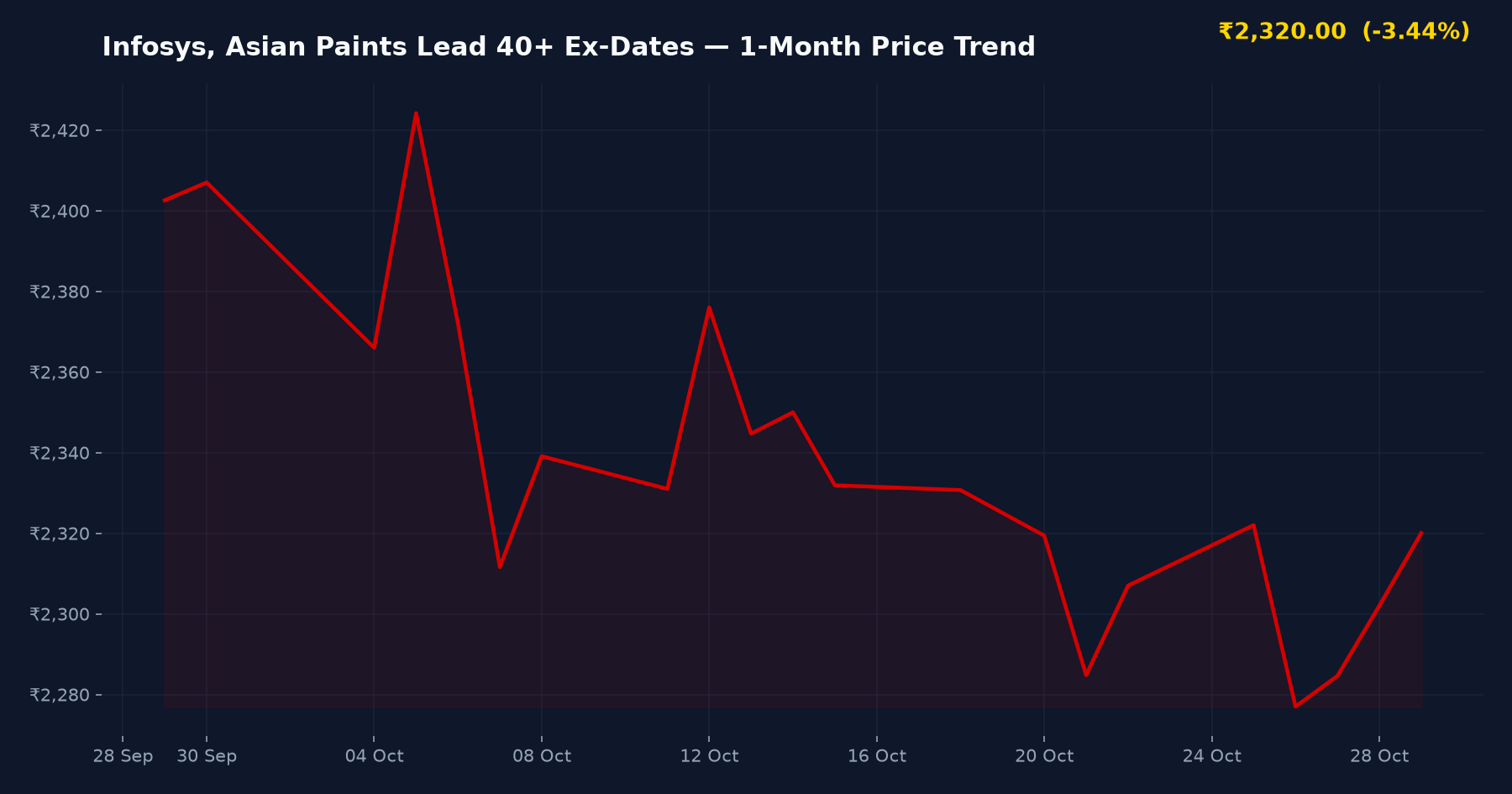
Infosys, Asian Paints Lead 40+ Ex-Dates
NSE: ASIANPAINT
▲ +₹18.00 (+0.78%)
Day Range: ₹2,271.20 – ₹2,348.00
52W Range: ₹2,115.00 – ₹2,985.70
● Real-Time Feed
Corporate Action Schedule & Ex-Date Calendar (November 2–6, 2026)
Under the current regulatory framework enforced by the Securities and Exchange Board of India (SEBI), equity transactions on Indian bourses settle on a T+1 settlement cycle (trade date plus one operational day). Consequently, an investor must purchase the shares at least one trading session before the ex-date to ensure the securities credit to their demat depository account prior to the close of the designated record date. Market participants tracking benchmark shifts via the Indian market indices dashboard should note that index weightings automatically adjust for cash dividends and share additions at market open on the respective ex-dates.
| Company / Entity | Corporate Action Type | Payout / Adjustment Ratio | Ex-Date / Record Window |
|---|---|---|---|
| Sanofi India Ltd | Interim Dividend | ₹75.00 per share | November 2–6, 2026 |
| Infosys Ltd | Interim Dividend | Declared Q2 Interim | November 2–6, 2026 |
| Asian Paints Ltd | Interim Dividend | Declared Q2 Interim | November 2–6, 2026 |
| Coal India Ltd | Interim Dividend | PSU Cash Distribution | November 2–6, 2026 |
| Power Grid Corp | Interim Dividend | Declared Board Interim | November 2–6, 2026 |
| Info Edge (India) Ltd | Interim Dividend | Declared Cash Dividend | November 2–6, 2026 |
Mechanics of Dividends, Bonus Issues, and Stock Splits
Corporate actions represent structured balance-sheet operations that alter either a company’s capital structure or return accrued surplus capital to registered shareholders. Understanding the precise distinctions between these operations is essential for accurate portfolio tracking and accounting:
- Cash Dividends: Direct distribution of corporate profits credited to eligible investors’ bank accounts. On the ex-dividend date, the stock’s market opening price typically adjusts downward by approximately the gross amount of the dividend per share declared.
- Bonus Share Issues: Issuance of additional shares to existing investors free of cost out of accumulated retained reserves. While total paid-up share capital increases and face value remains identical, the share price adjusts proportionately downward, leaving aggregate shareholder wealth neutral before secondary trading.
- Stock Splits: Subdivision of existing shares into a higher quantity by reducing face value (for example, splitting a ₹10 face value share into two ₹5 face value shares). Stock splits aim to enhance secondary liquidity without touching retained reserves.
- Rights Issues: Offering existing shareholders the statutory option to subscribe to newly created equity shares at a specified discount to prevailing market prices within an established subscription window. Investors tracking secondary market liquidity alongside fresh equity offerings can explore the live IPO calendar and primary market schedule to gauge corporate capital calls.
Taxation and Settlement Factors for Corporate Entitlements
According to fundamental metrics from Screener.in and corporate compliance data filed with BSE India and NSE India, corporate distributions carry specific statutory implications under current Indian taxation laws. Dividend payments are fully taxable in the hands of recipient shareholders at their applicable income tax slab rates under the head ‘Income from Other Sources’. Furthermore, domestic listed companies are required to deduct Tax Deducted at Source (TDS) at 10% on gross dividend disbursements exceeding ₹5,000 per financial year for resident individuals.
For bonus shares, the acquisition cost for calculating Capital Gains Tax is legally deemed to be zero under Section 55 of the Income-tax Act, 1961. The holding period for calculating Short-Term Capital Gains (STCG) or Long-Term Capital Gains (LTCG) begins from the date of bonus share allotment, rather than the initial acquisition date of the underlying parent shares. Investors monitoring cash balances post-settlement or re-allocating corporate action proceeds into post-debut equities frequently utilize the recent IPO listing performance tracker to assess performance trends across newly listed shares.
Analytical Investor Framework: Capital Return Drivers vs. Adjustment Risks
Evaluating companies executing corporate actions requires an objective balance between balance-sheet strength and market adjustment realities:
Corporate Return Drivers
- Operating Cash Flow Generation: Frontline dividend payers like Infosys, Coal India, and Sanofi India demonstrate steady free cash flow yields capable of sustaining capital returns without leveraging balance sheets.
- Retail Liquidity Enhancements: Stock splits and bonus issues lower the nominal single-share purchase price, broadening secondary retail participation and narrowing bid-ask trading spreads on exchanges.
- Promoter Commitment & Capital Discipline: Regular payouts prevent unproductive cash build-up, maintaining optimal Return on Net Worth (RoNW) and Return on Capital Employed (RoCE).
Downside & Adjustment Risks
- Immediate Price Markdowns: Equities adjust downward by the payout amount on the ex-date, meaning dividend captures without sustained underlying business momentum frequently incur capital drawdown.
- Net Tax Drag: High-net-worth investors subject to marginal tax brackets face substantial tax friction on dividend income compared to unrealized compounding capital gains.
- Reinvestment Opportunity Cost: High payout ratios in cyclical sectors such as mining or manufacturing may limit capital expenditures during periods requiring technological modernization.
What to check before corporate action ex-dates
- Verify demat settlement status by ensuring buy orders are executed at least one business day before the announced ex-date to achieve credited depository ownership by the record date.
- Review corporate filing notices on BSE and NSE India to confirm exact payout dates and ensure valid bank mandate details are linked to your depository participant (DP).
- Assess applicable Tax Deducted at Source (TDS) thresholds and submit Form 15G or Form 15H to company registrars well ahead of the cut-off date if aggregate taxable income falls below statutory limits.
- Audit post-adjustment portfolio weightings to avoid unintentional sector concentration following stock splits or bonus equity additions.
Frequently Asked Questions
How does the T+1 settlement cycle affect dividend and bonus eligibility?
Under the T+1 settlement cycle operating across Indian bourses, equity purchases settle on the next business day after trade execution. Because of this accelerated mechanism, the ex-date and record date coincide on the exact same calendar day, meaning investors must execute buy orders prior to the ex-date to establish eligible ownership on company records.
Why do stock prices adjust downward on their corporate ex-date?
Stock prices adjust downward on the ex-date because company assets or capital structures are mathematically recalibrated. For cash dividends, the company’s net asset base contracts by the cash disbursed, resulting in an equivalent opening price markdown; for bonus issues and stock splits, market capitalisation is distributed over a higher total volume of equity shares.
How are interim dividends and bonus shares taxed under Indian tax rules?
Dividend income is added to an investor’s annual gross income and taxed according to their applicable personal income tax slab, with a 10% TDS deduction triggered if dividends exceed ₹5,000 annually. Bonus shares are allotted at zero acquisition cost, meaning any future capital gains calculations treat the entire sale consideration as gross capital proceeds from the date of bonus allotment.
SEBI Compliance & Statutory Disclaimer
The information and analysis presented on IPO Bulletin (ipobulletin.com) are for informational and educational purposes only and do not constitute financial, investment, or legal advice. Securities market investments are subject to market risks; please read all offer documents (DRHP/RHP) thoroughly before committing capital. Grey Market Premium (GMP) figures are unofficial, unregulated street estimates. Always consult a SEBI-registered investment advisor before making financial decisions.
Sources referenced: BSE India filings, NSE India announcements, Screener.in, and Economic Times Markets.
Reusing this article or its images? Credit IPO Bulletin and link to https://ipobulletin.com/news/infosys-asian-paints-lead-ex-dates/. Content licence.