
MUMBAI / NEW DELHI, OCTOBER 30, 2026 — Ahead of Friday’s session, shares of Hero MotoCorp remained under investor scrutiny after tumbling 4% in the preceding session on October 29, despite the two-wheeler giant posting a 42% year-on-year surge in net profit for the September quarter (Q2 FY27). While aggressive volume expansion in scooters and the VIDA electric vehicle (EV) lineup expanded segment market share to 7.3%, elevated raw material expenses compressed gross margins, prompting a divergent reaction across domestic benchmark indices.
Key Takeaways at a Glance
- Earnings vs. Price Action: Q2 FY27 standalone net profit expanded by 42% year-on-year, but the stock slipped 4% to settle lower on October 29 as operating margin pressure dampened sentiment.
- Segment Market Share: Enhanced dispatches of premium scooters and VIDA electric two-wheelers lifted quarterly market share to 7.3%.
- triggers on Horizon: Management guided for an export recovery in the second half of FY27 alongside multiple premium motorcycle launches.
▼ ₹217.50 (-4.09%)
Day Range: ₹5,095.00 – ₹5,412.00
52W Range: ₹4,671.50 – ₹6,388.50
● Real-Time Feed
Hero MotoCorp Q2 FY27 Key Financial Milestones & Calendar Timeline
The corporate performance prints reflect a period of dynamic product rotation, shifting from standard commuter bikes toward higher-margin premium motorcycles and alternative powertrains. The key calendar milestones for the period are outlined below:
| Milestone / Corporate Event | Exact Calendar Date |
|---|---|
| Q1 FY27 Earnings Announcement & Rally (4.5% surge) | August 7, 2026 |
| August 2026 Monthly Sales Volume Disclosure | September 2, 2026 |
| Q2 FY27 Board Meeting & Financial Results Release | October 29, 2026 |
| H2 FY27 International Export Ramp-Up Commences | November 1, 2026 |
Q2 Operational Snapshot: Profit Growth vs Input Cost Inflation
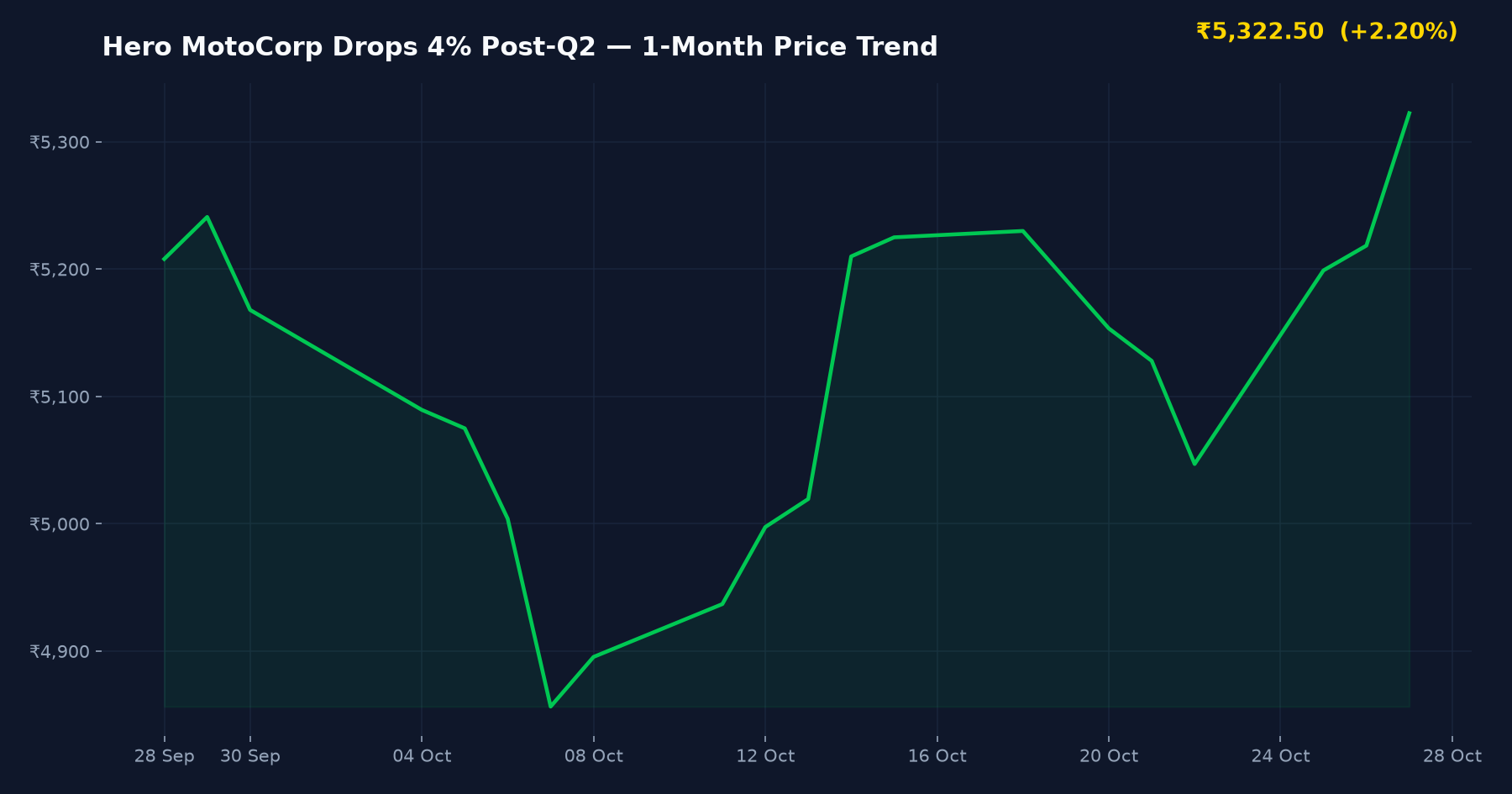
Hero MotoCorp filed its regulatory disclosures with the BSE India and NSE on October 29. The headline figures demonstrated an impressive 42% growth in bottom-line profit, underpinned by robust domestic festival dispatches and improved product realizations. However, equity analysts tracking the Indian market indices dashboard noted that raw material inflation—specifically in precious metals, aluminum, and specialty battery components—placed sustained pressure on earnings before interest, taxes, depreciation, and amortization (EBITDA) margins.
| Financial & Operating Metric | Q2 FY27 Reported Figure |
|---|---|
| Net Profit Growth (YoY) | +42% |
| Scooter & EV Segment Market Share | 7.3% |
| Intraday Share Price Impact (October 29, 2026) | -4.00% |
Strategic Shift: Premiumisation Drive and the VIDA EV Strategy
For decades, Hero MotoCorp built its market leadership around mass-market commuter motorcycles such as the Splendor and Passion series. However, changing consumer preferences in urban and semi-urban markets have led the company to pursue an aggressive two-pronged strategy: premiumisation and rapid electrification.
Expansion of the Premium Motorcycle Portfolio
According to corporate commentary from company management, several new models in the 200cc to 440cc category are scheduled to enter production. High-capacity motorcycles yield significantly higher average selling prices (ASPs) and richer gross margins, which helps insulate the automaker against periodic downturns in rural entry-level purchasing power.
Scaling the VIDA Electric Vehicle Network
Hero’s electric vehicle subsidiary brand, VIDA, delivered strong traction during the September quarter, directly contributing to the company’s 7.3% market share in the scooter and EV category. Unlike emerging pure-play EV players that frequently explore the primary market—as tracked via our live IPO calendar and primary market schedule—Hero possesses the balance sheet depth to fund EV manufacturing plants, proprietary fast-charging hubs, and software R&D without external equity dilution.
International Export Markets: Revival Expected in H2 FY27
Overseas shipments faced headwinds in early FY27, with August export volumes declining across select African and Latin American economies due to currency volatility. However, filings indicate an expected turnaround in export dispatches for the second half of FY27, driven by distribution agreements in Southeast Asia and expanded product homologation in South America.
Peer Comparison: Two-Wheeler Auto Giants
Comparing Hero MotoCorp against listed peers provides essential context on how input cost pressures are being absorbed across the Indian two-wheeler space:
| Company Name | Q2 Profit Growth (YoY) | Key Strategic Focus |
|---|---|---|
| Hero MotoCorp | +42% | VIDA EV network scaling, scooter expansion, and premium 200cc-440cc launches |
| Eicher Motors (Royal Enfield) | Historical peer comparison | Mid-weight premium retro motorcycles (350cc-650cc) and global brand positioning |
Comparative performance context sourced from Moneycontrol, Livemint, and BSE India filings.
Institutional Brokerage Insights and Market Reactions
The financial community has displayed nuanced perspectives on Hero MotoCorp’s valuation trajectory. Global investment banking firm JPMorgan maintained an optimistic posture on the stock, noting in earlier research that the company possesses the distribution leverage and product pipeline to outpace broader two-wheeler industry growth.
Conversely, domestic institutional desks highlighted that the sharp correction on October 29 was an operational repricing. While top-line revenue and net income advanced markedly, analysts scrutinizing gross margins noted that pass-through pricing on raw materials takes time to materialize without curbing consumer festive demand. Investors reviewing newer auto-ancillary suppliers can cross-check market debuts on our recent IPO listing performance tracker.
Balanced Analytical Framework: triggers vs. Downside Risks
To evaluate Hero MotoCorp’s medium-term risk-reward profile, market participants evaluate multiple structural drivers:
Structural Growth triggers
- Accelerating Electrification: Rapid retail adoption of the VIDA electric scooter lineup delivers an expanding foothold in the zero-emission urban transit market.
- Premium Margin Accretion: Expanding the 200cc–440cc motorcycle lineup provides structural margin expansion as product mix improves.
- Rural Volume Recovery: Broad-based agricultural cash flows and festival demand continue to sustain the high-volume entry-level motorcycle segment.
- Global Export Rebound: Stabilization of overseas currency reserves in key Latin American and African territories could lift export realizations across H2 FY27.
Key Downside Risks
- Persistent Input Cost Pressures: Continued volatility in base metal and battery raw material prices could restrict EBITDA margin recovery.
- Intensified EV Competition: Aggressive price competition from legacy rivals and well-funded electric mobility startups could compress unit-level realizations.
- Export Market Sensitivities: Geopolitical realignments or trade frictions may delay the anticipated recovery in overseas dispatches.
What to Check Before Making Investment Decisions
- Examine quarterly EBITDA margins alongside top-line volume growth to monitor how effectively raw material inflation is passed through to consumers.
- Track monthly dispatch disclosures for the VIDA electric scooter series to gauge market share progression against competing two-wheeler brands.
- Review secondary market valuation multiples (Trailing Twelve Months P/E and EV/EBITDA) relative to historical 5-year averages and sector peers.
- Assess macroeconomic indicators, such as monsoon distribution and rural consumer confidence metrics, that govern entry-level motorcycle sales.
Frequently Asked Questions
Why did Hero MotoCorp shares drop after reporting 42% profit growth?
Despite a 42% year-on-year increase in Q2 net profit, Hero MotoCorp shares dropped 4% on October 29 because operating margins faced compression from elevated raw material costs. Institutional investors focused on input cost pressures, which offset the positive sentiment surrounding higher sales volumes.
What is Hero MotoCorp’s market share in the scooter and EV category?
Hero MotoCorp expanded its combined market share in the scooter and electric vehicle category to 7.3% during the September quarter. This growth was driven primarily by robust customer response to its premium scooters and the VIDA electric two-wheeler range.
What are Hero MotoCorp’s primary operational triggers for H2 FY27?
The key triggers include the rollout of new premium motorcycles in the 200cc–440cc category, the expansion of VIDA EV distribution and charging infrastructure across tier-2 and tier-3 towns, and an anticipated recovery in export dispatches across international markets in Latin America and Southeast Asia.
SEBI Compliance & Statutory Disclaimer
The information and analysis presented on IPO Bulletin (ipobulletin.com) are for informational and educational purposes only and do not constitute financial, investment, or legal advice. Securities market investments are subject to market risks; please read all offer documents (DRHP/RHP) thoroughly before committing capital. Grey Market Premium (GMP) figures are unofficial, unregulated street estimates. Always consult a SEBI-registered investment advisor before making financial decisions.
Sources referenced: Economic Times, Moneycontrol, Livemint, BSE India filings
Reusing this article or its images? Credit IPO Bulletin and link to https://ipobulletin.com/news/hero-motocorp-drops-post-q2-profit/. Content licence.