
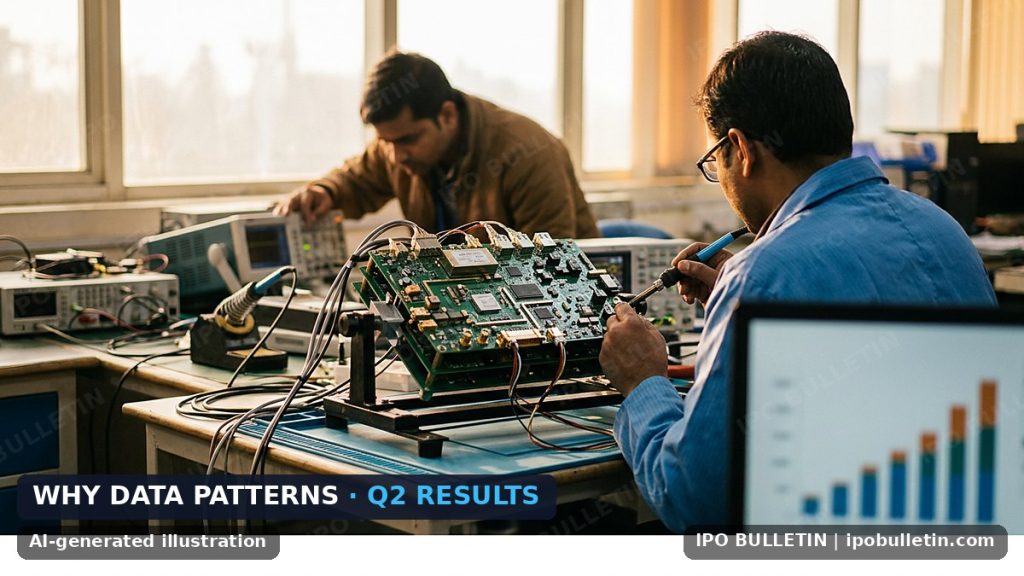
MUMBAI / NEW DELHI, NOVEMBER 09, 2026 — During morning trade on Monday, November 09, 2026, shares of defence electronics specialist Data Patterns (India) Limited surged as much as 9% on the National Stock Exchange (NSE) and BSE, even after the company reported a 55.3% year-on-year drop in its second-quarter net profit. The rally was propelled by management commentary reaffirming operational delivery timelines and full-year FY27 growth guidance, as institutional market participants looked past near-term quarterly lumpiness toward long-term indigenous defence procurement tailwinds.
Key Takeaways at a Glance
- Earnings Versus Street Reaction: Data Patterns recorded a standalone Profit After Tax (PAT)—the net profit remaining after all operating costs, interest, and statutory taxes are paid—of ₹21.97 Crore in Q2 FY27, down 55.3% from ₹49.19 Crore in Q2 FY26.
- Management Guidance Reaffirmed: Despite consecutive quarters of bottom-line contractions, executive leadership stated firm confidence in meeting overall FY27 financial targets as delivery schedules shift into the second half of the fiscal year.
- Price Action & Valuation Context: The stock extended its steady recovery, nearly doubling from its January 2026 multi-month lows as defence sector capital expenditure allocations continue to expand across Indian market indices dashboard constituents.
Data Patterns Regulatory Filings & Earnings Timeline
Defence manufacturing and radar technology firms operate under project-based supply contracts where customer inspection schedules and delivery acceptances by the armed forces or defence public sector undertakings (DPSUs) dictate revenue recognition. The table below traces the chronological milestone disclosures submitted by Data Patterns to BSE India and NSE India over recent quarters.
| Event / Filing Milestone | Exact Calendar Date |
|---|---|
| Q4 FY26 Financial Print (Revenue down 13% YoY to ₹344.85 Cr) | May 14, 2026 |
| Q1 FY27 Financial Results (Net Profit drops 14% YoY to ₹22 Cr) | July 31, 2026 |
| Defence Acquisition Council (DAC) Clearances Sector Surge | September 08, 2026 |
| Q2 FY27 Financial Results Submission & 9% Intraday Rally | November 09, 2026 |
Q2 FY27 Financial Performance & Operational Metrics
According to exchange disclosures verified by financial data platforms including Moneycontrol and Business Standard, Data Patterns experienced noticeable margin compression and lower dispatches during the July-September quarter of fiscal 2027 compared to the record base period of Q2 FY26.
| Financial Metric | Q2 FY27 | Q2 FY26 | YoY Variance (%) |
|---|---|---|---|
| Profit After Tax (PAT) | ₹21.97 Cr | ₹49.19 Cr | -55.3% |
| Intraday Trading Move (Nov 09, 2026) | +9.0% | — | — |
Why Did Data Patterns Rally Despite Weak Earnings?
The market response to a corporate earnings print often reflects expectations rather than trailing accounting headlines. When Data Patterns delivered ₹21.97 Crore in net profit, retail sentiment initially anticipated selling pressure. However, trading desks identified two structural factors driving institutional accumulation:
1. Cyclicality and Second-Half Weighting
In high-reliability electronics—encompassing radars, electronic warfare suites, avionics, and missile guidance systems—revenues are heavily skewed toward the third and fourth quarters. In Q4 FY26, for example, standalone net sales stood at ₹344.85 Crore, far surpassing early-fiscal quarters. Management reiterated that component deliveries, milestone clearances, and export shipments are back-ended for FY27, reassuring market participants that the second-quarter drop does not signify structural demand destruction.
2. Defence Procurement Policy & Order Pipeline
On September 08, 2026, the Defence Acquisition Council (DAC)—the apex body of the Ministry of Defence chaired by the Raksha Mantri responsible for capital acquisitions—cleared multiple multi-thousand-crore modernisation proposals. Electronics subsystems supply contracts typically flow downward to specialised manufacturers like Data Patterns. Having completed its initial public offering in December 2021 (tracked on our recent IPO listing performance tracker), the company holds net-debt-free balance sheet flexibility to support working capital-intensive execution cycles.
Data Patterns Bull vs. Bear Analytical Framework
Evaluating companies exposed to capital goods and sovereign defence spending requires weighing structural technological moats against operational delivery risks:
- Growth triggers (Bull Case):
- Indigenous Import Substitution: Continuous expansion of positive indigenisation lists by the Ministry of Defence benefits domestic intellectual property (IP) owners.
- High Entry Barriers: Design cycles for electronic warfare, naval consoles, and airborne radar hardware take 3 to 7 years to certify, shielding incumbents from new domestic entrants.
- Target Realisation: If management delivers on reaffirmed FY27 guidance, Q3 and Q4 execution must see significant acceleration, driving operating leverage.
- Key Downside Risks (Bear Case):
- Quarterly Earnings Volatility: As evidenced by the 55.3% drop in Q2 FY27 and a 14% decline in Q1 FY27, single-quarter delays in customer testing can compress quarterly numbers.
- Working Capital Stretch: Extended testing procedures and receivables from government agencies can occasionally tie up operating cash flows.
- Valuation Multiples: Having doubled from its January 2026 lows, the stock trades at premium valuation multiples, leaving minimal safety margin for operational missteps in Q3 or Q4.
Frequently Asked Questions
Why did Data Patterns shares surge despite a 55% profit decline in Q2?
Data Patterns rallied 9% on November 09, 2026, because management confirmed that its annual financial trajectory remains on schedule. Because defence electronics manufacturing recognizes revenues upon formal customer inspection and delivery, quarterly numbers are inherently uneven, and investors focused on expected second-half delivery volumes rather than trailing Q2 figures.
What were the core financial figures reported by Data Patterns for Q2 FY27?
Data Patterns reported a Profit After Tax of ₹21.97 Crore for the quarter ending September 30, 2026 (Q2 FY27). This represents a 55.3% year-on-year drop compared to the ₹49.19 Crore net profit recorded in the corresponding period of the previous fiscal year (Q2 FY26).
What primary factors influence Data Patterns’ long-term business performance?
The company’s performance is governed by domestic defence budget allocations, clearances by the Defence Acquisition Council, the pace of supply contracts for indigenous fighter and radar programs, and its ability to manage working capital cycles amid government inspection protocols.
SEBI Compliance & Statutory Disclaimer
The information and analysis presented on IPO Bulletin (ipobulletin.com) are for informational and educational purposes only and do not constitute financial, investment, or legal advice. Securities market investments are subject to market risks; please read all offer documents (DRHP/RHP) thoroughly before committing capital. Grey Market Premium (GMP) figures are unofficial, unregulated street estimates. Always consult a SEBI-registered investment advisor before making financial decisions.
Sources referenced: BSE India filings, NSE India disclosures, Moneycontrol, Business Standard, The Economic Times.
Reusing this article or its images? Credit IPO Bulletin and link to https://ipobulletin.com/news/data-patterns-shares-surged-q2/. Content licence.