

MUMBAI / NEW DELHI, OCTOBER 15, 2026 — During intraday trade on Thursday, Cemindia Projects successfully concluded its Qualified Institutional Placement (QIP), raising ₹1,400 crore. The issue, priced at ₹1,108 per share, witnessed robust demand, being oversubscribed 2.3 times by institutional investors including prominent names like Edelweiss Life, Nuvama, and Motilal Mutual Fund.
Key Takeaways at a Glance
- Issue & Valuation Snapshot: Cemindia Projects raised ₹1,400 Crore through a QIP, priced at ₹1,108 per share, attracting 2.3x oversubscription.
- Timeline & Lot Economics: The QIP closed on October 15, 2026, with significant institutional participation from leading fund houses.
- Filing & Market Context: The successful capital raise reflects strong institutional confidence in Cemindia Projects, as reported by The Economic Times.
▲ +₹67.90 (+5.89%)
Day Range: ₹1,168.00 – ₹1,268.80
52W Range: ₹503.30 – ₹1,649.20
● Real-Time Feed
Cemindia Projects QIP: Key Dates & Issue Details
| Event / Catalyst Milestone | Exact Calendar Date |
|---|---|
| QIP Closing Date | October 15, 2026 |
| QIP Allotment Date | Pending official confirmation |
| Funds Credit Date | Pending official confirmation |
| Parameter | Verified Detail |
|---|---|
| Issuer | Cemindia Projects |
| Type of Issue | Qualified Institutional Placement (QIP) |
| Total Issue Size | ₹1,400 Crore |
| Issue Price per Share | ₹1,108 |
| Subscription Rate | 2.3x |
| Key Institutional Investors | Edelweiss Life, Nuvama, Motilal MF |
| Listing Exchanges | NSE, BSE |
Cemindia Projects’ QIP: Institutional Demand and Funding Strategy
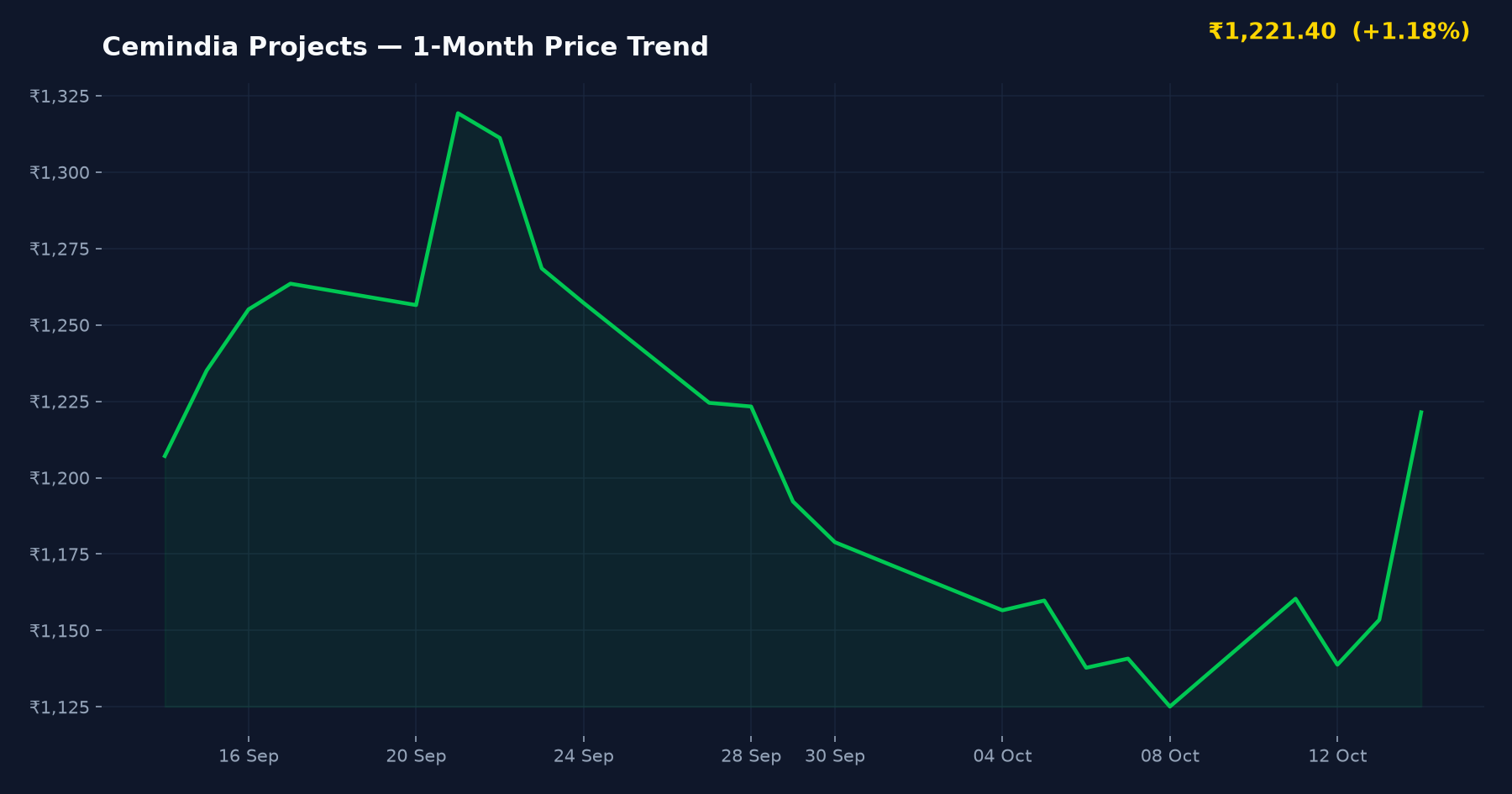
Cemindia Projects, a prominent player in the infrastructure sector, successfully raised ₹1,400 crore through a Qualified Institutional Placement (QIP) on October 15, 2026. A QIP is a mechanism allowing listed companies to raise capital from Qualified Institutional Buyers (QIBs) without undergoing the lengthy public offering process. This method enables companies to quickly access funds from a select group of institutional investors, including mutual funds, insurance companies, and foreign institutional investors.
The issue, priced at ₹1,108 per share, saw an impressive 2.3 times oversubscription, signaling strong confidence from the institutional investment community. Key participants in the QIP included major financial institutions such as Edelweiss Life, Nuvama, and Motilal Mutual Fund, as reported by The Economic Times. This significant capital infusion is expected to bolster Cemindia Projects’ financial position, providing resources for future growth initiatives and operational expansion.
Market Sentiment and Investor Confidence in Cemindia Projects
The substantial oversubscription of Cemindia Projects’ QIP underscores a positive market sentiment towards the company and its future prospects. Institutional investors typically conduct extensive due diligence before committing capital, and their strong participation suggests a favorable outlook on Cemindia’s business model and execution capabilities. The successful QIP, coupled with the company’s strong credit ratings mentioned in market reports, positions Cemindia Projects favorably within the competitive infrastructure landscape.
This capital raise comes at a time when the broader Indian market indices dashboard continues to attract significant domestic and foreign institutional investment, particularly in sectors poised for growth. The ability of Cemindia Projects to attract such substantial funding indicates its perceived value and growth potential among sophisticated investors.
Implications for Cemindia Projects’ Balance Sheet and Future Growth
The ₹1,400 crore raised through the QIP will significantly strengthen Cemindia Projects’ balance sheet. While the specific utilization of funds will be detailed in regulatory filings, QIP proceeds are typically deployed for purposes such as debt reduction, funding capital expenditure for new projects, enhancing working capital, or pursuing strategic acquisitions. This financial flexibility can enable the company to capitalize on emerging opportunities in the infrastructure sector and accelerate its growth trajectory.
For existing shareholders, a QIP involves equity dilution, as new shares are issued. However, the fresh capital infusion is often viewed positively if it leads to enhanced profitability and long-term value creation. Investors often monitor the performance of companies post-fundraising, similar to how they track recent IPO listing performance tracker, to assess the effective deployment of capital.
Balanced Investor Framework: Cemindia Projects QIP
- Bullish Catalysts:
- Strong institutional backing and 2.3x oversubscription signal high investor confidence.
- Significant capital infusion of ₹1,400 crore strengthens the balance sheet and provides financial flexibility.
- Potential for funding new, large-scale infrastructure projects and expanding operational capabilities.
- Improved credit profile and reduced reliance on debt for future growth.
- Key Downside Risks:
- Equity dilution for existing shareholders due to the issuance of new shares.
- Execution risks associated with deploying the raised capital effectively into new projects.
- Increased competition in the infrastructure sector could impact project margins.
- General market volatility and economic slowdowns could affect project timelines and profitability.
What to check before investing in Cemindia Projects
- Review the company’s latest financial results and investor presentations to understand its performance.
- Analyze the QIP offer document to understand the terms of the issue and the intended use of proceeds.
- Assess the impact of the equity dilution from the QIP on earnings per share and return ratios.
- Evaluate the company’s order book, project pipeline, and management commentary on future growth prospects.
Frequently Asked Questions
What is the significance of Cemindia Projects’ QIP oversubscription?
The 2.3x oversubscription for Cemindia Projects’ Qualified Institutional Placement (QIP) indicates robust demand from institutional investors. This strong interest suggests confidence in the company’s growth trajectory and financial health, allowing it to raise significant capital efficiently.
How does the QIP pricing of ₹1,108 per share impact existing shareholders?
The QIP pricing of ₹1,108 per share is the rate at which new shares were issued to institutional investors. While it brings in fresh capital for Cemindia Projects, existing shareholders experience a degree of equity dilution, meaning their ownership percentage in the company slightly decreases.
What are the potential uses of the ₹1,400 crore raised by Cemindia Projects?
While specific uses are typically outlined in the QIP offer document, companies generally utilize such funds for strategic growth initiatives, debt reduction, expansion of operations, or to bolster working capital. This capital infusion strengthens Cemindia Projects’ financial position for future projects.
SEBI Compliance & Statutory Disclaimer
The information and analysis presented on IPO Bulletin (ipobulletin.com) are for informational and educational purposes only and do not constitute financial, investment, or legal advice. Securities market investments are subject to market risks; please read all offer documents (DRHP/RHP) thoroughly before committing capital. Grey Market Premium (GMP) figures are unofficial, unregulated street estimates. Always consult a SEBI-registered investment advisor before making financial decisions.
Sources referenced: The Economic Times, BSE India, NSE India
Reusing this article or its images? Credit IPO Bulletin and link to https://ipobulletin.com/news/cemindia-projects-%e2%82%b91400-cr-qip-oversubscribed-2-3x-price-market-impact/. Content licence.