
MUMBAI, NOVEMBER 02, 2026 — Ahead of Monday’s session, November 02, 2026, shares of public sector lender Bank of Baroda drew active institutional interest following a 36% year-on-year increase in second-quarter (Q2 FY27) net profit. The bottom-line surge was significantly aided by exceptional capital gains realized from the divestment of a partial equity stake in the National Stock Exchange of India (NSE), prompting institutional brokerages including Nomura to issue revised target prices ranging between ₹260 and ₹285 per share.
Key Takeaways at a Glance
- Headline Growth: Standalone net profit climbed 36% year-on-year in Q2 FY27, driven primarily by non-interest income and divestment proceeds from unlisted NSE equity.
- Brokerage Target Corridor: Research desks including Nomura maintain a mixed outlook on core operational trends, establishing a 12-month target band of ₹260 to ₹285.
- Balance Sheet & Global Footprint: The bank is simultaneously advancing an international expansion roadmap focusing on wholesale banking across developed financial jurisdictions.
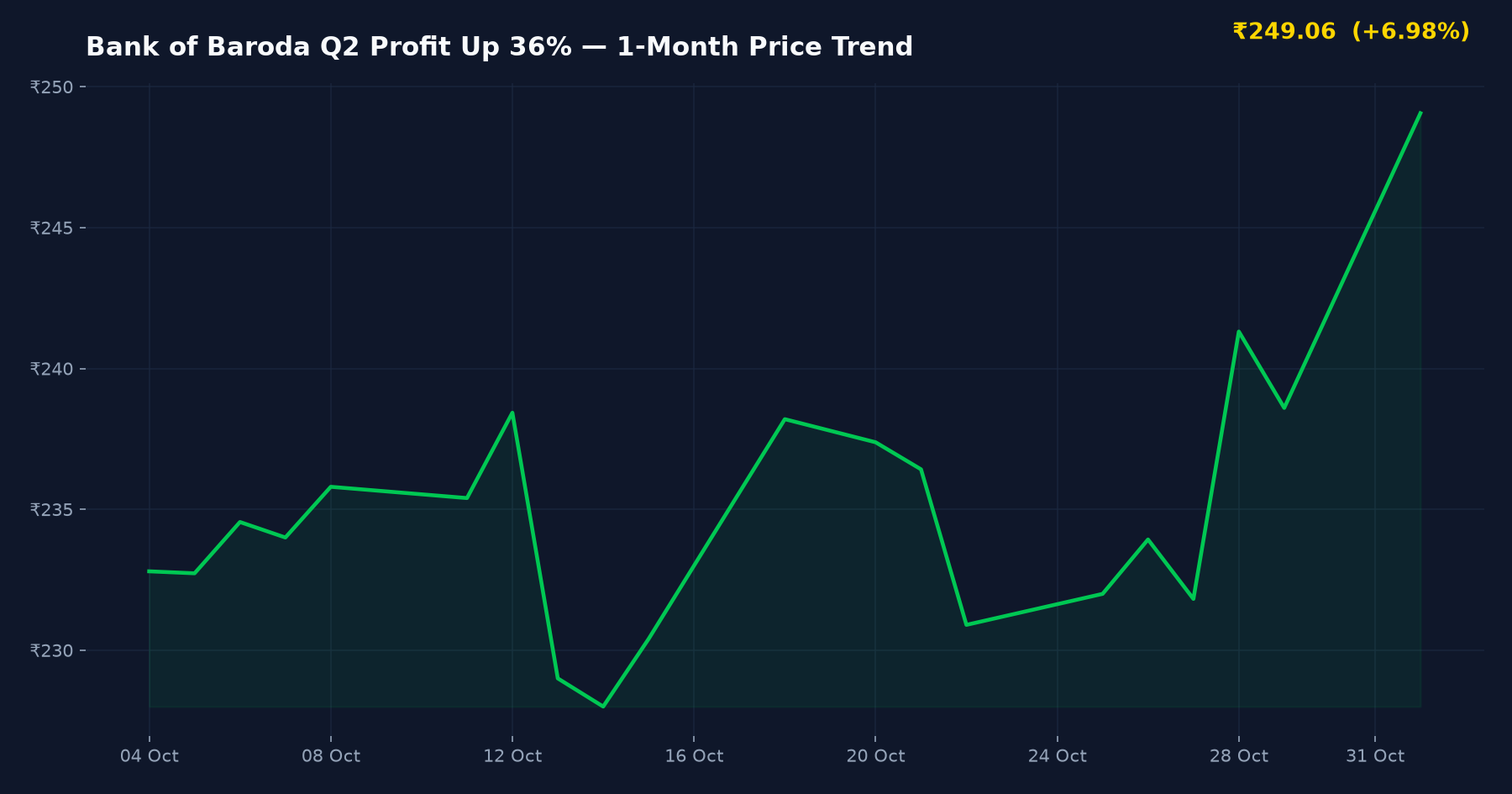
Bank of Baroda Q2 Profit Up 36%
NSE: BANKBARODA
▲ +₹10.50 (+4.40%)
Day Range: ₹243.00 – ₹250.89
52W Range: ₹223.82 – ₹325.50
● Real-Time Feed
Bank of Baroda: Recent Corporate Milestones & Calendar Timeline
To place the earnings print in historical and operational context, the table below highlights verified regulatory developments, overseas strategic initiatives, and corporate disclosures recorded across October and November 2026.
| Event / triggers Milestone | Calendar Date |
|---|---|
| Exchange Filing on NMC Healthcare / B.R. Shetty Legal Defense | October 14, 2026 |
| Overseas Wholesale Banking Expansion Blueprint Disclosed | November 01, 2026 |
| Q2 FY27 Earnings Announcement & NSE Stake Monetisation Print | November 02, 2026 |
Q2 FY27 Financial Metrics & Valuation Parameters
The quarterly performance reflected a substantial divergence between reported headline profit and underlying pre-provision operating earnings. Exceptional treasury income accrued from monetising shares in unlisted exchange infrastructure assets provided a non-recurring cushion to capital ratios.
| Financial Metric / Operational Driver | Reported Figure / Broker Parameter |
|---|---|
| Year-on-Year Net Profit Growth (Q2 FY27) | 36% |
| Primary Non-Interest Income triggers | NSE Equity Stake Sale |
| Consensus Brokerage Target Price Band | ₹260 – ₹285 |
| Trailing 3-Month Share Price Correction Prior to Q2 Print | ~15% |
Dissecting the Numbers: Core Operating Health vs. One-Off Gains
Financial filings submitted to the BSE India and NSE India confirm that non-interest treasury income played an outsized role in the 36% net profit expansion. Institutional desks, including Nomura, highlighted that while the capital infusion from the NSE transaction reinforces CET-1 (Common Equity Tier 1, the core equity capital measure representing a bank’s highest quality capital under Basel III norms), recurring operational variables warrant detailed scrutiny.
Core Net Interest Margin (NIM, the spread between interest income earned on advances and interest expenses paid on deposits) has faced systemic margin pressure across public-sector lenders due to elevated term deposit repricing. Equity analysts track whether asset yields can sustain profitability once one-off divestment proceeds dissipate from subsequent quarterly prints. For comparative sector tracking, review broader sector trends on the Indian market indices dashboard.
International Wholesale Banking Push & Balance Sheet Restructuring
Beyond quarterly accounting numbers, Bank of Baroda’s executive leadership has formulated a targeted overseas expansion strategy. According to corporate disclosures reported by Livemint on November 01, 2026, the lender is redirecting its international resources toward wholesale banking within developed financial markets, while systematically calibrating retail exposure abroad.
This structural reallocation is designed to finance high-grade corporate syndications, cross-border trade corridors, and bilateral lending arrangements where risk-weighted capital charges are optimized. Analysts tracking the banking sector’s primary market offerings and tier-2 bond issuances on the live IPO calendar and primary market schedule note that clean cross-border wholesale assets often yield superior risk-adjusted RoNW (Return on Net Worth, measuring how efficiently shareholder equity generates surplus profit).
Legal Scrutiny & Contingency Disclosures
The quarterly print arrives alongside legal disclosures. On October 14, 2026, regulatory filings documented that B.R. Shetty, founder of the troubled UAE-based NMC Healthcare conglomerate, initiated legal claims seeking approximately $15 billion across various financial institutions, naming Bank of Baroda among the respondents. The lender affirmed in exchange communications that it considers the allegations baseless and will vigorously defend its position.
While market observers point to historical provisions already recognized against NMC-related loan books, sovereign-backed banking balance sheets remain subject to thorough stress-testing regarding potential overseas litigation expenses. Investors tracking recent financial-sector listings via the recent IPO listing performance tracker continue to monitor legal provisions across state-run balance sheets.
Analytical Breakdown: triggers vs. Downside Factors
Evaluating Bank of Baroda’s current valuation corridor requires weighing asset-monetisation capacity against broader credit cycle constraints:
Key Growth triggers
- Asset Value Unlocking: Ongoing ownership of unlisted sovereign exchange equities and financial infrastructure stakes allows periodic capital replenishment without diluting core equity.
- Wholesale Corporate Lending Discipline: Focusing international branches on developed-market wholesale debt reduces operational overhead and credit default slippages.
- Credit Growth Momentum: Broad-based domestic loan expansion across retail, agriculture, and MSME sectors continues to generate solid operating cash flows.
Primary Risk Factors
- One-Off Earnings Skew: Non-recurring divestment income masks underlying quarterly stagnation or margin compression in core net interest income.
- Deposit Cost Pressure: Competition among commercial banks for low-cost current account savings account (CASA) deposits keeps funding expenses elevated.
- Cross-Border Legal Exposures: High-profile legacy exposures, such as the NMC Healthcare proceedings, present recurring headline and legal management friction.
What to Check Before Allocating Capital
- Examine the pre-provision operating profit (PPOP) trajectory excluding one-off non-interest gains from unlisted stake sales.
- Review the trend in Net Interest Margin (NIM) and the proportion of low-cost CASA deposits on the liability side.
- Audit gross and net non-performing asset (NPA) ratios alongside slippages originating from overseas wholesale advances.
- Track regulatory updates from the Reserve Bank of India (RBI) regarding project-finance provisioning and capital-adequacy directives.
Frequently Asked Questions
What drove Bank of Baroda’s 36% profit growth in Q2 FY27?
The 36% year-on-year surge in net profit was heavily driven by non-operating income, primarily realized capital gains resulting from a partial stake sale in the National Stock Exchange of India (NSE). This exceptional income complemented the bank’s domestic credit growth while offsetting pressure on underlying lending spreads.
What are institutional brokerages targeting for Bank of Baroda shares?
Institutional research desks, including Nomura, have established 12-month price targets spanning from ₹260 to ₹285 per share. Their valuation assessments balance strong capital adequacy and asset value realisation against persistent net interest margin compression across the public-sector banking basket.
How does the overseas expansion plan affect Bank of Baroda?
Bank of Baroda is realigning its foreign footprint by shifting capital away from sub-scale international retail units toward wholesale corporate banking in developed economies. This structural pivot aims to capture cross-border trade finance and syndicated corporate lending while lowering localized credit risk.
SEBI Compliance & Statutory Disclaimer
The information and analysis presented on IPO Bulletin (ipobulletin.com) are for informational and educational purposes only and do not constitute financial, investment, or legal advice. Securities market investments are subject to market risks; please read all offer documents (DRHP/RHP) thoroughly before committing capital. Grey Market Premium (GMP) figures are unofficial, unregulated street estimates. Always consult a SEBI-registered investment advisor before making financial decisions.
Sources referenced: Livemint, Moneycontrol, Economic Times, BSE India, NSE India filings.
Reusing this article or its images? Credit IPO Bulletin and link to https://ipobulletin.com/news/bank-baroda-q2-profit-up/. Content licence.