
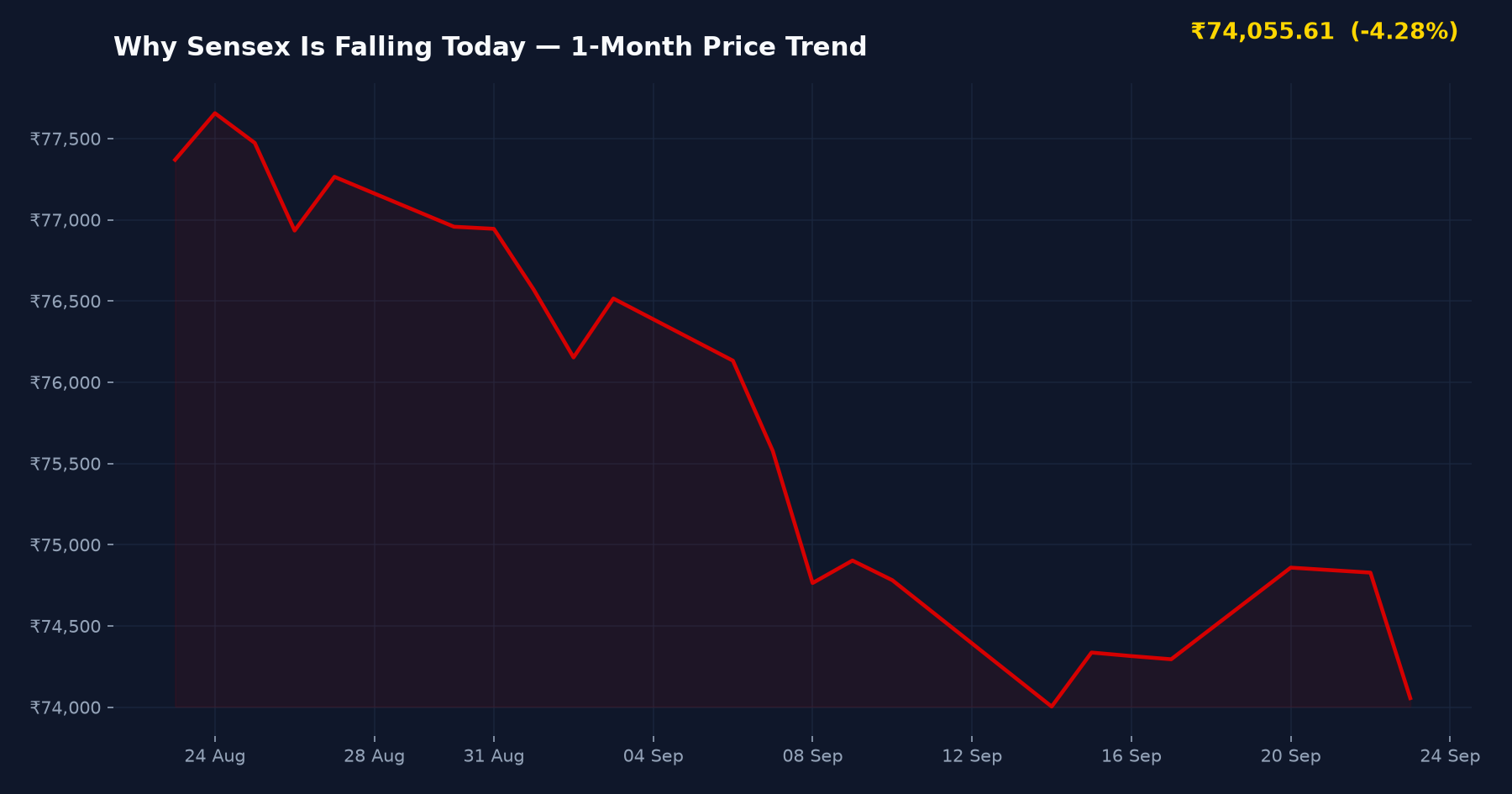
MUMBAI / NEW DELHI, SEPTEMBER 24, 2026 — During trading on Thursday, September 24, 2026, the domestic equity benchmarks witnessed a sharp sell-off, with the BSE Sensex plunging over 600 points in early trade as surging crude oil prices above $100 per barrel and rising global bond yields rattled investor confidence.
| Event / Macro Catalyst | Exact Calendar Date |
|---|---|
| GIFT Nifty Gap-Down Signal | September 24, 2026 |
| Sensex Intraday 600+ Pt Drop | September 24, 2026 |
| Nifty 50 Breach Below 23,250 | September 24, 2026 |
SENSEX
INDEX
▼ ₹778.81 (-1.04%)
Day Range: ₹74,039.68 – ₹74,362.29
52W Range: ₹71,545.81 – ₹86,159.02
● Real-Time Feed
Macroeconomic Triggers Behind the Sensex Slump
According to market reports compiled from Moneycontrol and Livemint, the market correction on Thursday was catalyzed by a confluence of severe macroeconomic headwinds. GIFT Nifty indicators initially signaled a gap-down start of nearly 200 points following a broader Wall Street sell-off. Compounding the pressure, global crude oil benchmarks topped $102 per barrel, threatening India’s import bill and fiscal deficit parameters.
Bond Yields and US Dollar Strength
Financial data tracked by Reuters and Bloomberg highlights that rising US Treasury yields and a US Dollar index touching a near two-month high have triggered foreign institutional investor (FII) capital outflows from emerging markets like India. Furthermore, domestic financial and insurance equities faced heavy selling pressure following recent regulatory proposals from the IRDAI.
Market Sector Impact and Peer Performance
| Index / Sector Metric | Value / Change | Key Note |
|---|---|---|
| BSE Sensex | -600+ pts (-1.0%) | Breached key intraday support |
| Nifty 50 Index | Below 23,250 | Snapping previous recovery gains |
| Crude Oil (Brent) | > $102 / barrel | Multi-month high pressure |
Market breadth data sourced from Moneycontrol and Livemint analytical terminals.
Bull vs. Bear Market Catalysts
Growth Catalysts (Bull Case):
- Strong structural domestic retail inflows through mutual fund SIPs provide a crucial cushion against aggressive FII selling.
- Corporate earnings for major index heavyweights remain resilient despite input cost pressures.
Downside Risks (Bear Case):
- Sustained crude oil trading above $100 per barrel directly impacts macroeconomic stability, inflation, and currency valuations.
- Aggressive global bond yield spikes continue to drive foreign capital away from emerging market equities.
Market Sentiment Analysis Verdict
Suitable For: Long-term value accumulators / Tactical hedgers
Risk Level: High — Volatility remains elevated due to global commodity shocks.
Key Watch Point: Crude oil price trajectory and FII net outflow persistence.
Frequently Asked Questions
Why did the Sensex drop over 600 points on September 24, 2026?
The Sensex tumbled over 600 points due to weak global cues, including GIFT Nifty signaling a steep gap-down, US Treasury yield surges, a stronger US Dollar, and crude oil prices breaching the $100 per barrel threshold.
How does crude oil trading above $100 impact the Indian stock market?
Crude oil crossing $100 per barrel negatively impacts India’s import bills, widens the current account deficit, fuels domestic inflationary pressures, and compresses corporate profit margins across manufacturing and consumer sectors.
What are analysts advising investors during this market correction?
Financial analysts recommend defensive asset allocation, avoiding leveraged positions, and accumulating fundamentally sound blue-chip stocks in a staggered manner as market volatility persists.
SEBI Compliance & Statutory Disclaimer
The information and analysis presented on IPO Bulletin (ipobulletin.com) are for informational and educational purposes only and do not constitute financial, investment, or legal advice. Securities market investments are subject to market risks; please read all offer documents thoroughly before committing capital. Always consult a SEBI-registered investment advisor before making financial decisions.
Sources cross-checked for this article: The Hindu, Moneycontrol, Livemint, BSE India filings