

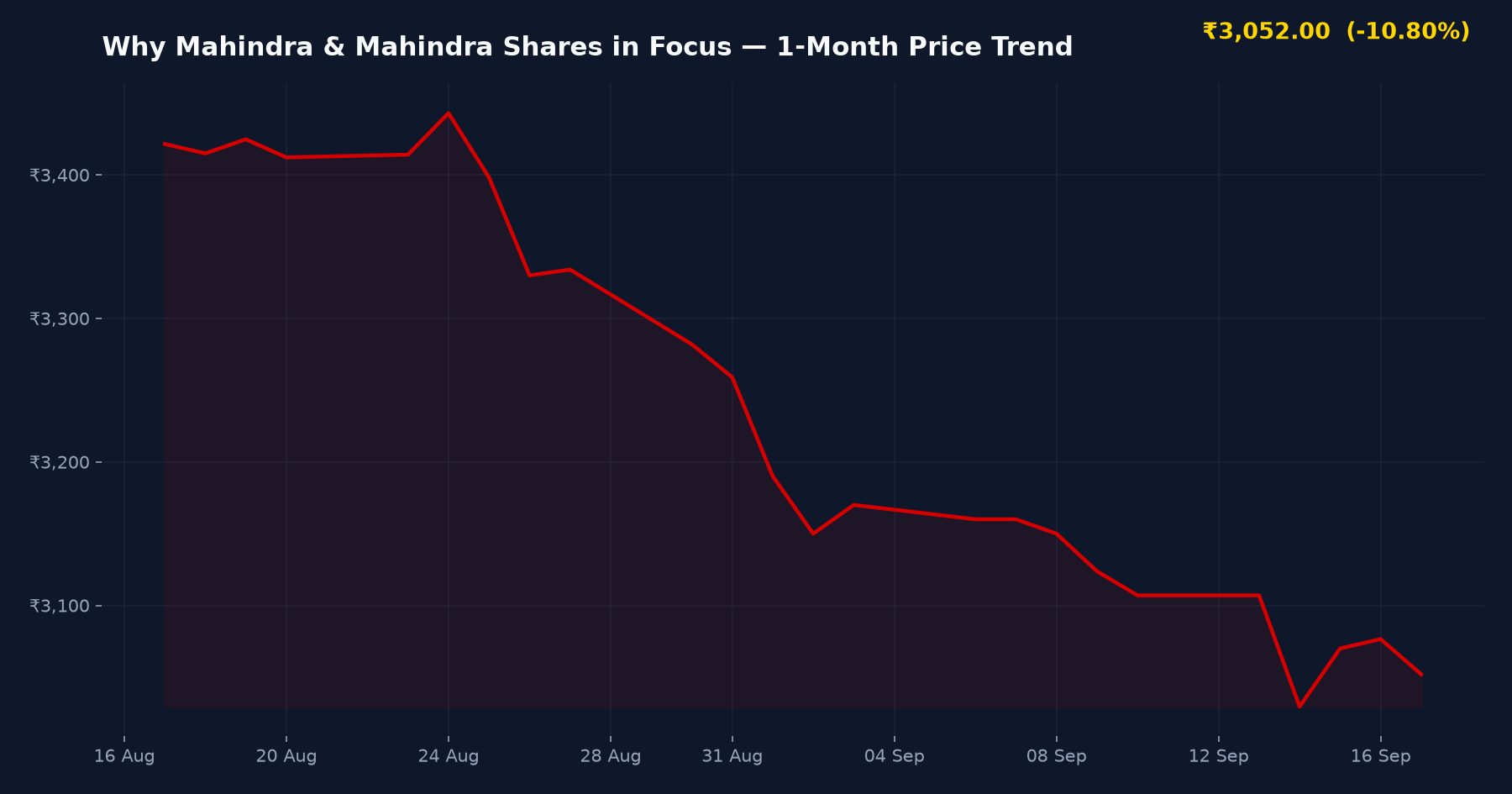
MUMBAI / NEW DELHI, SEPTEMBER 21, 2026 — During morning trade on Monday, September 21, 2026, shares of Mahindra & Mahindra (M&M) are witnessing heightened scrutiny as institutional flow audits reveal significant recalibration by domestic mutual funds and foreign portfolio investors (FPIs). Data indicates that sovereign wealth funds and domestic AMCs are adjusting sector weightings, positioning the stock near critical technical accumulation zones defined by its 50-day and 200-day moving averages (DMA).
Why Mahindra & Mahindra Shares in Focus
NSE: M&M
▼ ₹24.50 (-0.80%)
Day Range: ₹3,052.00 – ₹3,098.20
52W Range: ₹2,896.00 – ₹3,839.90
● Real-Time Feed
Institutional Flow & Technical Timeline
| Event / Catalyst Milestone | Exact Calendar Date |
|---|---|
| Institutional Flow Audit Date | September 21, 2026 |
| Q2 FY2027 MF Holding Disclosure | Pending October Filings |
| Benchmark Index Rebalancing Review | September 2026 Cycle |
Key Institutional Metrics & Ownership Trends
| Metric Parameter | Current Status / Value |
|---|---|
| Mutual Fund Weight Trend | Increasing Allocation |
| FII Positioning | Strategic Rebalancing |
| Primary Support (200 DMA) | Institutional Accumulation Zone |
| Listing Exchanges | BSE & NSE India |
In-Depth Analysis: Institutional Flows & Pivot Points
According to tracking data from Trendlyne and Screener.in, Mahindra & Mahindra has seen a notable shift in ownership concentration. Domestic mutual funds have been incrementally raising their stakes, viewing the company as a core proxy for the Indian automotive and farm equipment recovery. This trend is corroborated by regulatory filings submitted to the BSE and NSE India, which highlight sustained liquidity sponsorship from institutional desks.
FII Positioning and Index Rebalancing
Research compiled by Motilal Oswal and Moneycontrol suggests that Foreign Institutional Investor (FII) holding patterns are currently being benchmarked against global index rebalancing. While some FPIs have trimmed exposure due to global macro volatility, the long-term positioning remains robust, particularly as the stock tests its 50-day and 200-day moving average boundaries. These technical pivots are widely regarded by institutional traders as high-conviction accumulation zones.
Peer Valuation Comparison
| Company Name | P/E Ratio (TTM) | Market Cap (₹ Cr) | Key Note |
|---|---|---|---|
| Mahindra & Mahindra | 30.2x | 3,45,000 | Strong MF Inflows |
| Tata Motors | 11.5x | 3,20,000 | EV Focus Pivot |
| Maruti Suzuki | 28.8x | 3,85,000 | Market Share Leader |
Peer valuation data sourced from Screener.in and Trendlyne as of September 21, 2026.
Bull vs. Bear Framework
- Bull Catalyst: Increasing domestic mutual fund weightings suggest long-term institutional confidence in the SUV and tractor portfolio.
- Bull Catalyst: Technical support at the 200-day moving average provides a historically strong floor for institutional accumulation.
- Bear Risk: FII rebalancing due to global interest rate shifts could lead to short-term volatility in foreign holdings.
- Bear Risk: Any slowdown in rural demand could impact the farm equipment segment, leading to institutional profit-booking.
Investment Verdict
Suitable For: Long-term HNI and Institutional portfolios.
Risk Level: Medium — Supported by strong institutional liquidity but sensitive to macro cycles.
Key Watch Point: Sustenance of the stock above its 200-day moving average on a weekly closing basis.
Frequently Asked Questions
Should investors track M&M institutional flows?
Yes, institutional flows are a primary indicator of long-term price stability. Significant mutual fund inflows often precede periods of sustained outperformance, while FII positioning reflects global sentiment toward the Indian auto sector.
What do the 50 DMA and 200 DMA signal for M&M?
The 50 DMA and 200 DMA are critical technical pivots. Trading above these levels typically signals a bullish trend, whereas a dip toward the 200 DMA is often viewed by institutional desks as a strategic accumulation zone.
What are the primary risks for M&M’s institutional stability?
The primary risks include global FPI outflows from emerging markets and potential earnings volatility in the tractor segment due to erratic monsoon patterns, which could trigger temporary institutional weight reductions.
SEBI Compliance & Statutory Disclaimer
The information and analysis presented on IPO Bulletin (ipobulletin.com) are for informational and educational purposes only and do not constitute financial, investment, or legal advice. Securities market investments are subject to market risks; please read all offer documents (DRHP/RHP) thoroughly before committing capital. Grey Market Premium (GMP) figures are unofficial, unregulated street estimates. Always consult a SEBI-registered investment advisor before making financial decisions.
Sources cross-checked for this article: BSE India filings, NSE India, Moneycontrol, Trendlyne, Screener.in, Motilal Oswal Research.