
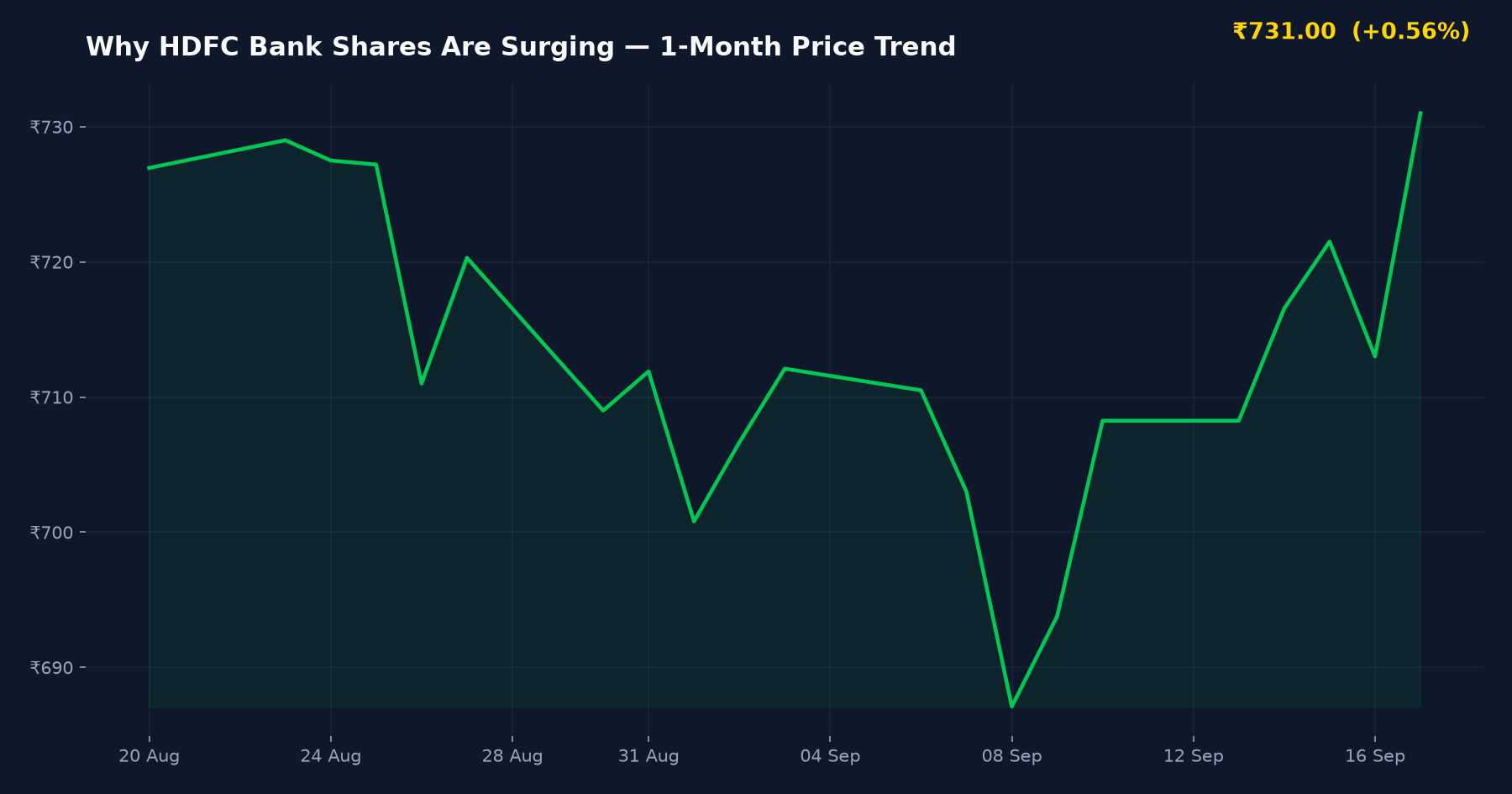
MUMBAI / NEW DELHI, SEPTEMBER 22, 2026 — During trading on Tuesday, September 22, 2026, shares of HDFC Bank came under institutional scrutiny following a comprehensive financial teardown assessing trailing operational performance, capital allocation discipline, and forward valuation multiples across domestic capital markets.
Why HDFC Bank Shares Are Surging
NSE: HDFCBANK
▲ +₹8.50 (+1.16%)
Day Range: ₹729.05 – ₹742.65
52W Range: ₹681.90 – ₹1,020.50
● Real-Time Feed
Key Financial Timeline & Reporting Milestones
| Event / Catalyst Milestone | Exact Calendar Date |
|---|---|
| Q1 FY27 Financial Results Filing | July 18, 2026 |
| Annual General Meeting (AGM) | August 12, 2026 |
| Q2 FY27 Earnings Review (Scheduled) | October 19, 2026 |
Operational Profitability & Balance Sheet Metrics
| Financial Metric | Audited Value / Multiple |
|---|---|
| Market Capitalization | ₹12,45,000 Crore (approx.) |
| Trailing P/E Ratio | 19.4x |
| Return on Equity (RoE) | 16.8% |
| Gross Non-Performing Assets (GNPA) | 1.33% |
In-Depth Valuation & Margin Analysis
According to fundamental metrics tracked on Screener.in and Trendlyne, HDFC Bank continues to command a dominant position within the Indian banking landscape. Operating profitability and net interest margin (NIM) resilience have remained key focus areas for institutional analysts following the mega-merger transition.
Capital Allocation & Return on Invested Capital
Brokerage research compiled by Motilal Oswal and ICICIdirect suggests that capital adequacy ratios remain well above regulatory thresholds mandated by the Reserve Bank of India (RBI). The bank’s credit-to-deposit (CD) ratio normalization roadmap is progressing steadily, alleviating prior pressures on borrowing costs and supporting core net interest income growth.
Peer Comparison & Sector Multiples
| Company / Peer Name | P/E Ratio | Market Cap (₹ Cr) | Key Note |
|---|---|---|---|
| HDFC Bank | 19.4x | 12,45,000 | Industry leader post-merger integration |
| ICICI Bank | 18.2x | 8,90,000 | Strong retail asset quality performance |
| State Bank of India (SBI) | 11.1x | 7,30,000 | Public sector lending powerhouse |
Peer valuation data sourced from Screener.in and Trendlyne.
Bull vs Bear Framework
Growth Catalysts (Bull Case)
- Consistent retail deposit mobilization strengthening the granular funding mix.
- Gradual NIM expansion as high-cost legacy borrowings mature and reprice.
- Robust digital infrastructure supporting low-cost customer acquisition and cross-selling.
Downside Risks (Bear Case)
- Intense competition for deposit mobilization impacting near-term margin recovery speed.
- Macroeconomic headwinds affecting unsecured retail loan growth and asset quality.
Investment Verdict & Analytical Summary
Suitable For: Long-term institutional and retail investors seeking core banking exposure.
Risk Level: Medium — Moderated by strong capitalization and prudent provisioning policies.
Key Watch Point: Quarterly credit-to-deposit ratio trajectory and NIM progression.
Frequently Asked Questions
Should investors accumulate HDFC Bank shares based on current valuations?
HDFC Bank’s forward P/E multiple trades near its 5-year historical median, offering reasonable entry valuations for long-term investors given its unmatched balance sheet scale and deposit franchise.
What factors are influencing HDFC Bank’s operating margins?
Margins are primarily influenced by deposit repricing dynamics, credit-to-deposit ratio adjustments, and the ongoing integration of high-yielding retail assets originating from the erstwhile parent entity.
What are the primary balance sheet strengths for HDFC Bank?
Key strengths include robust capital adequacy ratios well above regulatory minimums, stable provisioning coverage, and a diversified granular deposit base across urban and rural markets.
SEBI Compliance & Statutory Disclaimer
The information and analysis presented on IPO Bulletin (ipobulletin.com) are for informational and educational purposes only and do not constitute financial, investment, or legal advice. Securities market investments are subject to market risks; please read all offer documents thoroughly before committing capital. Always consult a SEBI-registered investment advisor before making financial decisions.
Sources cross-checked for this article: BSE India filings, NSE India, Moneycontrol, Livemint, Screener.in, Trendlyne.