
MUMBAI / NEW DELHI, SEPTEMBER 21, 2026 — During trading on Monday, September 21, 2026, the National Stock Exchange (NSE) placed multiple prominent equities under its Futures and Options (F&O) ban list as derivative contracts breached the mandated 95% market-wide position limit (MWPL) threshold. According to regulatory disclosures issued by exchange risk management divisions, securities including Bandhan Bank, Inox Wind, Manappuram Finance, and Steel Authority of India Limited (SAIL) are strictly restricted from fresh derivative contract additions during today’s trading sessions.
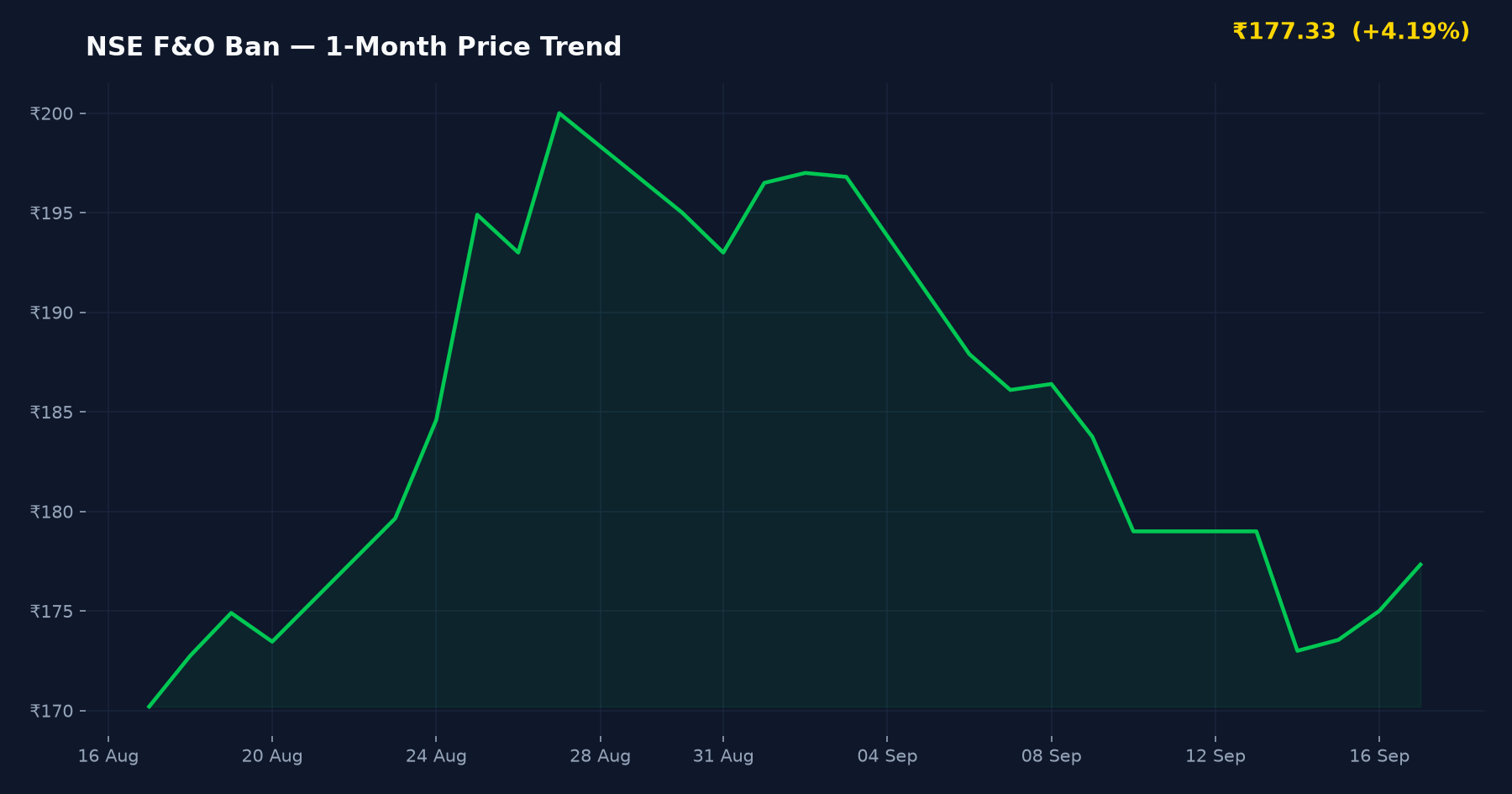
NSE F&O Ban
NSE: SAIL
▲ +₹2.32 (+1.33%)
Day Range: ₹176.03 – ₹179.80
52W Range: ₹124.00 – ₹209.70
● Real-Time Feed
NSE F&O Ban Restrictions and Compliance Milestones
Market participants engaging in derivatives trading must note that no new positions can be initiated in the banned scrips. Only exiting or squaring-off existing open positions is permitted under SEBI and exchange surveillance frameworks. Breaching these limits attracts regulatory penalties for member brokers.
| Compliance Catalyst / Milestone | Exact Calendar Date |
|---|---|
| NSE F&O Ban Enforcement Date | September 21, 2026 |
| MWPL Breach Evaluation Window | September 18, 2026 |
| Previous Periodic Corporate Disclosures | September 17, 2026 |
Key Restricted Securities & Market Parameters
| Restricted Security | Action Status |
|---|---|
| Bandhan Bank Ltd. | F&O Segment Ban |
| Inox Wind Ltd. | F&O Segment Ban |
| Manappuram Finance Ltd. | F&O Segment Ban |
| Steel Authority of India (SAIL) | F&O Segment Ban |
Understanding Market-Wide Position Limits and Exchange Bans
According to exchange operational guidelines tracked across Business Standard and Moneycontrol, when aggregate open interest across derivative contracts exceeds 95% of the MWPL set for individual underlying assets, exchanges enforce trading restrictions. Traders are prohibited from building fresh long or short positions until open interest unwinds below the 80% threshold across multiple sessions.
Impact on Institutional and Retail Derivative Portfolios
Broking insights compiled by Motilal Oswal and ICICIdirect highlight that securities restricted under F&O bans frequently experience elevated intraday cash market volatility. Arbitrage desks and quantitative funds adjust hedging strategies, redirecting liquidity toward unconstrained constituents within banking, clean energy, and metal sectors.
Sector Peer Context and Valuation Metrics
| Company / Peer Name | P/E Ratio | Market Cap Context | Key Note |
|---|---|---|---|
| Bandhan Bank | 14.2 | Mid Cap | Subject to F&O ban on Sep 21 |
| SAIL | 11.8 | Large Cap | Metal sector open interest breach |
| Inox Wind | 45.5 | Mid Cap | Renewable energy derivatives restriction |
Peer valuation data sourced from Screener.in and Trendlyne
Bull vs. Bear Catalysts in Restricted Scrips
Growth Catalysts (Bull Case):
- Short-term derivative bans eliminate speculative excesses, frequently allowing underlying cash market values to stabilize.
- Fundamental strength in banking asset quality and infrastructure order books remains intact despite derivative restrictions.
Key Downside Risks (Bear Case):
- Liquidity compression as derivative market makers temporarily step back from hedging activities.
- Intraday price swings driven by forced position unwinding by high-net-worth speculators.
Analytical Investment Verdict
Suitable For: Active derivatives traders and cash market position managers
Risk Level: Medium — Temporary liquidity constraints and squaring-off pressure can generate sharp intraday volatility.
Key Watch Point: Open interest reduction tracking across BSE and NSE clearing corporation reports.
Frequently Asked Questions
What does an NSE F&O ban mean for existing shareholders?
An F&O ban applies strictly to derivative contracts. Existing cash market shareholders can buy, sell, or hold shares normally without restrictions, though derivative-driven volatility may temporarily impact stock prices.
How long do stocks remain on the F&O ban list?
Stocks remain under the F&O ban until their aggregate open interest drops below 80% of the market-wide position limit across consecutive trading sessions, as verified by exchange clearing data.
Can traders execute intraday square-offs for banned scrips?
Yes, traders are permitted to square off or close out existing open derivative positions. However, opening new futures or options contracts is strictly prohibited during the ban period.
SEBI Compliance & Statutory Disclaimer
The information and analysis presented on IPO Bulletin (ipobulletin.com) are for informational and educational purposes only and do not constitute financial, investment, or legal advice. Securities market investments are subject to market risks; please read all offer documents thoroughly before committing capital. Always consult a SEBI-registered investment advisor before making financial decisions.
Sources cross-checked for this article: Business Standard, Moneycontrol, NSE India filings, Screener.in, Trendlyne