
MUMBAI / NEW DELHI, SEPTEMBER 17, 2026 — During trading on Thursday, September 17, 2026, Indian stock markets experienced notable divergence as the BSE Sensex closed in the red following intense closing auction volatility, while the NSE Nifty held above the 23,250 mark. According to market coverage from Moneycontrol and The Economic Times, the recurring phenomenon known as ‘CAS chaos’ continues to trigger sharp swings during the final minutes of trading sessions.
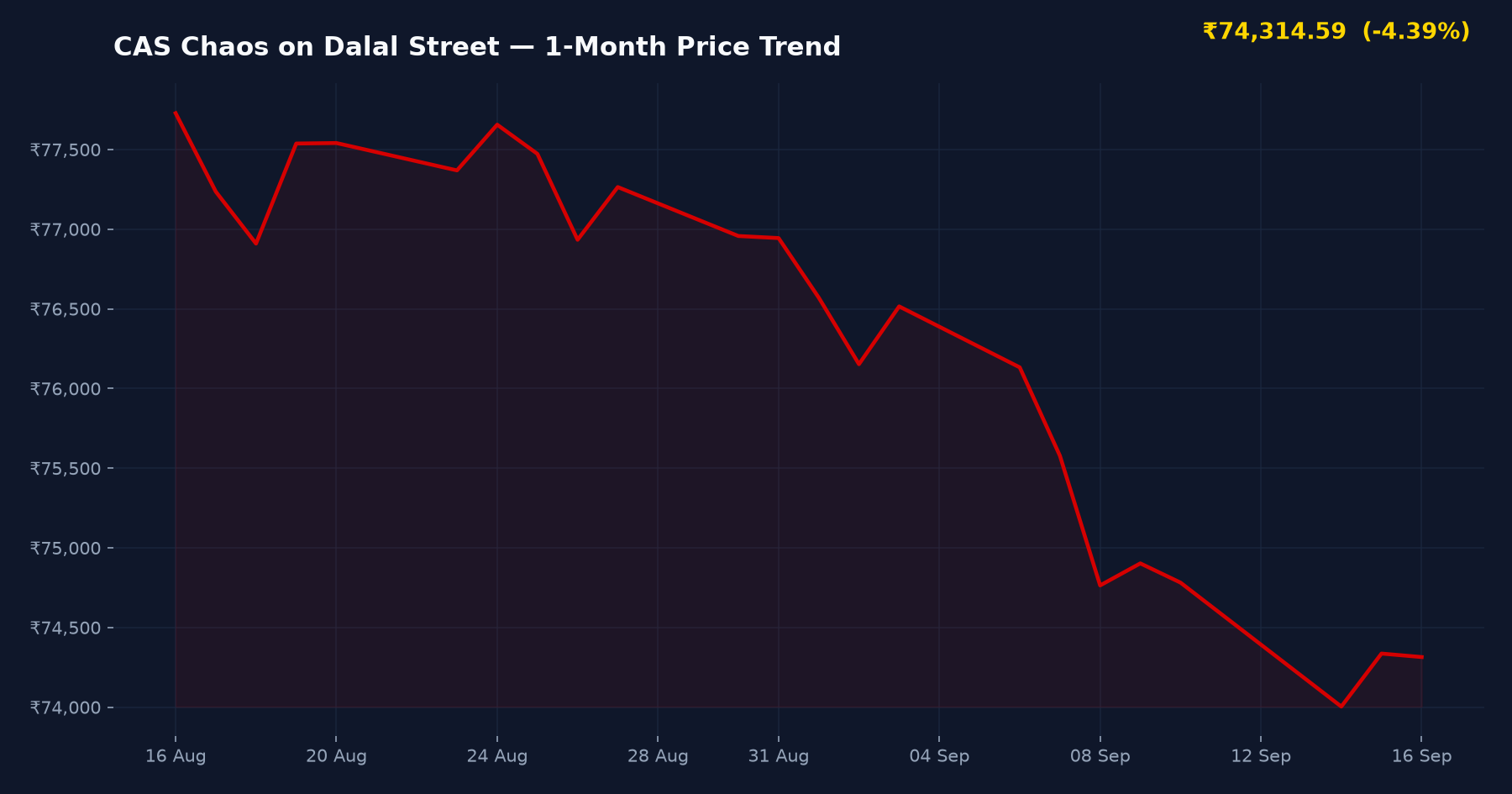
SENSEX
INDEX
▲ +₹310.79 (+0.42%)
Day Range: ₹74,163.95 – ₹74,677.56
52W Range: ₹71,545.81 – ₹86,159.02
● Real-Time Feed
Key Timeline & Market Catalysts

| Event / Catalyst Milestone | Exact Calendar Date |
|---|---|
| CAS Chaos Trading Reform Rollout | August 7, 2026 |
| Monthly F&O Expiry Volatility Spike | August 28, 2026 |
| F&O Expiry Index Swing Session | September 10, 2026 |
| Latest Intraday Divergence Print | September 17, 2026 |
Market Metrics & Index Parameters
| Metric / Parameter | Value / Status |
|---|---|
| Nifty Index Threshold | Above 23,250 |
| Sensex Closing Auction Swing | 270-Point Drop |
| Exchanges Impacted | BSE & NSE |
| Primary Trigger | Closing Auction Session (CAS) |
In-Depth Analysis of Closing Auction Volatility
Financial reports from Moneycontrol and The Economic Times highlight that the implementation of the Closing Auction Session (CAS) has fundamentally altered fag-end trading dynamics on Dalal Street. Initially introduced as a major stock trading reform in early August 2026, the mechanism has repeatedly triggered sharp intraday reversals. On Thursday, September 17, 2026, traders observed a swift 270-point downward swing in the Sensex during the final minutes of trade.
Why the Closing Auction Session Diverges Indices
According to institutional brokerage commentary compiled by Motilal Oswal and ICICIdirect, the divergence between the BSE Sensex and NSE Nifty stems from distinct weightings and index calculation methodologies during the closing auction window. While derivative expiry positions and institutional rebalancing frequently concentrate execution in the final minutes, the new auction mechanism amplifies price discovery swings.
Bull vs. Bear Market Catalysts
Bullish Drivers:
- Resilience in broader indices like Nifty Midcap and Smallcap, demonstrating strong underlying fundamentals.
- Robust retail participation across primary and secondary segments despite global rate hike anxieties.
- Enhanced price transparency and institutional liquidity absorption via structured exchange mechanisms.
Bearish Risks:
- Sudden fag-end volatility shocks catching leveraged F&O traders off guard during expiry sessions.
- Persistent global geopolitical tensions and shifting Federal Reserve rate trajectory expectations.
- Liquidity concentration risks during the closing auction window.
Investment Verdict
Suitable For: Experienced derivatives and intraday equity traders managing execution risk.
Risk Level: High — Rapid price swings during the closing auction require strict stop-loss protocols.
Key Watch Point: Order flow dynamics and indicative price movements in the final 10 minutes of trade.
Frequently Asked Questions
What is CAS chaos and why does it impact the Sensex?
CAS chaos refers to the sharp intraday volatility and sudden index swings observed during the Closing Auction Session (CAS) introduced on Dalal Street. Institutional rebalancing and derivative positioning during this final auction window frequently cause abrupt point drops or spikes in indices like the BSE Sensex.
How does the Closing Auction Session affect Nifty versus Sensex?
Due to differing constituent weightings and settlement flows between the BSE and NSE, closing auction adjustments can cause temporary divergence, leading to scenarios where Sensex closes lower while Nifty maintains key technical support levels.
How can traders protect themselves against closing auction volatility?
Traders can mitigate CAS-driven volatility risks by avoiding unhedged overnight derivatives positions, utilizing limit orders instead of market orders during closing windows, and closely monitoring pre-close indicative pricing.
SEBI Compliance & Statutory Disclaimer
The information and analysis presented on IPO Bulletin (ipobulletin.com) are for informational and educational purposes only and do not constitute financial, investment, or legal advice. Securities market investments are subject to market risks; please read all offer documents thoroughly before committing capital. Always consult a SEBI-registered investment advisor before making financial decisions.
Sources cross-checked for this article: Moneycontrol, The Economic Times, BSE India filings, NSE India.