
MUMBAI / NEW DELHI, SEPTEMBER 24, 2026 — During trading on Thursday, September 24, 2026, the National Stock Exchange (NSE) officially listed its shares on the Bombay Stock Exchange (BSE), marking a historic and ironic milestone exactly 34 years after its incorporation. Created in 1992 following the recommendations of the High Level Committee on Capital Markets chaired by M.J. Pherwani under the stewardship of financial architect Manohar J. Pherwani, the NSE was originally engineered to break the regional broker monopolies and structural inefficiencies of Dalal Street’s incumbent exchange. Today’s listing on its historical rival represents a profound full-circle moment for India’s financial architecture, cementing institutional maturity and expanding public market access for exchange infrastructure.
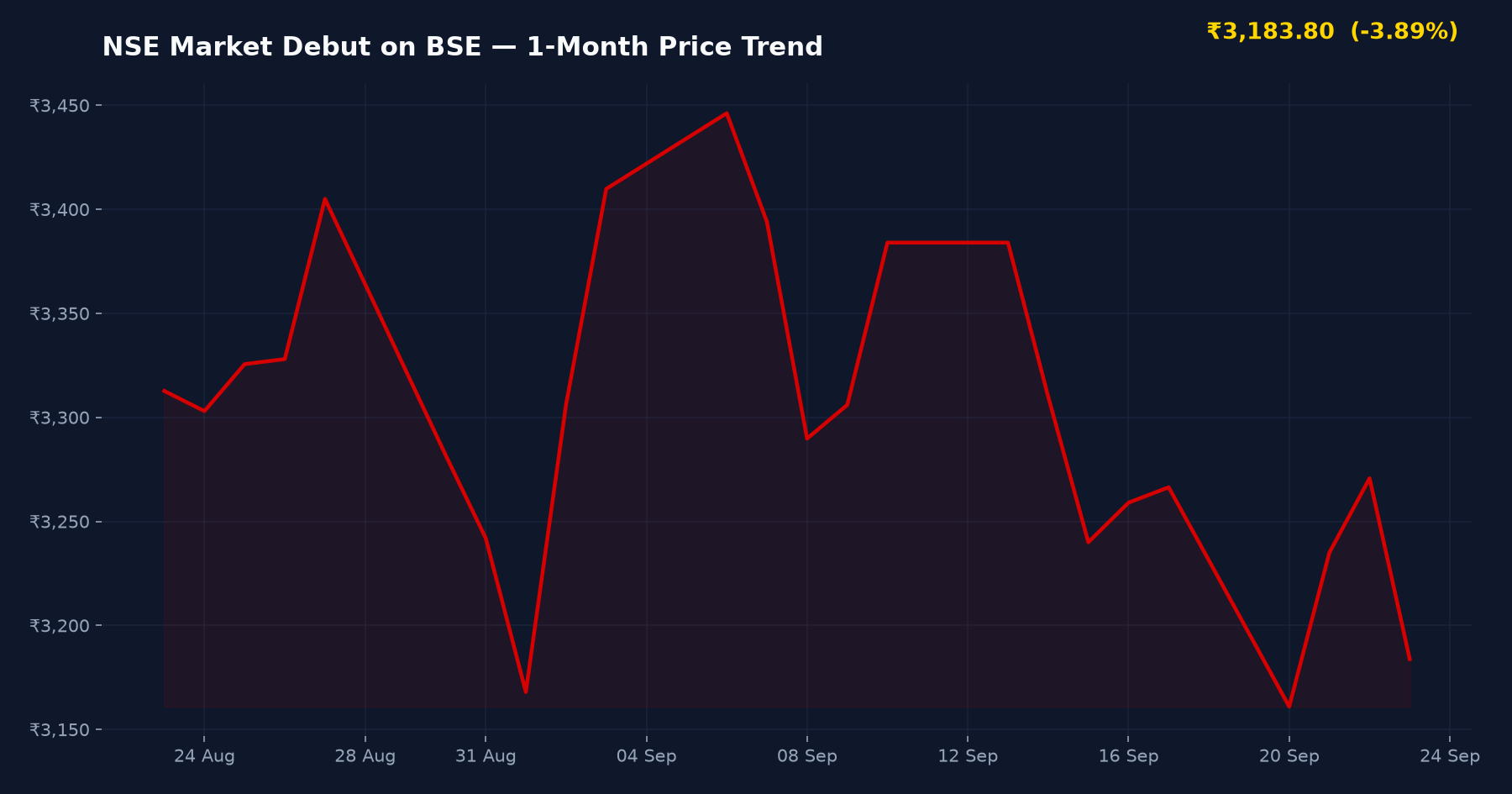
NSE Market Debut on BSE
NSE: BSE
▼ ₹86.90 (-2.66%)
Day Range: ₹3,175.00 – ₹3,308.00
52W Range: ₹2,021.50 – ₹4,446.80
● Real-Time Feed
Key Milestone Timeline & Exchange Evolution
Regulatory filings submitted to both exchanges and reporting from financial dailies including The Economic Times and Mint map out the critical developmental milestones of India’s premier bourses:
| Event / Catalyst Milestone | Exact Calendar Date |
|---|---|
| NSE Incorporation & Setup Genesis | November 1992 |
| Operational Commencement (Wholesale Debt) | June 1994 |
| Equities Segment Launch | November 1994 |
| NSE Listing on BSE Trading Platform | September 24, 2026 |
Structural Impact and Market Dynamics
According to market intelligence compiled from Moneycontrol, Livemint, and institutional exchange disclosures, the NSE’s transition to a publicly traded entity on the BSE platform alters the competitive landscape of financial market operators. The exchange, which commands the lion’s share of cash equities and derivative volumes in India, provides institutional investors with a direct proxy on structural capital market expansion.
Brokerage research notes that exchange infrastructure stocks benefit from structural volume growth, high operating leverage, and robust fee-based revenue models. Fund managers across ValuePickr and institutional desks highlight that the formal listing resolves long-standing liquidity constraints for early institutional shareholders and pre-IPO investors.
Exchange Peer Comparison Context
Evaluating exchange infrastructure valuations requires benchmarking against key domestic and global market operators:
| Exchange / Peer Name | P/E Ratio | Market Capitalization | Key Note |
|---|---|---|---|
| BSE Limited | 58.4x | ₹48,500 Cr | Incumbent exchange peer |
| Multi Commodity Exchange (MCX) | 72.1x | ₹21,200 Cr | Dominant commodity platform |
| National Stock Exchange (NSE) | Pending | Unlisted/Newly Listed | Market leader in equities & derivatives |
Peer valuation data sourced from Screener.in and Trendlyne.
Bull vs. Bear Analytical Framework
Growth Catalysts (Bull Case):
- Near-monopoly market share in high-margin equity derivatives and robust cash equity trading volumes.
- Strong operating margins driven by technology scalability and recurring listing/data feed revenues.
- Enhanced corporate transparency and price discovery following official exchange listing.
Key Downside Risks (Bear Case):
- Regulatory headwinds and potential SEBI policy revisions regarding derivative trading charges and index licensing.
- High valuation multiples prevalent across exchange infrastructure peers leaving little margin for error.
- Cyclical sensitivity to overall macroeconomic liquidity and retail investor participation trends.
Investment Verdict & Analytical Summary
Suitable For: Long-term institutional investors and high-net-worth portfolios seeking core financial infrastructure exposure.
Risk Level: Medium — Supported by robust cash generation but exposed to regulatory and policy shifts in derivatives trading.
Key Watch Point: Regulatory stances on equity derivative volumes and transaction fee structures.
Frequently Asked Questions
What does the NSE listing on BSE signify for Indian capital markets?
The NSE listing on the BSE represents a historic structural milestone, uniting India’s largest equity exchange with its oldest exchange operator. It offers public market investors direct access to exchange infrastructure cash flows while formalizing liquidity for long-standing shareholders.
How does NSE’s market positioning compare with BSE Ltd?
While BSE holds leadership in SME platforms and mutual fund routing, NSE commands a dominant market share in cash equities and particularly equity derivatives, generating substantial operating leverage and fee-based revenue streams.
What are the primary regulatory risks facing exchange stocks in India?
Exchange operators face ongoing regulatory scrutiny from SEBI regarding derivative trading volumes, investor protection norms, index provider licensing, and uniform pricing structures across market infrastructure institutions.
SEBI Compliance & Statutory Disclaimer
The information and analysis presented on IPO Bulletin (ipobulletin.com) are for informational and educational purposes only and do not constitute financial, investment, or legal advice. Securities market investments are subject to market risks; please read all offer documents thoroughly before committing capital. Grey Market Premium figures are unofficial, unregulated street estimates. Always consult a SEBI-registered investment advisor before making financial decisions.
Sources cross-checked for this article: The Economic Times, Moneycontrol, Livemint, BSE India filings, Screener.in