
MUMBAI / NEW DELHI, SEPTEMBER 20, 2026 — During trading on Sunday, September 20, 2026, market participants turned their focus toward upcoming corporate actions as over 150 listed companies, including prominent public sector enterprises like Indian Railway Catering and Tourism Corporation (IRCTC) and BEML, fixed their record dates for dividends and stock splits for the week starting September 21.
According to regulatory filings submitted to the BSE and NSE India, these corporate actions require eligible shareholders to hold shares in their demat accounts on the specified record dates to qualify for payouts, interim dividends, or share subdivisions. Institutional tracking data compiled from Moneycontrol and Livemint highlights a heavy concentration of PSU announcements during this September window.
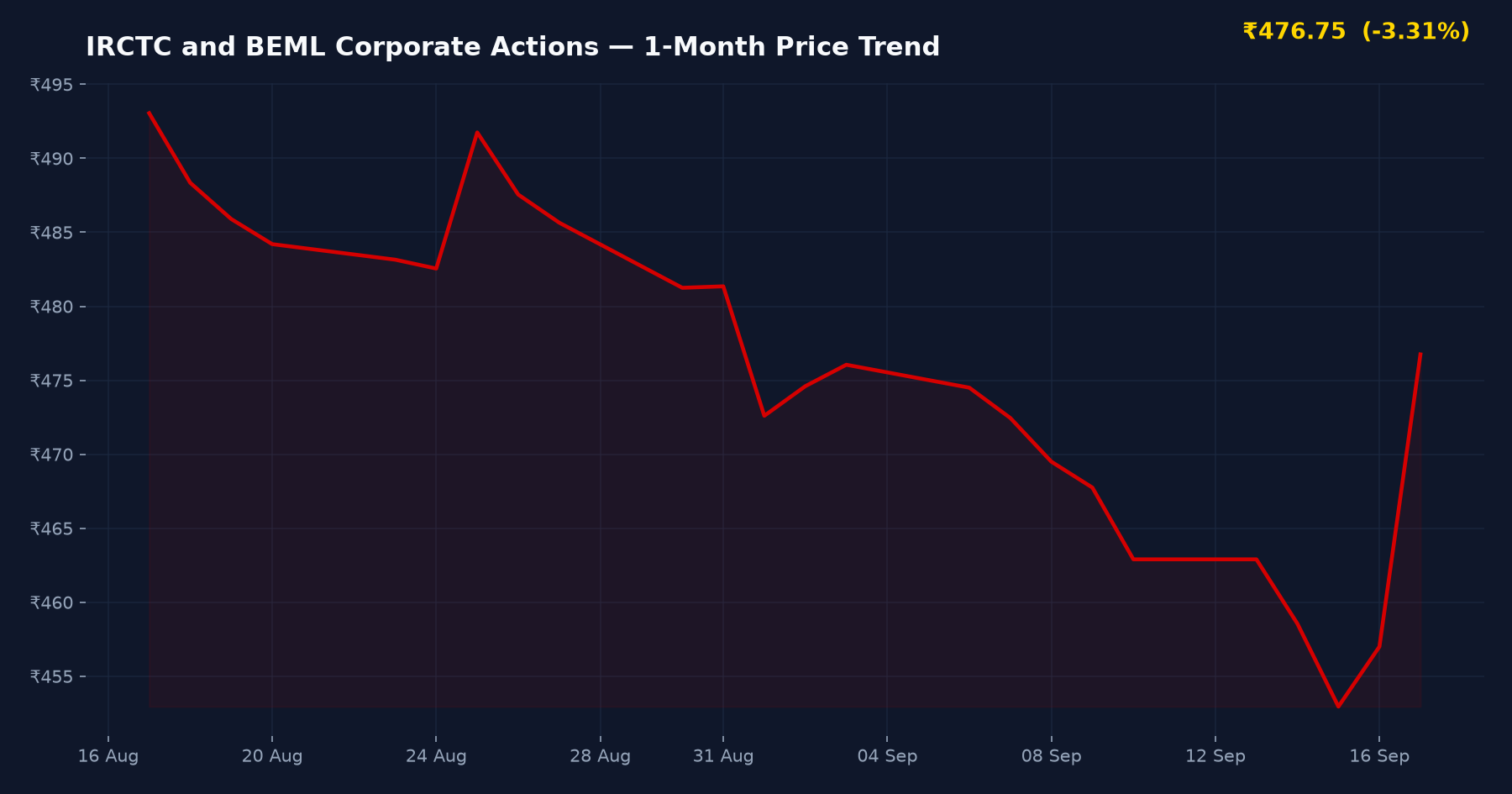
IRCTC and BEML Corporate Actions
NSE: IRCTC
▲ +₹19.75 (+4.32%)
Day Range: ₹457.15 – ₹480.00
52W Range: ₹446.50 – ₹736.95
● Real-Time Feed
Key Corporate Action Milestones This Week
| Event / Catalyst Milestone | Exact Calendar Date |
|---|---|
| Corporate Action Week Initiation | September 21, 2026 |
| Record Date Window (IRCTC, BEML & Peers) | September 21 – September 25, 2026 |
| Ex-Date Verification Period | Ongoing throughout the week |
Understanding Dividend and Stock Split Mechanics
For retail and institutional investors tracking the September 20, 2026 announcements, understanding the timeline of ex-dates and record dates is critical. When a company announces a stock split or dividend, the exchange sets an ex-date—typically one trading day prior to the record date. Investors must purchase shares before the ex-date to be entered into the company’s register of members.
Impact on Stock Liquidity and Valuation
Brokerage research compiled by Motilal Oswal and ICICIdirect indicates that corporate actions such as stock splits often enhance retail liquidity by reducing the absolute per-share price, making high-value counters more accessible. Meanwhile, regular dividend payouts by cash-rich PSUs like IRCTC and BEML provide steady cash flow returns to long-term equity holders, bolstering overall portfolio yields during volatile market phases.
Sector Peer Benchmarking & Corporate Action Overview
| Company / Entity | P/E Ratio (Approx) | Corporate Action Type | Key Note |
|---|---|---|---|
| IRCTC | 62.4 | Dividend / Action | Record date scheduled during week of Sept 21. |
| BEML | 45.8 | Dividend / Action | Part of 150+ stocks with September record dates. |
| Hindustan Copper | 38.2 | Dividend | Featured in September corporate action schedules. |
Peer valuation data sourced from Screener.in and Trendlyne.
Investor Framework: Catalysts vs Risks
Growth Catalysts:
- Enhanced retail participation driven by lower nominal share prices following stock splits.
- Consistent cash returns via dividends from fundamentally robust public sector undertakings.
- Improved stock liquidity and trading volumes around record dates.
Downside Risks:
- Post-ex-date price corrections often mirror the exact dividend or split value adjusted in the market.
- Short-term volatility due to speculative buying ahead of record dates followed by profit booking.
Investment Verdict Analysis
Suitable For: Long-term dividend investors and tactical traders
Risk Level: Medium — Price adjustments on ex-dates require careful entry timing.
Key Watch Point: Exact ex-date and record date synchronization in broker terminals.
Frequently Asked Questions
Should investors buy stocks specifically for upcoming dividends and stock splits?
Purchasing shares solely for dividends or splits often results in neutral financial outcomes because share prices adjust downward on the ex-date by an amount proportional to the corporate action. Investors should evaluate the fundamental business strength rather than short-term corporate payouts.
What is the significance of the record date in corporate actions?
The record date is the cutoff point determined by a company to establish which shareholders are eligible to receive declared dividends, bonus issues, or stock splits. Investors must hold the shares in their demat accounts on this date to qualify.
How do stock splits impact overall equity value?
A stock split divides existing shares into multiple units, lowering the per-share price proportionally without altering the company’s total market capitalization or fundamental underlying value. However, it frequently improves retail market liquidity.
SEBI Compliance & Statutory Disclaimer
The information and analysis presented on IPO Bulletin (ipobulletin.com) are for informational and educational purposes only and do not constitute financial, investment, or legal advice. Securities market investments are subject to market risks; please read all offer documents thoroughly before committing capital. Always consult a SEBI-registered investment advisor before making financial decisions.
Sources cross-checked for this article: The Economic Times, Moneycontrol, Livemint, BSE India filings, Screener.in