
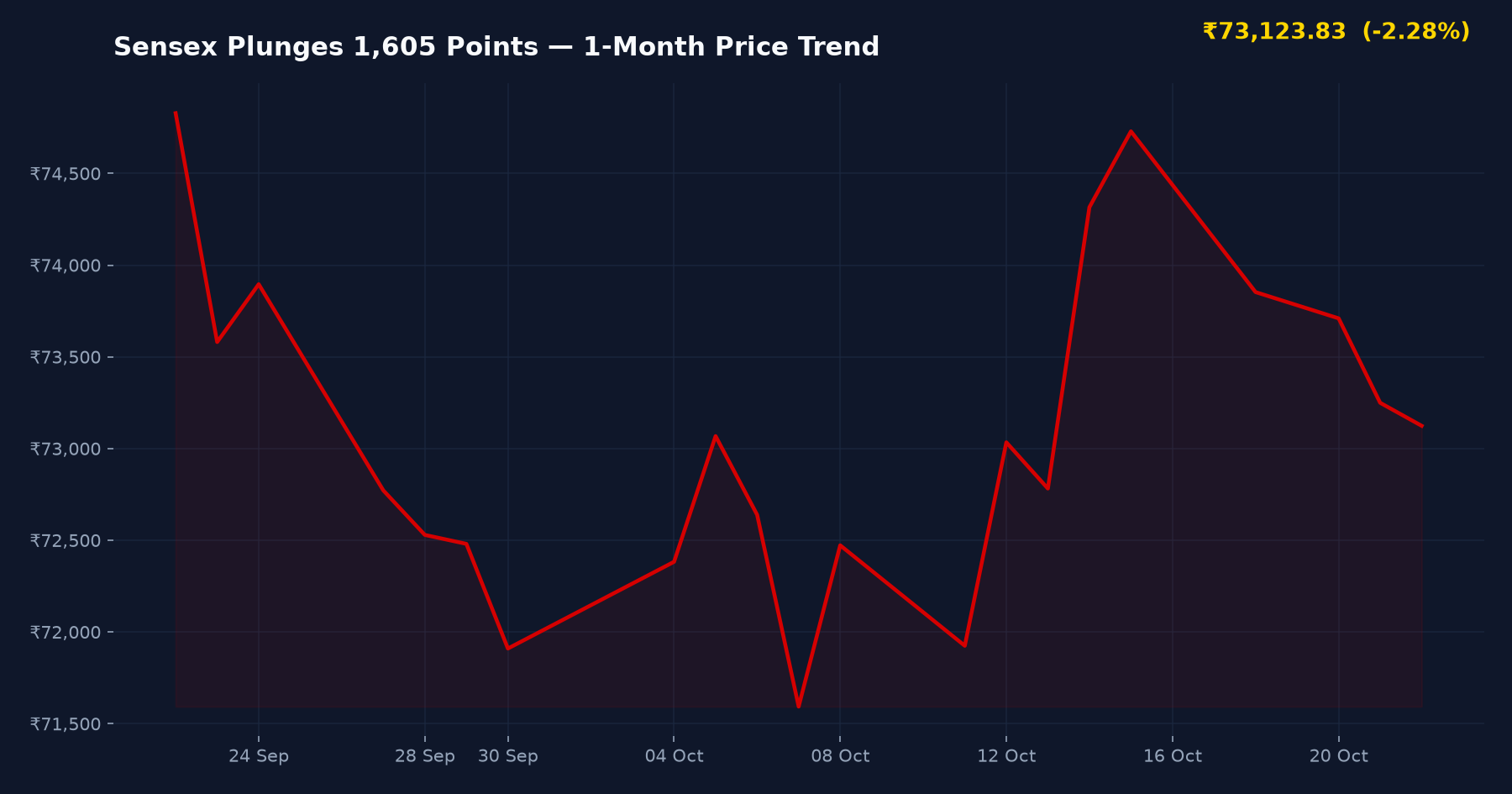
MUMBAI / NEW DELHI, OCTOBER 25, 2026 — During trading reviewed on Sunday, October 25, 2026, India’s equity benchmarks witnessed significant selling pressure as eight of the country’s top-10 most valued companies suffered a collective market capitalization erosion of ₹1.55 lakh crore. The 30-share BSE Sensex dropped by 1,605.44 points, weighed down heavily by private lenders and non-banking financial corporations, with HDFC Bank and Bajaj Finance emerging as the primary laggards while Tata Consultancy Services (TCS) and Larsen & Toubro (L&T) bucked the downward trend.
Key Takeaways at a Glance
- Valuation Erosion: Eight of the top 10 listed Indian firms lost a combined ₹1.55 lakh crore in market capitalization during the week.
- Benchmark Contraction: The BSE Sensex plunged 1,605.44 points, reflecting broad institutional de-risking across frontline equities.
- Stock Divergence: HDFC Bank and Bajaj Finance absorbed the deepest declines, whereas IT and capital goods leaders TCS and Larsen & Toubro posted resilient gains.
SENSEX
INDEX
▼ ₹125.56 (-0.17%)
Day Range: ₹72,452.37 – ₹73,766.51
52W Range: ₹71,292.88 – ₹86,159.02
● Real-Time Feed
BSE Sensex Benchmark Movement & Key Weekly Milestones
The broader equity pullback reflected cautious positioning across institutional desks. Monitoring shifts across the Indian market indices dashboard shows that financial heavyweights exerted the heaviest drag on headline performance over the five-day trading period.
| Event / Market Milestone | Calendar Date / Measure |
|---|---|
| Market Capitalization Assessment Date | October 25, 2026 |
| BSE Sensex Net Weekly Point Decline | -1,605.44 pts |
| Total Top-10 Valuation Depletion | ₹1.55 Lakh Crore |
| Next Major Trading Session Window | October 26, 2026 |
Valuation Breakdown: Financial Majors Face Steep De-Rating
Market capitalization—calculated as the total number of outstanding shares multiplied by the prevailing stock price—reflects shifting investor sentiment and institutional allocations. During the week ended October 25, 2026, foreign institutional investors (FIIs) and domestic asset managers adjusted weights ahead of critical macroeconomic releases.
| Market Segment / Firm Metric | Impact Observation |
|---|---|
| Leading Valuation Laggard 1 | HDFC Bank |
| Leading Valuation Laggard 2 | Bajaj Finance |
| Top Resilient Counter 1 | Tata Consultancy Services |
| Top Resilient Counter 2 | Larsen & Toubro |
| Total Impacted Blue-Chip Entities | 8 of Top 10 |
Why Did HDFC Bank and Bajaj Finance Drive the Market Decline?
According to trade execution data compiled by BSE India and NSE India, large-cap banking and NBFC counters faced consistent distribution across institutional blocks. Financial institutions hold disproportionate weightage in both the Nifty 50 and the BSE Sensex, meaning downward movements in lenders like HDFC Bank automatically compound the index-level drop.
Analysts tracking secondary market volumes on Screener.in and Trendlyne point to ongoing net interest margin (NIM) pressures and elevated cost-of-funds ratios across lending businesses as investors digest Q2 corporate results. While the financial pack bore the brunt of the downturn, defensive demand supported TCS and engineering bellwether Larsen & Toubro, which recorded modest gains due to healthy order pipeline visibility.
The volatility in secondary markets also filters into primary issuance windows. Market participants evaluating issues on the live IPO calendar frequently monitor large-cap liquidity, as broad index contractions can recalibrate anchor investor bidding appetite and pricing bands for upcoming public offers.
Market Structure Analysis: Bullish triggers vs. Downside Pressures
Evaluating frontline equities during a 1,605-point index correction requires balancing cyclical risks against underlying balance sheet health:
- Resilience Triggers (Bullish Factors):
- Defensive allocation toward technology exports and infrastructure capital expenditure, evidenced by green closes in TCS and L&T.
- Healthy domestic systematic investment plan (SIP) inflows providing structural support beneath secondary market corrections.
- Sustained performance metrics tracked via the recent IPO listing performance tracker, showing selective investor appetite for high-growth sectors.
- Correction Drivers (Bearish Factors):
- Compressed loan margins and heightened credit cost scrutiny impacting high-weight financials like HDFC Bank and Bajaj Finance.
- Substantial foreign portfolio investor (FPI) outflows reallocating capital across broader Asian peers.
- Valuation premiums across large-cap consumer and lending franchises requiring consolidation to align with earnings trajectory.
What to Check Before Allocating Capital in Volatile Markets
- Net Interest Margin (NIM) Trends: Review whether private banks and NBFCs are maintaining yield spreads amidst competitive deposit pricing.
- Institutional Flow Consistency: Examine net FII and DII buying or selling patterns across exchange trade data on BSE and NSE.
- Earnings Delivery vs. P/E Multiples: Check trailing twelve-month (TTM) price-to-earnings ratios on platforms like Screener.in to verify if price declines have brought valuations in line with historical medians.
- Primary Market Pipeline Conditions: Track active liquidity by observing retail and QIB bidding participation on the open IPO subscription tracker.
Frequently Asked Questions
Why did top Indian companies lose ₹1.55 lakh crore this week?
Eight of India’s ten largest companies experienced a combined market capitalization decline of ₹1.55 lakh crore due to aggressive institutional selling in index heavyweights. The BSE Sensex fell by 1,605.44 points, driven primarily by valuation de-ratings in banking and non-banking finance leaders like HDFC Bank and Bajaj Finance.
Which stocks gained during the recent market correction?
Tata Consultancy Services (TCS) and Larsen & Toubro (L&T) managed to gain market value despite the widespread 1,605-point fall in the BSE Sensex. Investors rotated selectively into technology exporters and infrastructure companies with robust order books while trimming exposures to interest-rate sensitive financial shares.
How does large-cap index correction impact the IPO market?
Secondary market volatility often prompts primary market issuers and merchant bankers to adopt more conservative price bands. A sustained drop in benchmark indices can moderate grey market premiums (GMP) and prompt qualified institutional buyers (QIBs) to demand stricter valuation discipline on forthcoming public listings.
SEBI Compliance & Statutory Disclaimer
The information and analysis presented on IPO Bulletin (ipobulletin.com) are for informational and educational purposes only and do not constitute financial, investment, or legal advice. Securities market investments are subject to market risks; please read all offer documents (DRHP/RHP) thoroughly before committing capital. Grey Market Premium (GMP) figures are unofficial, unregulated street estimates. Always consult a SEBI-registered investment advisor before making financial decisions.
Sources referenced: BSE India, NSE India, Economic Times Markets Feed, Screener.in, Trendlyne.
Reusing this article or its images? Credit IPO Bulletin and link to https://ipobulletin.com/2026/10/sensex-plunges-points-top-stocks.html. Content licence.