
MUMBAI / NEW DELHI, SEPTEMBER 29, 2026 — During trading on Tuesday, September 29, 2026, the Nifty 50 index breached the crucial 23,000 threshold, slipping below key support levels amid mounting volatility driven by monthly futures and options (F&O) expiry and escalating crude oil price pressures.
According to market reports and data compiled from Moneycontrol and Livemint, the domestic benchmark indices faced intense selling pressure over multiple consecutive sessions, shedding over 550 points on the Nifty and 1,800 points on the Sensex. Analysts point toward a confluence of foreign institutional investor (FII) capital outflows, macroeconomic headwinds, and global commodity shocks as primary catalysts behind the sharp correction.
NIFTY 50
INDEX
▼ ₹467.10 (-2.02%)
Day Range: ₹22,569.65 – ₹22,753.25
52W Range: ₹22,182.55 – ₹26,373.20
● Real-Time Feed
Key Timeline & Market Milestone Schedule
| Market Event / Catalyst Milestone | Exact Calendar Date |
|---|---|
| Initial Selling Wave & Sensex Drop | September 25, 2026 |
| Nifty Breaches 23K Level Ahead of Expiry | September 28, 2026 |
| Monthly F&O Expiry & Intraday Rebound | September 29, 2026 |
Macroeconomic Factors Fueling the Correction
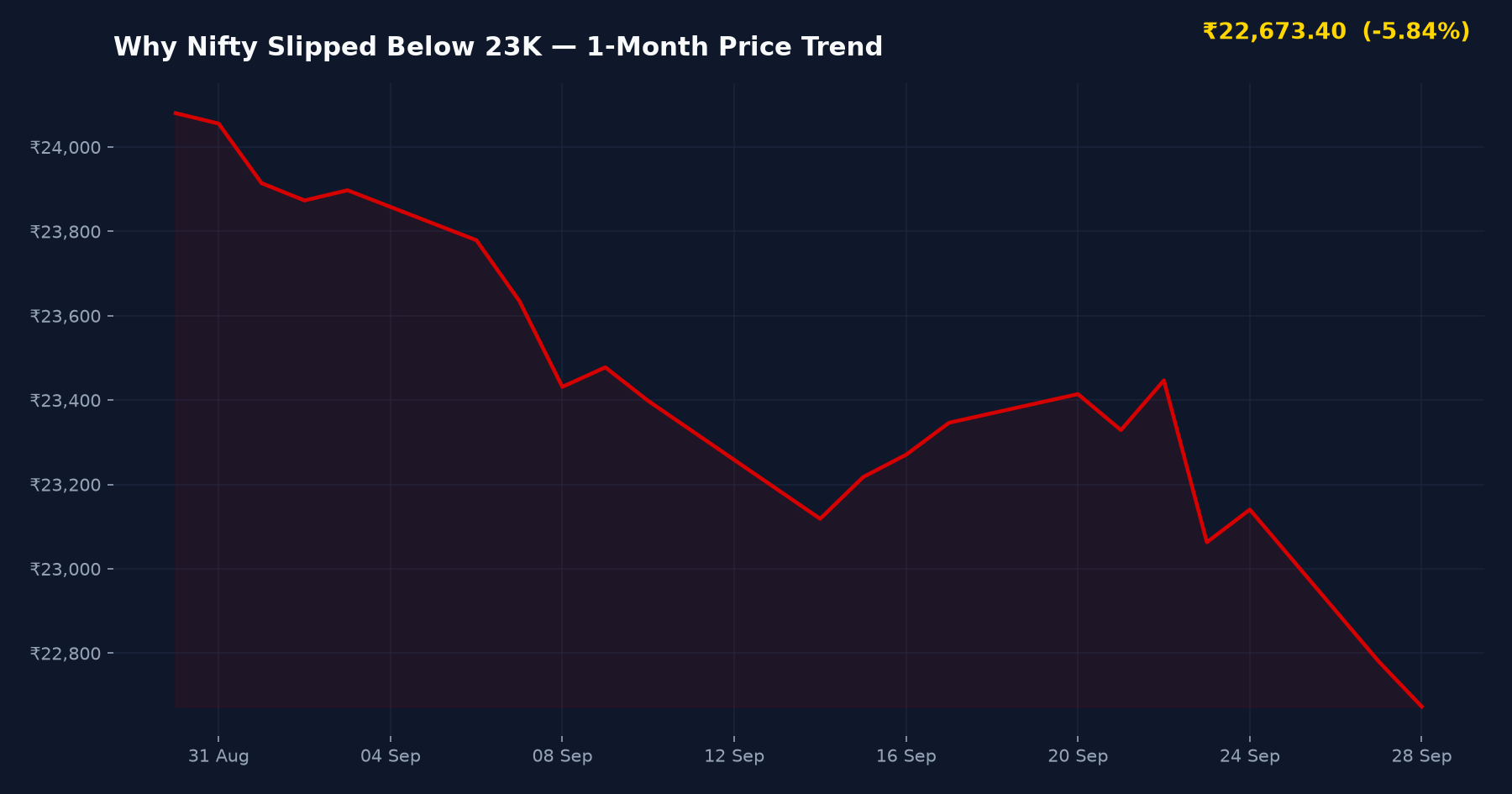
Financial commentary from platforms like Moneycontrol and Livemint highlights three core reasons for the current downturn: persistent geopolitical risks impacting crude oil prices, aggressive foreign fund outflows seeking higher yields in global markets, and technical breakdown below psychological support thresholds.
Technical charts monitored via TradingView and StockEdge indicate that the breakdown below 23,000 has increased short-term vulnerability, with several technical analysts projecting potential testing of the 21,000 to 21,500 zones if macroeconomic catalysts fail to stabilize.
Bull vs. Bear Market Framework
Growth Catalysts (Bull Case):
- Strong domestic retail participation via systematic investment plans (SIPs) continues to provide structural liquidity support.
- Corporate earnings remain resilient across core banking, infrastructure, and manufacturing sectors despite margin headwinds.
- Potential macroeconomic policy interventions or monetary easing could trigger aggressive relief rallies from lower valuation floors.
Key Downside Risks (Bear Case):
- Crude oil price shocks exerting direct pressure on India’s current account deficit and domestic fuel inflation.
- Continuous FII net selling driven by shifting global interest rate expectations and alternative asset attractiveness.
- Technical breach of critical support lines increasing stop-loss cascading during monthly F&O expiry sessions.
What to check before rebalancing your portfolio
- Evaluate asset allocation limits across domestic equities, debt instruments, and international asset classes.
- Review fundamental valuations and earnings growth projections of individual portfolio holdings rather than indexing alone.
- Monitor institutional cash flow data and global currency movements for signs of trend reversal.
Frequently Asked Questions
Why did the Nifty 50 break below the 23,000 mark?
The breakdown was triggered by a combination of persistent FII capital outflows, crude oil price volatility, and heavy selling pressure ahead of the monthly F&O expiry session.
Should investors consider global diversification when domestic markets struggle?
Financial experts note that allocating a portion of capital to global equities or international funds can hedge against domestic concentration risks, though currency fluctuations and international market valuations must be carefully evaluated.
What are the crucial support levels for the Nifty 50 index moving forward?
Technical analysts tracking primary market data on platforms like Moneycontrol and Livemint observe immediate resistance near higher levels, while downside support zones are being watched closely around 21,000–21,500 should current bearish momentum persist.
SEBI Compliance & Statutory Disclaimer
The information and analysis presented on IPO Bulletin (ipobulletin.com) are for informational and educational purposes only and do not constitute financial, investment, or legal advice. Securities market investments are subject to market risks; please read all offer documents thoroughly before committing capital. Always consult a SEBI-registered investment advisor before making financial decisions.
Sources referenced: Livemint, Moneycontrol, TradingView, BSE India filings
Reusing this article or its images? Credit IPO Bulletin and link to https://ipobulletin.com/2026/09/why-nifty-slipped-below-23k-key-macro-triggers-expert-roadmap-for-investors.html. Content licence.