
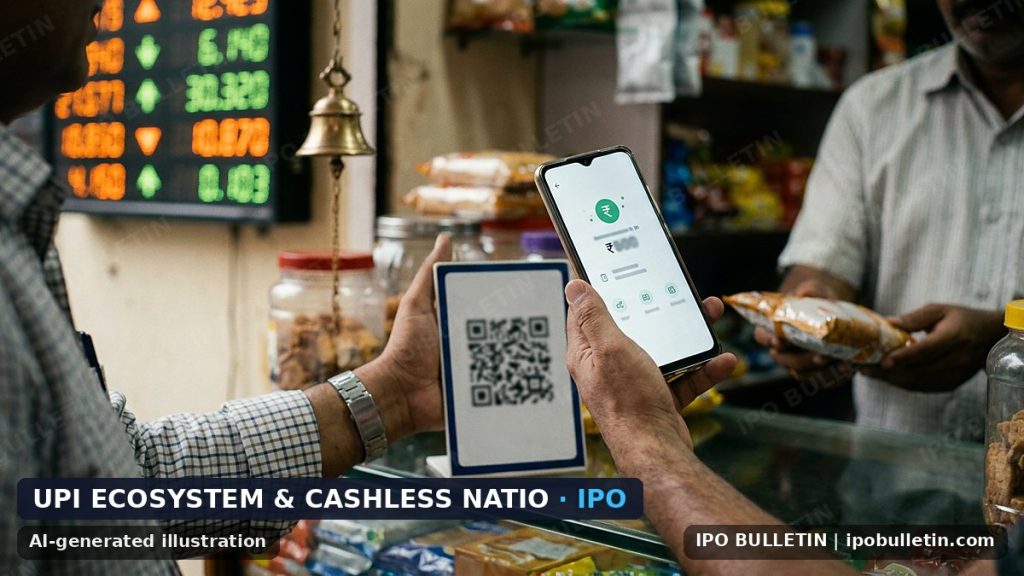
MUMBAI / NEW DELHI, NOVEMBER 15, 2026 — An analytical assessment of India’s rapid migration toward digital transactions, chronicled in the publication Cashless Nation, underscores how the Unified Payments Interface (UPI) developed by the National Payments Corporation of India (NPCI) transformed banking rails from proprietary cost centers into interoperable public utility infrastructure. On Sunday, November 15, 2026, financial market observers reviewed the structural mechanics that propelled UPI past peer global payment rails, highlighting implications for listed commercial banks, payment aggregators, and tech platforms.
Key Takeaways at a Glance
- Infrastructure Transition: Zero-merchant-discount-rate (Zero-MDR) policies established high user volume but forced payment aggregators to pivot toward lending distribution and software service cross-selling.
- Volume Expansion: Unified digital rails reduced cash handling expenses across the retail value chain while expanding merchant formalization for credit underwriting.
- Regulatory Watch: Market share concentration limits and merchant interchange discussions remain core variables monitored by institutional equity research desks.
UPI Infrastructure Evolution: Key Regulatory & Operational Milestones
According to research documented in Cashless Nation and verified by reporting from Livemint, India’s payments transformation was engineered through deliberate regulatory architecture initiated by the Reserve Bank of India (RBI) and implemented via NPCI. Rather than creating closed-loop mobile wallets, the architecture linked bank accounts directly through interoperable virtual payment addresses.
| Milestone triggers | Calendar Timeline |
|---|---|
| UPI Pilot Launch by NPCI with 21 Member Banks | April 11, 2016 |
| Implementation of Zero-MDR Policy on UPI P2M Transactions | January 1, 2020 |
| Linkage of RuPay Credit Cards on UPI Network | September 20, 2022 |
| Pre-Sanctioned Credit Lines Enabled on UPI Rails | September 4, 2023 |
Comparative Metrics: Digital Rail Interoperability vs Traditional Cards
To understand the commercial displacement detailed in Cashless Nation, equity research analysts track fee compression and network volume migration. While point-of-sale card networks charge merchant discount rates ranging between 1.0% and 2.0%, standard peer-to-merchant UPI remains free from merchant-borne transaction fees for small retail ticket sizes.
| Operating Parameter | Unified Payments Interface (UPI) | Point-of-Sale Card Networks |
|---|---|---|
| Merchant Discount Rate (MDR) on Basic P2M | 0.00% | 1.00% – 2.00% |
| Settlement Protocol Speed | Real-Time Immediate (T+0) | Batch Clearing (T+1 / T+2) |
| Hardware Onboarding Overhead | Static / Dynamic QR Display | Electronic Data Capture (EDC) Terminal |
Fintech Unit Economics: The Shift from Payment Fees to Financial Intermediation
Fundamental research tracking digital payments on Screener.in and broker notes from Motilal Oswal indicate that the absence of standard transaction MDR forced consumer-facing apps to rethink monetization. Platforms could not build sustainable businesses solely on transaction processing fees.
Consequently, fintech entities adapted their unit economics by deploying payment volume as a customer acquisition funnel. The data trails generated by high-frequency micro-transactions enabled algorithmic underwriting for unsecured working capital loans, device rentals (such as soundboxes), and mutual fund distribution. This commercial adaptation directly influenced capital raising across primary markets, as visible in our live IPO calendar and primary market schedule and tracked on the recent IPO listing performance tracker.
As highlighted in regulatory discussions recorded on the Indian market indices dashboard, banking stocks within the Nifty Bank and Nifty Financial Services benchmarks experienced dual outcomes: savings account stickiness improved, but infrastructure outlays to maintain low technical decline rates surged.
Structural Strengths vs Systemic Headwinds for Digital Rail Expansion
An objective market review requires balancing network advantages against operational vulnerabilities:
- Structural Growth triggers:
- Frictionless account-to-account settlement removing intermediary interchange barriers.
- Integration of credit lines and RuPay credit cards providing a path toward transactional monetization.
- Cross-border linkage agreements expanding real-time remittance rails across international jurisdictions.
- Operational & Regulatory Headwinds:
- High core banking infrastructure costs incurred by lenders without direct transactional revenue recovery.
- Market concentration where two primary third-party applications control a substantial percentage of total transaction volume.
- Rising frequency of social engineering fraud requiring increased compliance and cyber security provisions.
What to check when analyzing listed payment companies
- Examine the share of revenue derived from software subscriptions and soundbox hardware rentals versus pure payment processing.
- Audit loan distribution default rates and verify whether the balance sheet holds credit default risk or functions as an intermediary fee agent.
- Review payment processing charges (PPC) paid to sponsor banks relative to gross transaction value (GTV).
Frequently Asked Questions
How does UPI operate without charging merchant discount rates on basic retail transactions?
The Government of India implemented a Zero-MDR mandate on UPI peer-to-merchant payments to accelerate digital adoption. Operating costs are partially supported through special budgetary allocation schemes for digital payment promotion, while fintech platforms cross-subsidize payment processing by distributing financial products like merchant credit and soundbox hardware.
What impact does UPI growth have on listed Indian commercial banks?
Commercial banks benefit from reduced physical currency management expenses and higher low-cost Current Account Savings Account (CASA) balances. However, high-volume micro-transactions place sustained throughput demands on core banking server infrastructure, necessitating continuous technology capital expenditure to avoid technical transaction declines.
How does credit-on-UPI alter payment monetization for fintech companies?
By linking pre-sanctioned credit lines and RuPay credit cards to UPI handles, the network allows interchange fees to be charged on qualifying merchant transactions above ₹2,000. This framework provides an institutional avenue for payment aggregators and issuing banks to earn sustainable margins on digital credit transactions.
SEBI Compliance & Statutory Disclaimer
The information and analysis presented on IPO Bulletin (ipobulletin.com) are for informational and educational purposes only and do not constitute financial, investment, or legal advice. Securities market investments are subject to market risks; please read all offer documents (DRHP/RHP) thoroughly before committing capital. Grey Market Premium (GMP) figures are unofficial, unregulated street estimates. Always consult a SEBI-registered investment advisor before making financial decisions.
Sources referenced: Livemint, Reserve Bank of India, National Payments Corporation of India (NPCI) filings, Screener.in.
Reusing this article or its images? Credit IPO Bulletin and link to https://ipobulletin.com/news/upi-ecosystem-cashless-nation-digital/. Content licence.