
MUMBAI, NOVEMBER 15, 2026 — Leading market analysts highlighted Multi Commodity Exchange of India (MCX), BSE Limited, and Bharti Airtel as key large- and mid-cap equities to track, citing structural tailwinds across exchange derivatives turnover and telecom average revenue per user (ARPU) expansion. Regulatory filings and market updates published on Friday, November 13, and Sunday, November 15, 2026, outline resilient operational metrics for these market leaders against benchmark volatility on the Indian market indices dashboard.
Key Takeaways at a Glance
- Exchange Duopoly Drivers: BSE Limited and MCX continue to capture high operating leverage as retail and institutional options trading volumes consolidate on regulated national bourses.
- Telecom Balance Sheet Discipline: Bharti Airtel maintains sequential ARPU improvement, supported by premium 5G upgrades and sustained enterprise data expansion.
- Filing & Governance Visibility: Financial metrics compiled from quarterly submissions on BSE India and NSE India highlight debt reduction pathways and healthy Return on Net Worth (RoNW).
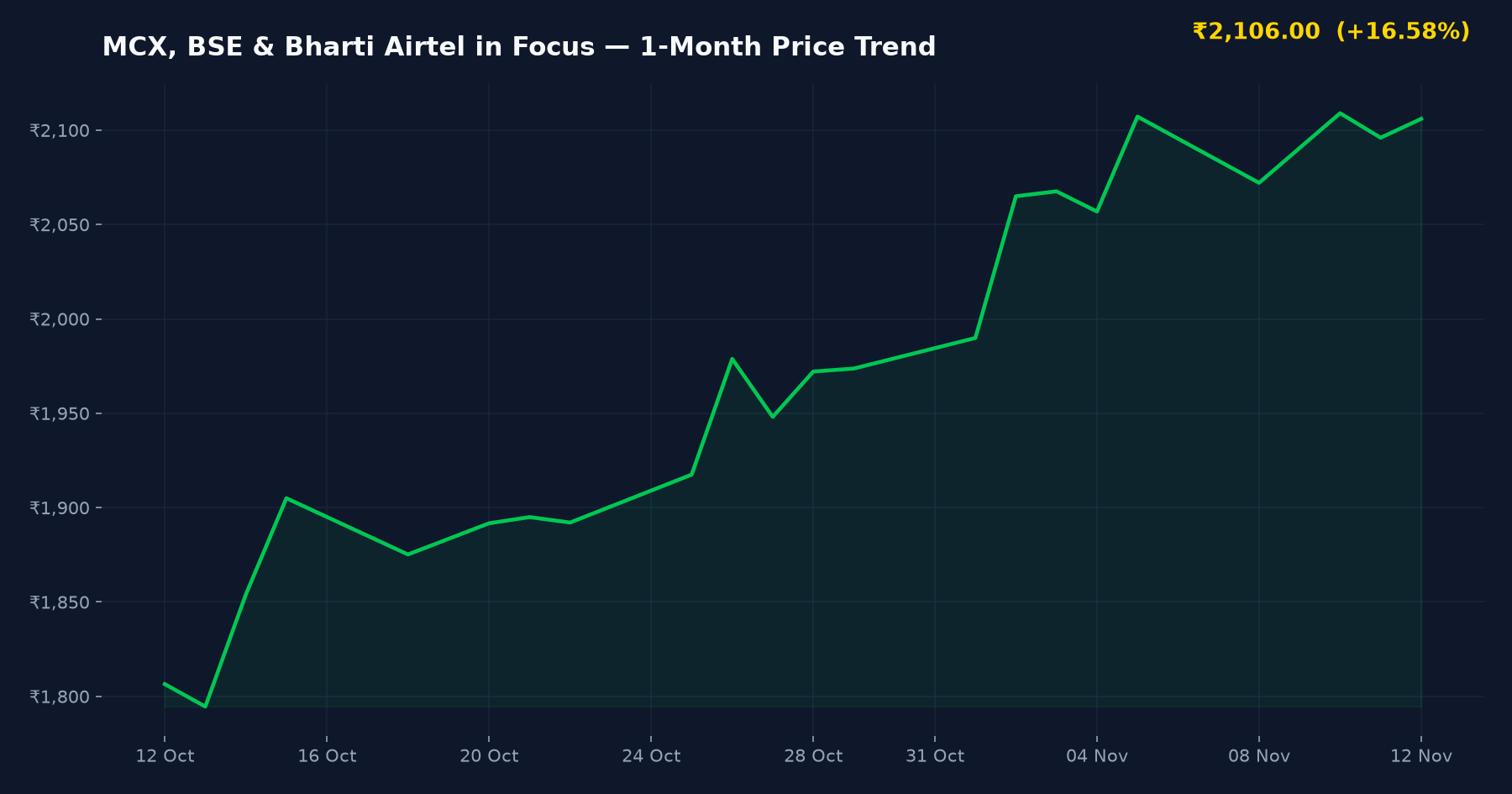
▲ +₹10.00 (+0.48%)
Day Range: ₹2,082.00 – ₹2,122.90
52W Range: ₹1,726.30 – ₹2,174.50
● Real-Time Feed
Market Calendar & Observation Schedule
The operational and market schedule tracking exchange disclosures and forthcoming earnings triggers for these companies is detailed below:
| Market Event / Disclosure Milestone | Calendar Date |
|---|---|
| Market Week Closing Disclosures (NSE & BSE) | November 13, 2026 |
| Expert Market Commentary Published (Livemint) | November 15, 2026 |
| Next Standard Trading Session Commences | November 16, 2026 |
Comparative Financial Parameters & Sector Roles
Each of the three tracked equities occupies a dominant infrastructure or utility position in the Indian economic landscape, benefiting from recurring transaction fees and non-discretionary communication consumption:
| Company Name | Primary Segment | Primary Listing Exchange |
|---|---|---|
| Multi Commodity Exchange of India (MCX) | Commodity Derivatives & Clearing | BSE, NSE |
| BSE Limited | Equity, Debt & Index Derivatives | NSE |
| Bharti Airtel Limited | Telecommunications & Digital Services | BSE, NSE |
Multi-Source Fundamental Analysis & triggers Breakdown
1. Multi Commodity Exchange of India: Technology Migration & Volume Scale
According to market research compiled by Livemint and institutional notes across leading brokerage desks, MCX has stabilized its commodity trading software infrastructure, unlocking operating margins that were previously depressed during vendor transition phases. The platform retains an overwhelming market share in energy and base metal contracts. Growth in options on commodity futures has expanded participant engagement among both retail traders and institutional algorithmic desks. Because an exchange business carries low incremental capital expenditure once software capacity is scaled, additional trading turnover translates directly into expanding operating leverage.
2. BSE Limited: Index Derivatives Market Share Expansion
Data published via BSE India and analyzed by platform trackers indicates that BSE has successfully built active liquidity in its benchmark derivative contracts, including the Sensex and Bankex expiries. Market observers note that the company continues to benefit from recurring listing fees, mutual fund platform transactions via BSE StAR MF, and services to market intermediaries. While regulatory interventions by the Securities and Exchange Board of India (SEBI) concerning derivatives contract sizing and weekly expiry limits have introduced moderation in retail turnover industry-wide, BSE’s diversified revenue profile provides structural balance against localized volume shifts.
3. Bharti Airtel: Tariff Realization & Enterprise Growth
In telecommunications, institutional tracking notes from domestic brokerages such as Motilal Oswal and ICICIdirect highlight Bharti Airtel’s strategic transition toward higher return on capital employed (ROCE). Regular tariff adjustments across mobile prepaid and postpaid plans, combined with customer upgrades to 5G packages, have consistently elevated average revenue per user (ARPU)—the industry’s critical metric measuring monthly recurring cash flow generated per SIM card. Furthermore, Airtel’s B2B enterprise division, Airtel Business, and its digital data center arm, Nxtra, provide compounding growth channels independent of consumer mobile cycles.
Investors evaluating capital deployment in primary offerings can also review our live IPO calendar and primary market schedule and analyze how newly listed tech and financial firms compare against heritage leaders on the recent IPO listing performance tracker.
Balanced Investor Framework: Structural triggers vs. Downside Risks
Market participation requires assessing the operational strengths alongside specific regulatory and macroeconomic headwinds:
Key Growth triggers
- Exchange Moats & High Operating Leverage: Both MCX and BSE operate licensed market infrastructure with steep regulatory entry barriers, high intellectual property moats, and low marginal costs per executed trade.
- Systemic Financialization: Expanding demat account penetration and systematic investment plan (SIP) inflows steadily elevate trading velocity and clearing house income.
- Telecom Industry Structure: The Indian telecommunications sector operates as a stable, consolidated three-player private market, enabling rational pricing discipline and long-term free cash flow generation.
Primary Risk Factors
- Regulatory Tightening on Derivatives: Direct policy shifts from SEBI concerning transaction charges, margin requirements, or retail derivative access could compress short-term turnover.
- Capital Expenditure Demands: For Bharti Airtel, ongoing network densification and spectrum debt servicing require substantial annual operating cash outflows.
- Valuation Multiples: After notable runs across exchange shares, multiples may already reflect significant earnings growth, leaving less margin of safety against cyclical equity pullbacks.
What to Check Before Investing
- Review the latest quarterly revenue run rates from exchange transactions versus non-transactional listing fees.
- Verify official regulatory circulars from SEBI concerning equity derivatives framework adjustments.
- Check Bharti Airtel’s net debt-to-EBITDA ratio and reported ARPU trajectories in official filings submitted to NSE and BSE.
- Assess historical price-to-earnings (P/E) bands relative to three-year and five-year median valuations on Screener.in or Trendlyne.
Frequently Asked Questions
What factors are supporting the operational momentum of MCX and BSE?
Both market infrastructure institutions benefit from structural growth in trading activity across commodity and equity derivatives. High operating leverage ensures that additional volume growth requires minimal incremental overhead, directly boosting operational margins.
How does tariff expansion affect Bharti Airtel’s financial profile?
Sequential tariff revisions directly raise average revenue per user (ARPU), enhancing cash generation across consumer mobility segments. This operating cash flow supports ongoing debt repayment for 5G spectrum purchases while funding enterprise cloud and digital infrastructure investments.
What regulatory risks should investors monitor for financial exchange stocks?
Investors must track SEBI guidelines regarding derivative contract expiries, minimum lot sizes, and retail risk containment measures. Policy changes that reduce speculative trading velocity can temper transaction-fee growth for market operators.
SEBI Compliance & Statutory Disclaimer
The information and analysis presented on IPO Bulletin (ipobulletin.com) are for informational and educational purposes only and do not constitute financial, investment, or legal advice. Securities market investments are subject to market risks; please read all offer documents (DRHP/RHP) thoroughly before committing capital. Grey Market Premium (GMP) figures are unofficial, unregulated street estimates. Always consult a SEBI-registered investment advisor before making financial decisions.
Sources referenced: Livemint, BSE India filings, NSE India disclosures, Screener.in, Motilal Oswal research.
Reusing this article or its images? Credit IPO Bulletin and link to https://ipobulletin.com/news/mcx-bse-bharti-airtel-focus/. Content licence.