

MUMBAI / NEW DELHI, NOVEMBER 08, 2026 — During market assessment on Sunday, November 08, 2026, global institutional allocators accelerated portfolio rotations away from overstretched artificial intelligence (AI) counters toward diversified Asian markets, anchoring India’s Nifty 50 comfortably above the 25,000 threshold as domestic equities enter Samvat 2083. The reallocation follows a turbulent week across international exchanges, where an estimated $2.3 trillion was wiped from Wall Street after the Nasdaq 100 plummeted 6.00% on Friday, November 06, 2026, triggering acute declines across South Korean and Japanese hardware exporters alongside domestic tech equipment plays.
Key Takeaways at a Glance
- Global De-Rating Trigger: A 6.00% drop in the Nasdaq 100 erased $2.3 trillion in equity value on November 06, 2026, sparked by macroeconomic recalculations following the US election cycle.
- Regional Hardware Contagion: South Korea’s KOSPI plunged 8.00% below the 5,000 level while Japan’s Nikkei 225 shed 5.00%, dragging bellwethers Samsung Electronics and SK Hynix.
- Domestic Market Resilience: Despite a 7.00% intraday drop in Indian server provider Netweb Technologies and falls of up to 8.00% in ancillary names, benchmark indices on NSE India retained key support above 25,000.
NIFTY 50
INDEX
▲ +₹493.75 (+2.01%)
Day Range: ₹24,388.05 – ₹25,030.35
52W Range: ₹22,179.90 – ₹26,373.20
● Real-Time Feed
Timeline of the Global AI Retrenchment & Asian Market Impact
The reassessment of capital expenditure returns in the technology sector created concentrated volatility across trading hubs. The table below outlines verified market developments as reported across exchange filings and primary financial trackers:
| Market triggers Milestone | Exact Calendar Date |
|---|---|
| US Midterm Election Results Drive Tech Capex Re-Evaluation | November 05, 2026 |
| Wall Street Nasdaq 100 Drops 6.00%; $2.3 Trillion Value Erased | November 06, 2026 |
| South Korea KOSPI Crashes 8.00%; Nikkei 225 Drops 5.00% | November 06, 2026 |
| Indian Equities Open Samvat 2083 with Nifty 50 Above 25,000 | November 07, 2026 |
| Global Fund Rotation into Indian and Chinese Domestic Proxies | November 08, 2026 |
Core Valuation Multiples & Market Performance Metrics
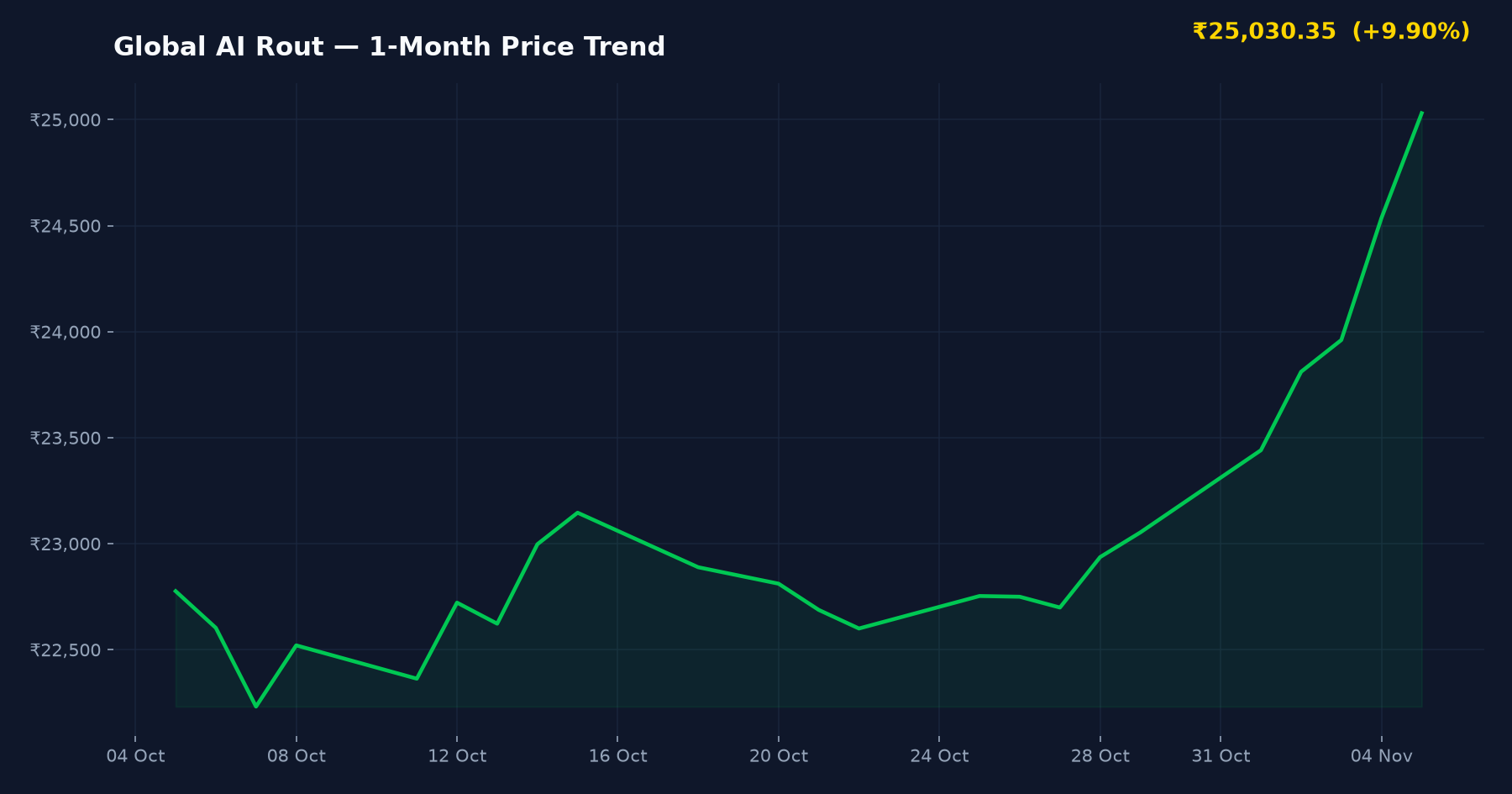
The dislocation in global tech benchmarks has highlighted stark performance divergences between pure-play semiconductor supply chains and broader domestic indices. The metrics below capture the magnitude of the November 06 drawdown across key market gauges:
| Index / Equity Asset Class | Key Performance Metric |
|---|---|
| Wall Street Total Market Cap Contraction | $2.30 Trillion |
| US Nasdaq 100 Index Single-Day Fall | -6.00% |
| South Korea KOSPI Benchmark Drawdown | -8.00% |
| Japan Nikkei 225 Benchmark Drawdown | -5.00% |
| Netweb Technologies 1-Day Stock Drop | -7.00% |
| Netweb Technologies 7-Day Cumulative Decline | -15.00% |
| Nifty 50 Baseline Level for Samvat 2083 | > 25,000 |
Global Tech Capex Reassessment & Domestic Ripple Effects
According to market reports by Livemint and Moneycontrol, the selloff gained velocity following election results in the United States, prompting hedge funds and institutional desks to reassess lofty price-to-earnings (P/E) multiples across enterprise tech. In Seoul, the KOSPI dropped below the 5,000 benchmark level as heavyweight semiconductor fabricators Samsung Electronics and SK Hynix witnessed intense selling pressure. Taiwan and Tokyo experienced corresponding pressure as the Nikkei 225 retreated 5.00%.
In India, the global tech rout spilled over into domestic AI equipment and power infrastructure providers on Friday, November 06. High-end computing solutions provider Netweb Technologies cracked over 7.00% intraday, extending its seven-day cumulative loss to 15.00%. Ancillary beneficiaries of data center expansion, including CG Power, MTAR Technologies, and Hitachi Energy India, also declined by up to 8.00% during intraday trade on the Indian market indices dashboard.
Why Global Allocators Are Pivoting Toward India & China
Despite the drag on localized tech names, institutional flows indicate a broader rotation into previously lagging Asian emerging markets. Financial commentary from Business Standard highlights that international funds are shifting allocations from hyper-concentrated US technology equities into value-oriented segments in China and growth-insulated plays in India.
Unlike export-dependent East Asian economies that rely heavily on semiconductor hardware cycles, the broader Indian equity market benefits from robust domestic consumption, infrastructure capital outlay, and defensive banking sectors. As Indian bourses welcomed Samvat 2083 on Saturday, November 07, 2026, the Nifty 50 preserved its baseline above 25,000, buoyed by domestic institutional support and corporate balance sheets displaying low debt-to-equity ratios. Primary market activity has also demonstrated steady absorption, as tracked on the recent IPO listing performance tracker.
Balanced Investor Framework: Structural triggers vs. Downside Risks
Investors monitoring sector rotations must weigh multiple opposing forces influencing equity valuations across international and domestic exchanges:
Growth triggers Supporting Capital Rotation
- Diversified Earnings Base: Indian benchmarks feature lower direct exposure to the semiconductor manufacturing cycle, leaning instead on diversified banking, automotive, and domestic infrastructure sectors.
- Relative Valuation Attractiveness: Following the $2.3 trillion drawdown in US mega-cap tech, global fund mandates are enforcing geographic diversification across developing Asia.
- Strong Domestic Balance Sheets: Leading non-financial corporates listed on BSE and NSE India maintain resilient return on net worth (RoNW) and manageable debt profiles entering Samvat 2083.
Key Downside Risks to Monitor
- Valuation Multiples in Premium Midcaps: Niche tech equipment providers still trade at elevated historical price-to-earnings multiples relative to broader industrial peers.
- Foreign Portfolio Outflows: Unwinding of systemic leveraged tech positions on Wall Street could trigger short-term liquidity repatriation across emerging markets.
- Slowing Enterprise IT Budgets: Extended delays in enterprise AI return on investment (ROI) could dampen forward contract renewals for domestic software exporters.
What to Check Before Reallocating Capital During Market Rotations
- Examine the price-to-earnings (P/E) multiple of high-beta tech equipment stocks against their 3-year median valuation.
- Review quarterly revenue concentration to identify whether order books depend on international data center capex or stable domestic contracts.
- Assess foreign institutional investor (FII) and domestic institutional investor (DII) net flow figures published daily by BSE and NSE India.
- Verify debt-to-equity ratios and free cash flow generation across capital goods suppliers before entering pullbacks.
Frequently Asked Questions
Why did global AI and tech stocks experience a sharp selloff on November 06, 2026?
Global technology stocks slumped following a reassessment of AI infrastructure spending and legislative shifts resulting from the US elections. The Nasdaq 100 dropped 6.00%, erasing approximately $2.3 trillion in market value, which spilled over into Asian chipmakers like Samsung Electronics and SK Hynix, pulling South Korea’s KOSPI down 8.00%.
How did the global tech rout impact Indian AI-related stocks like Netweb Technologies?
Domestic companies with exposure to AI hardware and data center infrastructure saw immediate profit booking on Friday, November 06. Netweb Technologies fell over 7.00% intraday, bringing its 7-day cumulative decline to 15.00%, while power and component suppliers including CG Power, MTAR Technologies, and Hitachi Energy India slipped up to 8.00%.
Why are institutional investors shifting focus toward India and China amidst the AI slump?
Investors are seeking portfolio diversification outside of concentrated US tech holdings whose valuations expanded significantly over recent quarters. India and China offer domestic-driven growth stories with lower direct reliance on the global semiconductor capex cycle, allowing Indian benchmarks like the Nifty 50 to maintain stability above the 25,000 mark into Samvat 2083.
SEBI Compliance & Statutory Disclaimer
The information and analysis presented on IPO Bulletin (ipobulletin.com) are for informational and educational purposes only and do not constitute financial, investment, or legal advice. Securities market investments are subject to market risks; please read all offer documents (DRHP/RHP) thoroughly before committing capital. Grey Market Premium (GMP) figures are unofficial, unregulated street estimates. Always consult a SEBI-registered investment advisor before making financial decisions.
Sources referenced: Livemint, Moneycontrol, Business Standard, BSE India, NSE India.
Reusing this article or its images? Credit IPO Bulletin and link to https://ipobulletin.com/news/global-ai-rout-capital-rotates/. Content licence.