
MUMBAI / NEW DELHI, OCTOBER 29, 2026 — During trading on Thursday, shares of Mahindra Lifespace Developers Ltd were in focus after the Mumbai-based realty firm reported a 66% year-on-year jump in half-yearly sales bookings to ₹1,988 Crore for April to September 2026, driven by strong residential bookings and steady collection velocity across key metropolitan micro-markets, according to regulatory filings submitted to the BSE and NSE.
Key Takeaways at a Glance
- H1 Operational Pre-Sales: Total booking value expanded 66% year-on-year to ₹1,988 Crore during the first half of FY27 (April–September 2026).
- Q2 Quarterly Traction: Second-quarter sales bookings increased to ₹1,063 Crore, up from ₹752 Crore recorded in the corresponding quarter of the previous fiscal year.
- Earnings Print: Net profit for the September 2026 quarter stood at ₹16.34 Crore, with total quarterly income reaching ₹104 Crore.
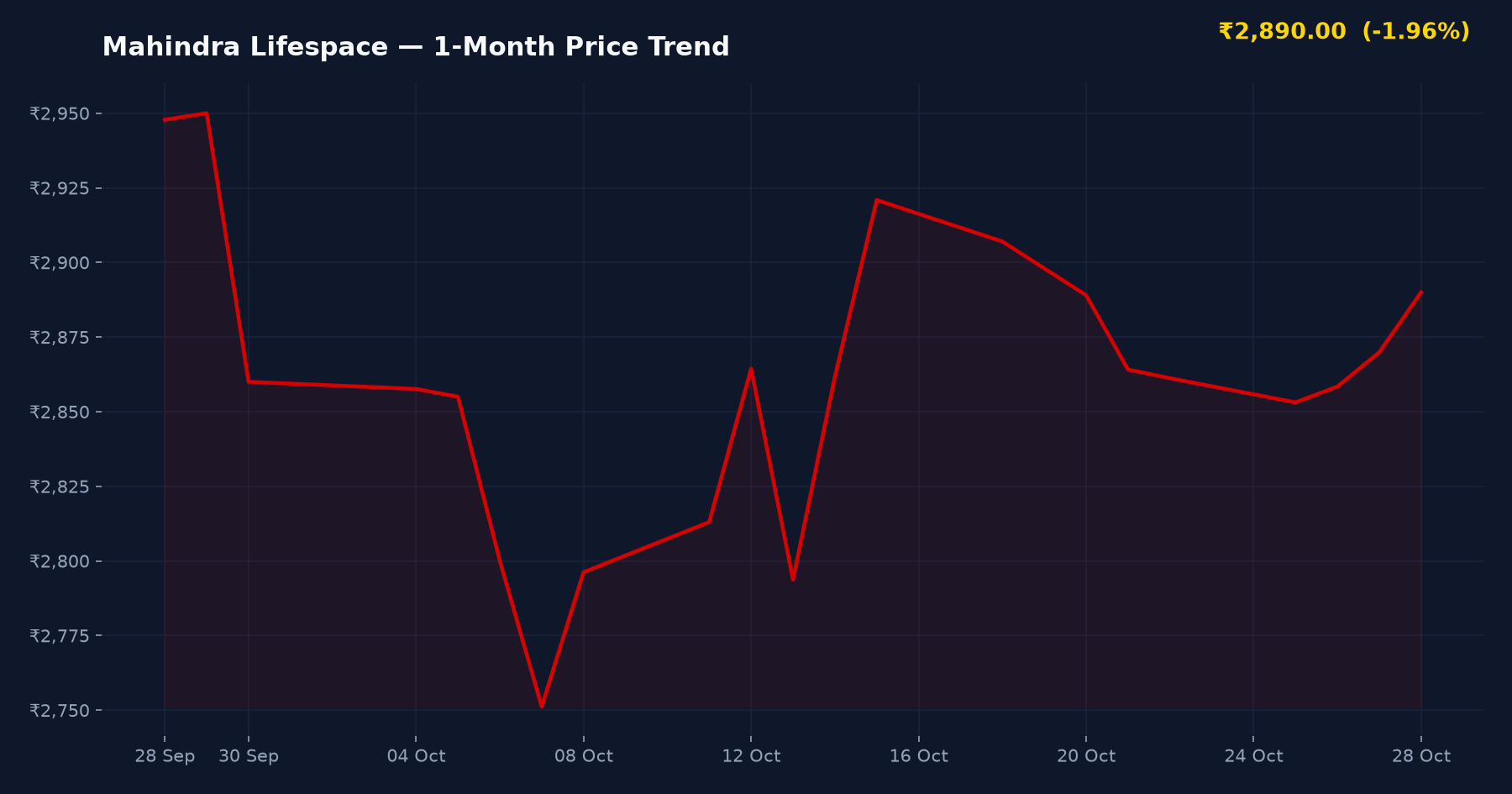
Mahindra Lifespace
NSE: M&M
▲ +₹20.10 (+0.70%)
Day Range: ₹2,856.20 – ₹2,912.90
52W Range: ₹2,744.30 – ₹3,839.90
● Real-Time Feed
Mahindra Lifespace Developers Earnings & Operational Milestone Schedule
The company announced its mid-year financial and operational operational performance in compliance with Regulation 30 of the SEBI (Listing Obligations and Disclosure Requirements) Regulations, 2015. Key corporate milestones for the period are summarized below:
| Event / Corporate triggers | Exact Calendar Date |
|---|---|
| Q2 & H1 FY27 Performance Disclosures | October 29, 2026 |
| H1 Period End (April–September 2026) | September 30, 2026 |
Operational Pre-Sales & Q2 Financial Metrics
Mahindra Lifespace Developers Ltd, the real estate and infrastructure development arm of the Mahindra Group, experienced significant pre-sales booking expansion across its residential portfolio. Pre-sales represent contractually committed purchases by home buyers prior to final revenue recognition, which under Ind AS 115 accounting standards occurs upon project completion and possession.
| Operational / Financial Parameter | Reported Figure |
|---|---|
| H1 Pre-Sales Booking Value (Apr–Sep 2026) | ₹1,988 Crore |
| H1 Pre-Sales Booking Growth (YoY) | 66% |
| Q2 Pre-Sales Booking Value (Jul–Sep 2026) | ₹1,063 Crore |
| Q2 Pre-Sales in Prior Year Period (Jul–Sep 2025) | ₹752 Crore |
| Q2 Standalone/Consolidated Net Profit | ₹16.34 Crore |
| Q2 Total Income | ₹104 Crore |
In-Depth Analysis: Pre-Sales Trajectory & Revenue Realization Dynamics
The real estate developer’s performance demonstrates a noticeable pickup in new home buyer inquiries and conversions across mid-premium and premium residential segments. During Q2 FY27, bookings moved from ₹752 Crore to ₹1,063 Crore, reflecting an increase of 41.3% quarter-over-quarter comparison against the previous fiscal’s base.
In corporate filings accessed through exchange portals and research aggregated on platforms such as Screener.in and Trendlyne, the broader real estate sector has seen active capital reallocation. Investors tracking the broader Indian market indices dashboard will observe that mid-cap real estate developers have prioritized land acquisitions via joint development agreements (JDAs) to limit upfront debt while scaling inventory pipelines.
Accounting Nuances & Tax Impact on Stated Net Profit
While pre-sales expanded to nearly ₹2,000 Crore over the six-month horizon, reported net profit for the September quarter stood at ₹16.34 Crore on total income of ₹104 Crore. Real estate accounting standards require developers to recognize revenue only when control of the property passes to the buyer upon completion (the percentage-of-completion method is no longer utilized under Ind AS 115). Consequently, strong operational pre-sales recorded in Q2 will translate into recognized revenue and operational cash flows over a 24- to 36-month construction cycle.
Additionally, the company witnessed higher tax provisions during the quarter, which impacted bottom-line conversion despite income rising to ₹104 Crore. Primary market participants tracking capital recycling from the live IPO calendar and primary market schedule often monitor balance sheet leverage and land-bank addition rates to evaluate medium-term cash flow predictability.
Balanced Investor Framework: Growth triggers vs. Downside Risks
An objective review of Mahindra Lifespace Developers balances ongoing operational momentum against structural sector risks:
Key Operational Strengths & triggers
- Brand Equity and Governance: Backed by the Mahindra Group, the company benefits from strong institutional credibility, which aids in securing redevelopment and JDA rights in high-barrier markets like the Mumbai Metropolitan Region (MMR) and Pune.
- Accelerating Sales Velocity: H1 pre-sales reaching ₹1,988 Crore (+66% YoY) confirms solid demand absorption and pricing power in active project launches.
- Industrial Cluster Synergies: Beyond residential projects, the company operates integrated industrial cities (Mahindra World City) that generate recurring industrial lease revenues and long-term land monetization.
Key Downside Risks & Watch Points
- Lumpy Revenue Recognition: Due to project-completion-based accounting, quarterly net profit prints remain uneven and may not directly correlate with concurrent quarterly pre-sales figures.
- Input Cost Pressures: Volatility in key raw materials, including cement and structural steel, poses margin risks on fixed-price or early-stage inventory sales.
- Execution and Approval Lead Times: Regulatory bottlenecks in municipal approvals can delay planned launch timelines, temporarily dampening booking momentum.
What to Check Before Allocating Capital
- Operating Cash Flows: Verify whether pre-sales growth translates into direct customer collections and reduced operating debt.
- Launch Pipeline Timeline: Check the RERA-registered launch dates and prospective gross development value (GDV) of upcoming residential phases.
- Valuation Multiples vs. Listed Peers: Compare trailing price-to-book (P/B) and enterprise value-to-EBITDA multiples with listed peers such as Godrej Properties, Oberoi Realty, and Sunteck Realty using platforms like Screener.in.
- Debt-to-Equity Position: Monitor net debt levels to ensure land acquisition financing remains sustainable across market cycles.
Frequently Asked Questions
How do pre-sales differ from reported revenue for Mahindra Lifespace?
Pre-sales bookings represent the total contract value of residential units booked by buyers during the period. Under Ind AS 115, this booking value cannot be recognized as accounting revenue on the income statement until the project achieves completion and legal possession is handed over, creating a structural time lag between booking expansion and stated net profit.
What drove the 66% growth in pre-sales during April–September 2026?
The 66% jump to ₹1,988 Crore was supported by strong conversion rates across core metropolitan residential projects and steady launch traction in Q2, where quarterly bookings rose from ₹752 Crore to ₹1,063 Crore compared to the previous fiscal year.
Where can investors verify Mahindra Lifespace regulatory disclosures?
Investors can review verified quarterly financial results, investor presentations, and operational updates directly on the corporate filing portals of BSE India and NSE India, or cross-reference real estate sector performance on the recent IPO listing performance tracker.
SEBI Compliance & Statutory Disclaimer
The information and analysis presented on IPO Bulletin (ipobulletin.com) are for informational and educational purposes only and do not constitute financial, investment, or legal advice. Securities market investments are subject to market risks; please read all offer documents and corporate filings thoroughly before committing capital. Always consult a SEBI-registered investment advisor before making financial decisions.
Sources referenced: BSE India filings, NSE India disclosures, The Economic Times, Screener.in
Reusing this article or its images? Credit IPO Bulletin and link to https://ipobulletin.com/2026/10/mahindra-lifespace-h1-pre-sales-surge.html. Content licence.