

MUMBAI, OCTOBER 28, 2026 — Ahead of Wednesday’s session, shares of pharmaceutical major Cipla Limited remained under scrutiny following the release of its quarterly financial results for the quarter ended September 30, 2026. The drugmaker reported a 35% year-on-year drop in consolidated net profit to ₹878 Crore alongside a 2.4% contraction in revenue from operations, weighed down by high-base comparisons and pricing headwinds in its United States formulation business, according to regulatory filings submitted to the BSE India and NSE India.
Key Takeaways at a Glance
- Profitability & Revenue Contraction: Cipla reported Q2 consolidated net profit of ₹878 Crore, sliding 35% year-on-year, while total operating revenue declined 2.4% against a elevated baseline.
- Domestic Market Defense: Strong prescription momentum in Indian branded formulations and chronic respiratory therapies partially countered offshore pricing pressure.
- Pipeline triggers Ahead: Long-term growth targets center on complex respiratory filings in North America and strategic biosimilar partnerships, including the recent Keytruda collaboration.
Cipla Share Price Drops
NSE: CIPLA
▼ ₹5.00 (-0.37%)
Day Range: ₹1,319.00 – ₹1,372.70
52W Range: ₹1,165.70 – ₹1,593.30
● Real-Time Feed
Cipla Corporate triggers & Financial Reporting Timeline
The quarterly print reflects shifting dynamics between established generic portfolios in regulated markets and expansion across domestic therapy categories. The following timeline outlines verified corporate events and disclosures recorded across exchange databases:
| Milestone / Corporate Event | Confirmed Calendar Date |
|---|---|
| Q4 FY26 Financials Disclosed (8% Share Price Gain) | May 14, 2026 |
| Q1 Financials Disclosed (Net Profit Up 42% QoQ) | July 24, 2026 |
| Keytruda Biosimilar Agreement Announced with Qilu | September 04, 2026 |
| Q2 Financial Results Approved by Board of Directors | October 27, 2026 |
Cipla Q2 Financial Snapshot & Operational Metrics
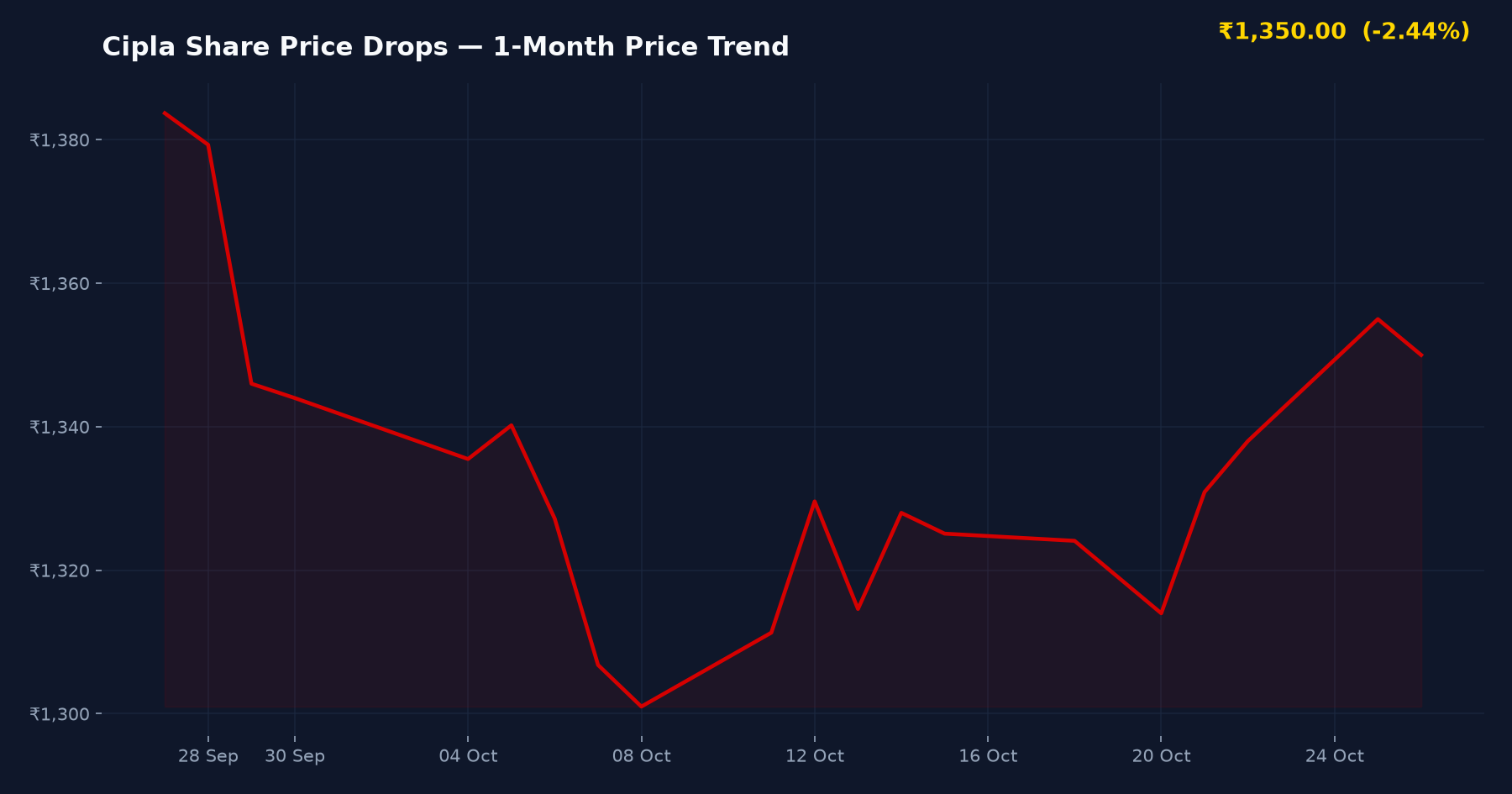
According to exchange filings compiled via Moneycontrol and corporate data platforms, Cipla faced temporary margin compression during the September quarter, driven primarily by channel supply variations in North America alongside research investments in complex generics:
| Financial Metric | Q2 FY27 Reported Data |
|---|---|
| Consolidated Net Profit | ₹878 Crore |
| Net Profit Year-on-Year Growth | -35% |
| Consolidated Revenue Year-on-Year Growth | -2.4% |
| Primary Listing Exchanges | NSE & BSE |
In-Depth Analysis: US Market Base Effects and Domestic Growth Drivers
The 35% contraction in net profit highlights the sensitivity of Indian formulation exporters to cyclical shifts in North American pricing. In the corresponding quarter of the prior financial year, Cipla benefited from an exceptionally elevated base supported by strong institutional demand and limited generic competition for key products such as Lanreotide and generic Albuterol. For market participants reviewing defensive sectors via our Indian market indices dashboard, Cipla’s performance serves as a bellwether for the broader Nifty Pharma basket.
Domestic Prescription Franchise Provides Operating Buffer
While North American revenue experienced moderation, Cipla’s India formulations business registered steady sequential gains. The company’s leadership across respiratory therapies, anti-infectives, and chronic care branded formulations sheltered consolidated gross margins from steeper contraction. Field-force productivity and continuous penetration into Tier-2 and Tier-3 healthcare delivery networks supported volume-led growth across domestic pharmacies.
Biosimilar Pipeline and Specialty Generic Strategy
To transition beyond plain-vanilla oral solid dosage forms, Cipla continues to redirect free cash flow toward specialty platforms and biosimilars (generic biological medical products that have no clinically meaningful differences from an existing reference medicine). On September 4, 2026, the company entered into an agreement with Qilu for a biosimilar candidate referencing Merck’s oncology drug Keytruda. Although near-term pricing competition remains an investor concern, brokerage assessments from Anand Rathi and Motilal Oswal previously indicated that complex respiratory filings and inorganic portfolio acquisitions represent critical drivers for structural margin recovery over the next 24 to 36 months.
Balanced Investor Framework: triggers vs. Downside Risks
Evaluating pharmaceutical companies requires analyzing pipeline execution against regulatory and compliance variables:
- Growth triggers: Expansion in domestic chronic branded formulations, planned rollouts of differentiated peptide and inhalation assets in the US, and inorganic bolt-on acquisitions in specialty therapies.
- Downside Risks: Intensified price erosion across US generics, delays in key manufacturing plant regulatory clearances by the US FDA, and rising clinical trial expenses associated with oncology biosimilars.
What to Check Before Investing
- Review the upcoming quarterly US revenue run-rate and any price erosion updates disclosed in management concall transcripts.
- Track domestic formulation market share gains across respiratory and cardiovascular portfolios relative to secondary audit benchmarks like IQVIA.
- Monitor regulatory inspection reports and Form 483 issuance statuses for key active pharmaceutical ingredient (API) and formulation facilities.
- Assess overall capital allocation efficiency and timeline targets for newly signed biosimilar commercialization deals.
Investors monitoring newly listed healthcare enterprises can also cross-examine industry valuations using our recent IPO listing performance tracker to track sector-wide multiples.
Frequently Asked Questions
Why did Cipla net profit decline in the September 2026 quarter?
Cipla consolidated net profit fell 35% year-on-year to ₹878 Crore primarily due to a high base effect in the US business during the prior year, alongside pricing pressure in mature generic categories. Operating margin compression and higher development costs in specialty pipelines also contributed to the decline.
How did the domestic India business perform during Q2?
Cipla India formulations business delivered resilient sequential expansion, anchored by sustained prescription demand across chronic respiratory and branded therapy segments. This domestic stability provided operational cash flow that partially insulated consolidated earnings from US headwinds.
What strategic steps is Cipla taking to accelerate future growth?
The company is scaling investments in complex respiratory therapies and biosimilar assets, including its September 2026 partnership with Qilu for a Keytruda biosimilar candidate. Management is also actively reviewing inorganic acquisition opportunities to strengthen its specialty healthcare footprint.
SEBI Compliance & Statutory Disclaimer
The information and analysis presented on IPO Bulletin (ipobulletin.com) are for informational and educational purposes only and do not constitute financial, investment, or legal advice. Securities market investments are subject to market risks; please read all offer documents (DRHP/RHP) thoroughly before committing capital. Grey Market Premium (GMP) figures are unofficial, unregulated street estimates. Always consult a SEBI-registered investment advisor before making financial decisions.
Sources referenced: BSE India filings, NSE India filings, Moneycontrol, Livemint, Economic Times Markets Feed.
Reusing this article or its images? Credit IPO Bulletin and link to https://ipobulletin.com/2026/10/cipla-share-price-drops-q2.html. Content licence.