

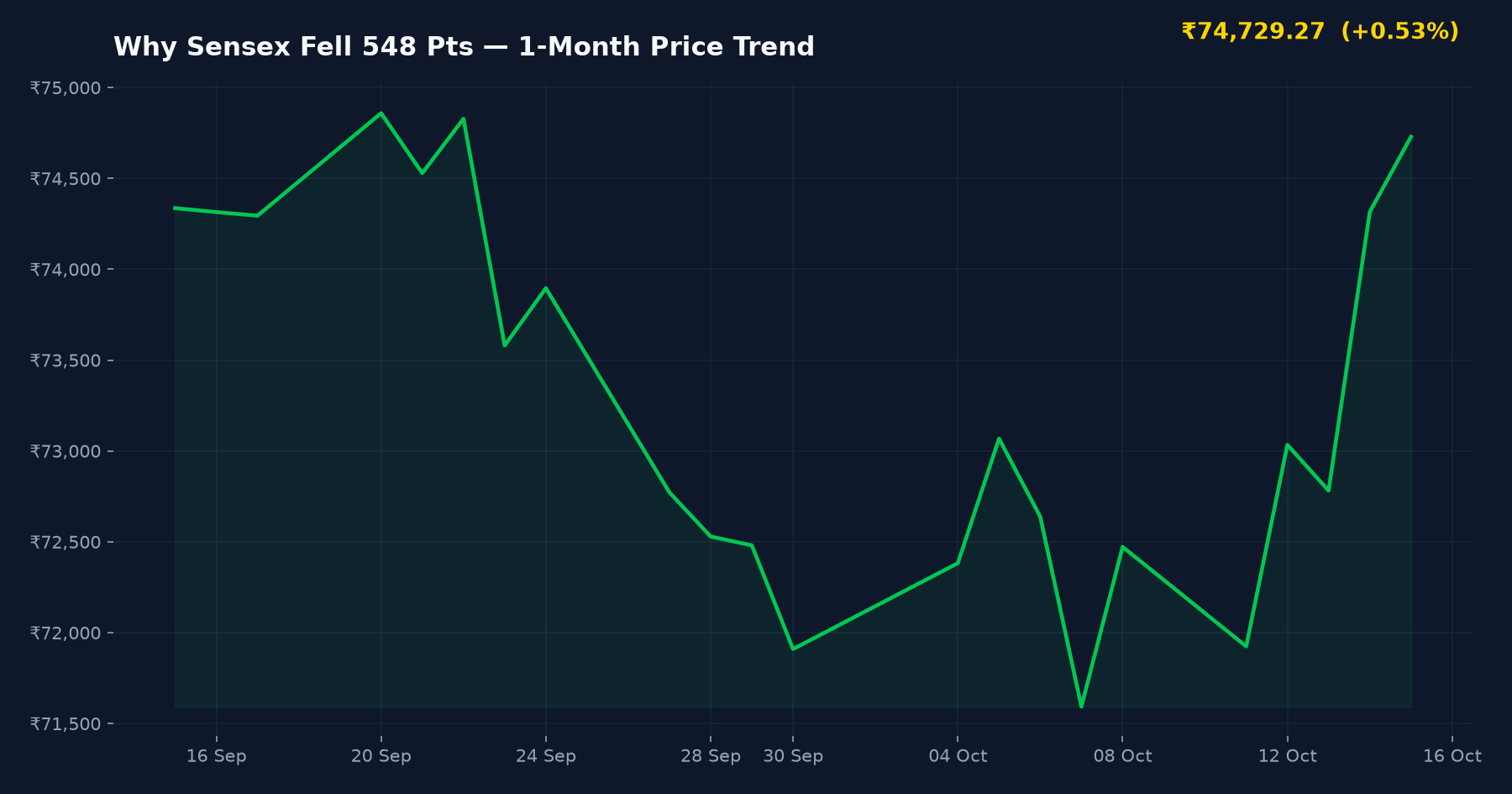
MUMBAI / NEW DELHI, OCTOBER 18, 2026 — During closing trade on Friday, October 17, 2026, the 30-share BSE Sensex experienced a significant downturn, shedding 547.65 points, or 0.76%, to settle at 71,924.68. This market correction was primarily attributed to a surge in international crude oil prices and persistent outflows by Foreign Institutional Investors (FIIs), erasing earlier intraday gains.
Key Takeaways at a Glance
- Market Performance: BSE Sensex declined by 547.65 points (0.76%) to close at 71,924.68 on October 17, 2026.
- Key Drivers: The downturn was primarily influenced by a spike in global crude oil prices and continued Foreign Institutional Investor (FII) selling.
- Intraday Volatility: The index had slumped as much as 796.23 points (1%) to 71,676.10 during intraday trading before paring some losses.
SENSEX
INDEX
▲ +₹413.67 (+0.56%)
Day Range: ₹74,012.99 – ₹74,778.78
52W Range: ₹71,292.88 – ₹86,159.02
● Real-Time Feed
Key Market Movements & triggers Timeline
| Event / triggers Milestone | Exact Calendar Date |
|---|---|
| Sensex & Nifty outlook (Livemint) | October 15, 2026 |
| Sensex jumps 1,534 points (Livemint) | October 15, 2026 |
| Sensex settles 1,500 pts higher (Moneycontrol) | October 15, 2026 |
| Sensex & Nifty outlook (Livemint) | October 16, 2026 |
| US bond yields impact alert (Livemint) | October 16, 2026 |
| GIFT Nifty signals positive start (Moneycontrol) | October 16, 2026 |
| Sensex closes with 0.76% decline | October 17, 2026 |
Key Market Metrics on October 17, 2026
| Parameter | Verified Detail |
|---|---|
| BSE Sensex Closing Price | 71,924.68 |
| Sensex Point Drop | 547.65 points |
| Sensex Percentage Drop | 0.76% |
| Intraday Low | 71,676.10 |
| Primary Market Drivers | Crude Oil Price Spike, FII Outflows |
Market Dynamics: Crude Oil & FII Outflows Weigh on Sentiment
The Indian equity benchmark, Sensex, witnessed a notable decline on Friday, October 17, 2026, primarily influenced by two significant external factors: a sharp rise in global crude oil prices and continued selling pressure from Foreign Institutional Investors (FIIs). According to reports from The Hindu Business & Markets, the 30-share index erased its initial gains to close in the red, reflecting broader market anxieties.
Rising crude oil prices are a critical concern for India, a major oil importer. Higher oil prices can lead to increased inflation, impact corporate margins, and widen the current account deficit, putting pressure on the Indian Rupee. This, in turn, can deter foreign investment and fuel inflationary expectations, prompting the Reserve Bank of India (RBI) to maintain a hawkish monetary policy stance. Investors closely monitor global commodity prices, especially crude, as they directly influence India’s economic stability and corporate profitability.
Concurrently, persistent Foreign Institutional Investor (FII) outflows have been a recurring theme, contributing to market volatility. FIIs, which are overseas entities investing in Indian markets, tend to withdraw capital when global risk aversion rises or when domestic factors like inflation, interest rate differentials, or geopolitical tensions become unfavorable. Data from exchanges like BSE India often reflects these selling trends, indicating a shift in foreign investor sentiment. This selling pressure can lead to a liquidity crunch and impact the overall demand-supply dynamics in the market, as observed in previous sessions detailed by Moneycontrol and Livemint.
Global Cues and Domestic Resilience
While global factors like crude oil and FII flows exert significant influence, the Indian market also takes cues from international developments, including US bond yields and the US Federal Reserve’s monetary policy. Reports on October 16, 2026, highlighted that US bond yields remained above 5%, a factor that often draws capital away from emerging markets like India. Despite these headwinds, domestic institutional investors (DIIs) often provide a cushion, absorbing some of the FII selling pressure. For a broader view of market performance, investors can refer to the Indian market indices dashboard.
Market Outlook: Bullish triggers vs. Bearish Risks
Understanding the prevailing market sentiment requires a balanced view of potential upside triggers and downside risks.
Potential Bullish triggers
- Domestic Demand: Strong underlying domestic economic growth and consumption could continue to support corporate earnings and equity valuations, offsetting some FII selling.
- Easing Global Inflation: A potential moderation in global inflation could lead to less aggressive monetary policies by central banks, including the US Fed, which might encourage FIIs to return to emerging markets.
- Strong Corporate Earnings: Robust quarterly results from Indian companies, particularly in key sectors, could instill confidence among investors and drive selective buying.
Key Bearish Risks
- Sustained High Crude Oil Prices: Prolonged elevation in crude oil prices could exacerbate inflationary pressures and further strain India’s current account, negatively impacting market sentiment.
- Continued FII Outflows: If global risk aversion persists or if the US dollar strengthens significantly, FIIs might continue to withdraw capital, leading to further market corrections.
- Global Economic Slowdown: A sharper-than-expected slowdown in major global economies could impact India’s export-oriented sectors and overall economic growth.
- Geopolitical Tensions: Escalating geopolitical conflicts could trigger broad-based risk-off sentiment, affecting global and Indian equity markets.
Readers tracking primary-market activity can compare issue timelines on our recent IPO listing performance tracker and review active bidding schedules via the Indian market indices dashboard.
Frequently Asked Questions
What factors influenced the Sensex drop on October 17, 2026?
The primary factors contributing to the Sensex’s decline on October 17, 2026, were a significant increase in international crude oil prices and sustained selling activity by Foreign Institutional Investors (FIIs). These external pressures led to a broad-based market correction, pushing the index lower despite earlier intraday gains.
How do crude oil prices impact the Indian stock market?
As a net importer of crude oil, India’s economy is highly sensitive to global oil price fluctuations. Higher crude oil prices can lead to increased import bills, inflationary pressures, a wider current account deficit, and a weakening of the Indian Rupee, all of which negatively impact corporate profitability and investor sentiment in the stock market.
What are Foreign Institutional Investor (FII) outflows and their market implications?
Foreign Institutional Investor (FII) outflows refer to the net selling of Indian equities and debt by foreign entities. When FIIs withdraw capital, it can lead to reduced liquidity, increased selling pressure, and a decline in stock prices, particularly in large-cap stocks where FIIs often hold significant stakes, impacting overall market stability.
SEBI Compliance & Statutory Disclaimer
The information and analysis presented on IPO Bulletin (ipobulletin.com) are for informational and educational purposes only and do not constitute financial, investment, or legal advice. Securities market investments are subject to market risks; please read all offer documents (DRHP/RHP) thoroughly before committing capital. Grey Market Premium (GMP) figures are unofficial, unregulated street estimates. Always consult a SEBI-registered investment advisor before making financial decisions.
Sources referenced: The Hindu, Moneycontrol, Livemint, BSE India filings
Reusing this article or its images? Credit IPO Bulletin and link to https://ipobulletin.com/2026/10/sensex-fell-pts-oil-spike.html. Content licence.