

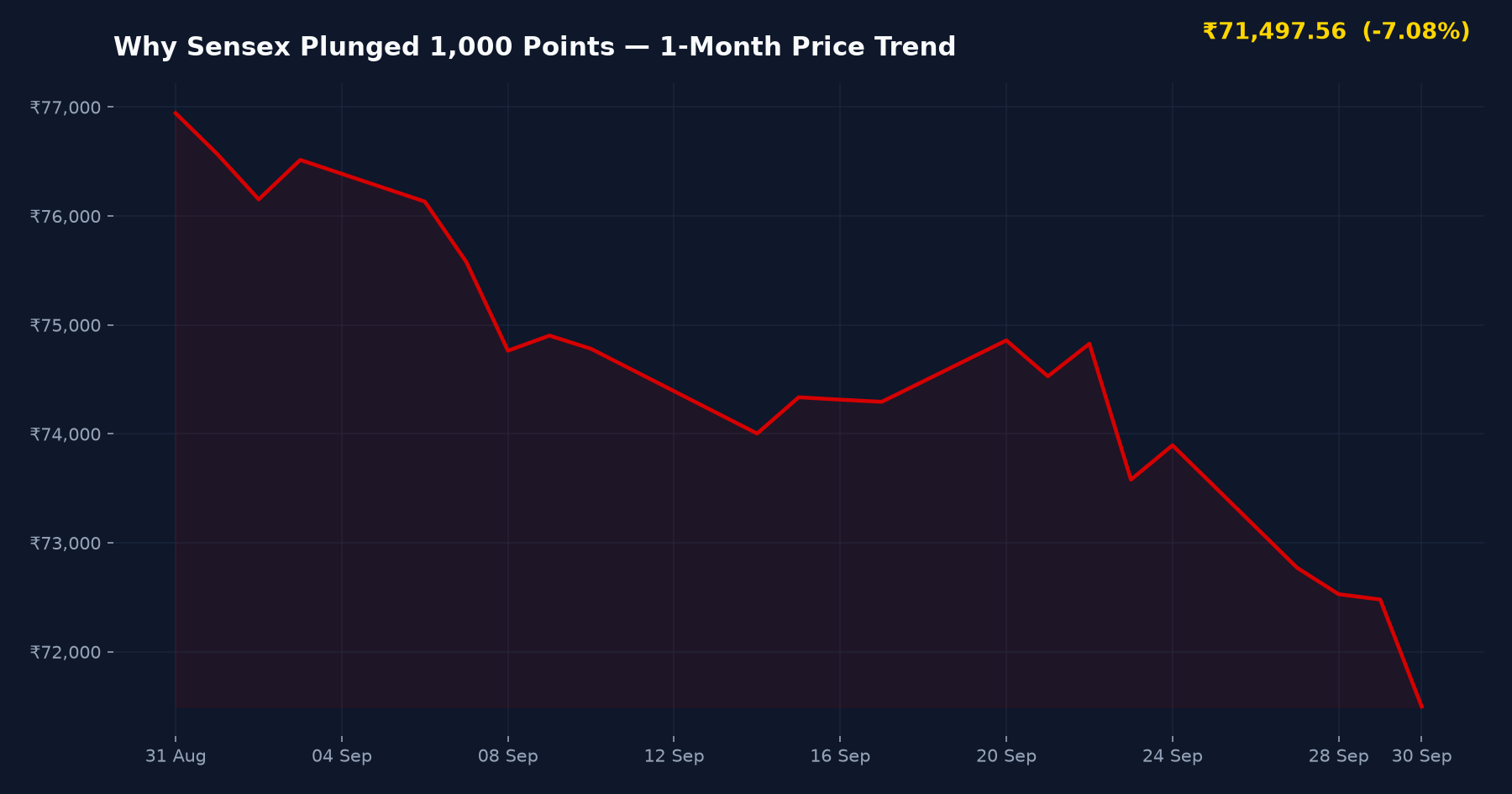
MUMBAI / NEW DELHI, OCTOBER 01, 2026 — During morning trade on Thursday, October 01, 2026, the Indian benchmark indices witnessed a sharp downturn, with the Sensex plummeting over 1,000 points and the Nifty falling below the 22,300 mark. This significant correction led to an estimated loss of ₹9.5 lakh crore in investor wealth within the first hour of trading, driven by factors including a rebound in crude oil prices and persistent Foreign Institutional Investor (FII) selling.
SENSEX
INDEX
▼ ₹1,038.61 (-1.43%)
Day Range: ₹71,467.45 – ₹72,572.90
52W Range: ₹71,467.45 – ₹86,159.02
● Real-Time Feed
Key Market Events & Timeline
| Event / Catalyst Milestone | Exact Calendar Date |
|---|---|
| Sensex settles 250 pts lower (previous session) | September 29, 2026 |
| GIFT Nifty signals gap down start for Indian markets | October 01, 2026 |
| Nifty, Sensex tank due to FII selling, high bond yields | October 01, 2026 |
| Sensex plunges 1,000+ points, Nifty below 22,300 | October 01, 2026 |
Key Market Metrics & Impact
| Metric | Value / Observation |
|---|---|
| Sensex Intraday Drop | 1,000+ points |
| Nifty Level (Intraday Low) | Below 22,300 |
| Investor Wealth Erased (in 60 mins) | ₹9.5 Lakh Crore |
| Primary Triggers | Rising Crude Oil, FII Selling, High Bond Yields |
| Impacted Sector | Broad-based across segments |
In-Depth Analysis: Triggers Behind the Market Plunge
The sharp correction in the Indian equity markets on Thursday, October 01, 2026, was primarily attributed to a confluence of negative global and domestic factors. According to reports from Moneycontrol and Livemint, the market opened with a significant gap-down, signaled earlier by a fall in GIFT Nifty, reflecting subdued sentiment in Asian markets.
Rising Crude Oil Prices
A key factor contributing to the market’s decline was the rebound in crude oil prices. India, being a net importer of crude, is highly sensitive to fluctuations in global oil benchmarks. Higher crude prices can lead to increased import bills, inflationary pressures, and potential current account deficit concerns, negatively impacting corporate profitability and overall economic outlook. Moneycontrol highlighted surging crude prices as a primary concern for investors.
Persistent FII Selling
Foreign Institutional Investors (FIIs) have been net sellers in the Indian markets, a trend that intensified on Thursday. Livemint noted FII selling as a significant reason behind the big plunge. Continuous outflows by foreign investors typically exert downward pressure on equity prices, especially in emerging markets like India, as they withdraw capital in favor of other asset classes or safer havens.
High Bond Yields & Global Cues
Elevated bond yields globally, particularly in the US, also played a role. Higher bond yields make fixed-income investments more attractive compared to equities, leading to capital reallocation. Furthermore, a subdued performance in major global indices such as the DJIA, S&P, NASDAQ, Kospi, and Nikkei, as tracked by Livemint, contributed to a cautious sentiment among domestic investors, signaling a broader risk-off environment.
Balanced Investor Framework: Catalysts vs. Risks
Potential Catalysts for Recovery (Bullish View)
- Value Buying Opportunities: Sharp corrections often present opportunities for long-term investors to accumulate quality stocks at lower valuations.
- Strong Domestic Fundamentals: Underlying strength in India’s economic growth trajectory and corporate earnings could provide resilience.
- Government Policy Support: Proactive fiscal and monetary policies aimed at stabilizing the economy and boosting investor confidence.
Key Downside Risks (Bearish View)
- Sustained FII Outflows: Continued selling by foreign investors could prolong market weakness.
- Inflationary Pressures: Persistent high crude oil prices and other commodity costs could fuel inflation, leading to tighter monetary policies.
- Global Economic Slowdown: A significant slowdown in major global economies could impact India’s export-oriented sectors and overall growth.
- Geopolitical Tensions: Any escalation in global geopolitical conflicts could introduce further uncertainty and volatility.
Frequently Asked Questions
What caused the Sensex to fall over 1,000 points on October 1, 2026?
The Sensex’s sharp decline was primarily triggered by a rebound in international crude oil prices, persistent selling by Foreign Institutional Investors (FIIs), and elevated global bond yields. These factors collectively contributed to a broad-based negative sentiment across the Indian equity markets.
How much investor wealth was lost during the market correction?
Within the first 60 minutes of trading on Thursday, October 1, 2026, Indian investors witnessed an erosion of approximately ₹9.5 lakh crore in wealth. This figure reflects the significant market capitalization lost as benchmark indices plunged.
What are the key factors influencing the current market sentiment in India?
Current market sentiment is heavily influenced by global crude oil price movements, the trajectory of FII flows, and the outlook for global interest rates and bond yields. Domestic factors such as corporate earnings, inflation trends, and government policy announcements also play a crucial role in shaping investor confidence.
SEBI Compliance & Statutory Disclaimer
The information and analysis presented on IPO Bulletin (ipobulletin.com) are for informational and educational purposes only and do not constitute financial, investment, or legal advice. Securities market investments are subject to market risks; please read all offer documents (DRHP/RHP) thoroughly before committing capital. Grey Market Premium (GMP) figures are unofficial, unregulated street estimates. Always consult a SEBI-registered investment advisor before making financial decisions.
Sources referenced: Moneycontrol, Livemint, NDTV Profit
Reusing this article or its images? Credit IPO Bulletin and link to https://ipobulletin.com/2026/10/why-sensex-plunged-1000-points-%e2%82%b99-5-lakh-cr-investor-loss-market-outlook.html. Content licence.