
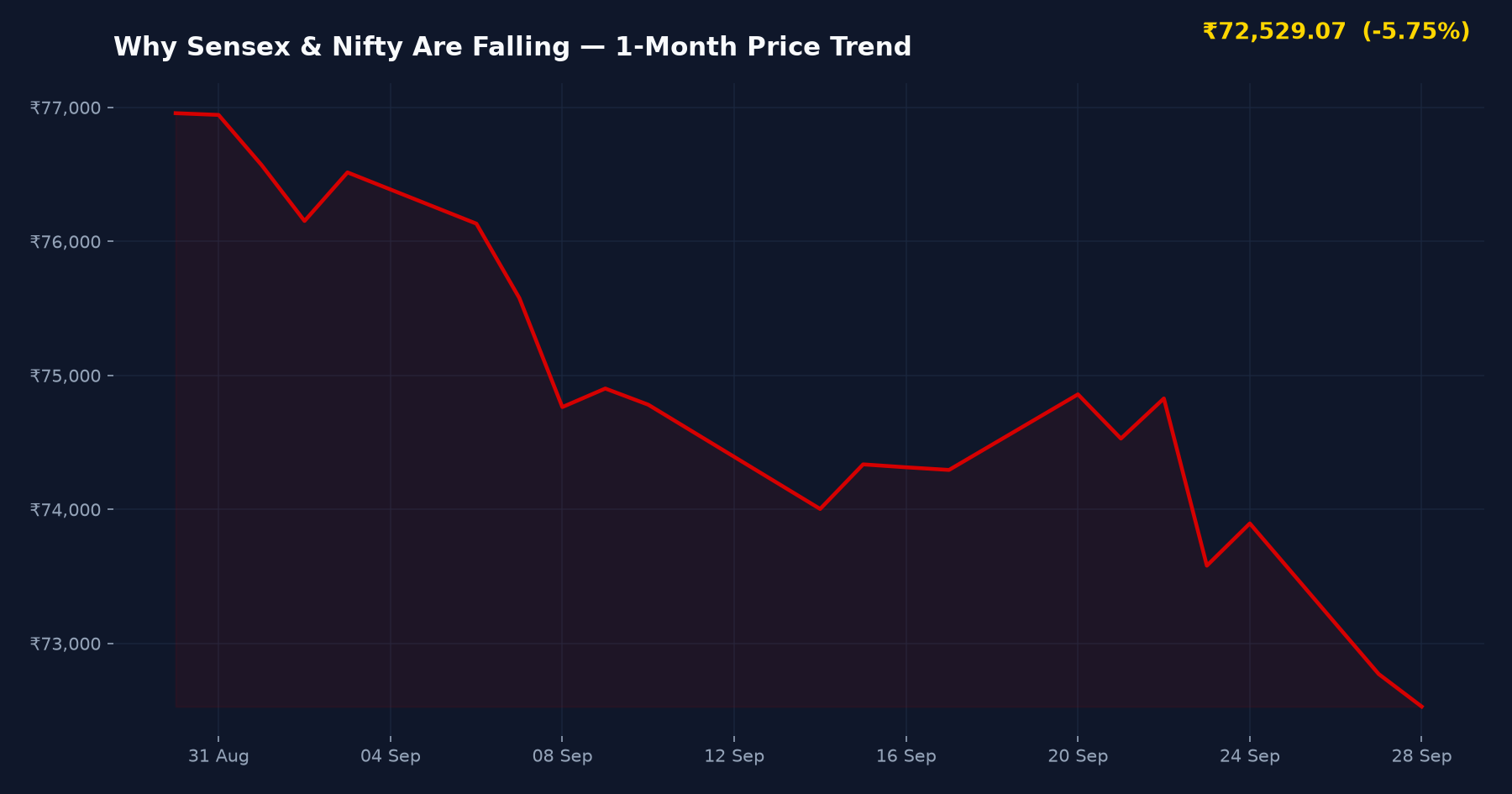
MUMBAI / NEW DELHI, SEPTEMBER 30, 2026 — During trading on Wednesday, benchmark indices Sensex and Nifty faced intense selling pressure, extending a correction phase driven by global macro headwinds, surging crude prices, and aggressive foreign institutional outflows. According to market data from Moneycontrol and Livemint, the broader markets have encountered severe turbulence over recent sessions, with the Sensex shedding 250 points to settle lower on Tuesday, September 29, 2026, following a massive 1,100-point rout on Monday, September 28, 2026.
| Market Event / Catalyst Milestone | Exact Calendar Date |
|---|---|
| Monday Market Mayhem & 1,100-Point Sensex Slump | September 28, 2026 |
| US Bond Yields Surge to 19-Year High Impacting Equities | September 29, 2026 |
| Intraday Rebound and Nifty Stabilization Check | September 30, 2026 |
SENSEX
INDEX
▼ ₹1,366.63 (-1.85%)
Day Range: ₹72,064.00 – ₹72,684.90
52W Range: ₹71,545.81 – ₹86,159.02
● Real-Time Feed
Key Drivers Behind the 2026 Market Correction
Financial reports compiled across Moneycontrol and Livemint indicate that the sharp downturn in Indian equities is propelled by a confluence of international and domestic triggers. On Tuesday, September 29, 2026, analysts noted that US bond yields touched a 19-year high, sucking liquidity away from emerging markets like India. Simultaneously, surging crude oil prices have raised domestic inflation concerns, putting pressure on corporate profit margins and macroeconomic stability.
Furthermore, foreign institutional investors (FIIs) have pared allocations toward Indian equities, reacting to shifting global interest rate expectations. The depreciation of the Indian rupee has compounded these challenges, amplifying losses for foreign portfolio investors converting dollar-denominated assets. However, fundamental research highlights that robust domestic mutual fund SIP inflows continue to act as a crucial cushion against foreign capital flight.
Bull vs. Bear Market Catalysts
Evaluating the long-term health of the Indian equity market requires weighing structural strengths against immediate macroeconomic risks:
- Bull Catalysts: Consistent domestic institutional inflows (DIIs), robust retail participation via mutual funds, and strong corporate earnings in select domestic-consumption sectors.
- Bear Risks: Escalating geopolitical tensions, volatile crude oil prices, persistent foreign institutional outflows, and headwinds from multi-year high US bond yields.
What to check before investing during market corrections
- Verify company debt-to-equity ratios and interest coverage buffers on Screener.in before deploying capital.
- Assess promoter pledging levels and institutional holding trends in latest BSE/NSE filings.
- Monitor macroeconomic indicators including RBI policy stances, domestic inflation prints, and crude pricing trends.
Frequently Asked Questions
Why are Sensex and Nifty experiencing sharp corrections in 2026?
Indian benchmark indices have faced heavy selling due to US bond yields hitting a 19-year high, surging crude oil prices, aggressive foreign portfolio outflows, and rupee depreciation. These macroeconomic shifts have tightened global liquidity and triggered risk-off sentiment among overseas investors.
How are domestic investors buffering the market crash?
Despite substantial foreign institutional selling, consistent domestic mutual fund inflows and retail Systematic Investment Plan (SIP) contributions have provided strong counterbalancing support, helping cushion the market against deeper structural pullbacks.
What should retail investors focus on during high market volatility?
Investors are advised to focus on fundamentally strong balance sheets with low debt, robust earnings visibility, and strong cash flows, steering clear of speculative rallies during periods of heightened macroeconomic uncertainty.
SEBI Compliance & Statutory Disclaimer
The information and analysis presented on IPO Bulletin (ipobulletin.com) are for informational and educational purposes only and do not constitute financial, investment, or legal advice. Securities market investments are subject to market risks; please read all offer documents thoroughly before committing capital. Always consult a SEBI-registered investment advisor before making financial decisions.
Sources referenced: Moneycontrol, Livemint, Economic Times, BSE India filings
Reusing this article or its images? Credit IPO Bulletin and link to https://ipobulletin.com/2026/09/why-sensex-nifty-are-falling-crude-shock-us-bond-yields-fii-outflows.html. Content licence.