
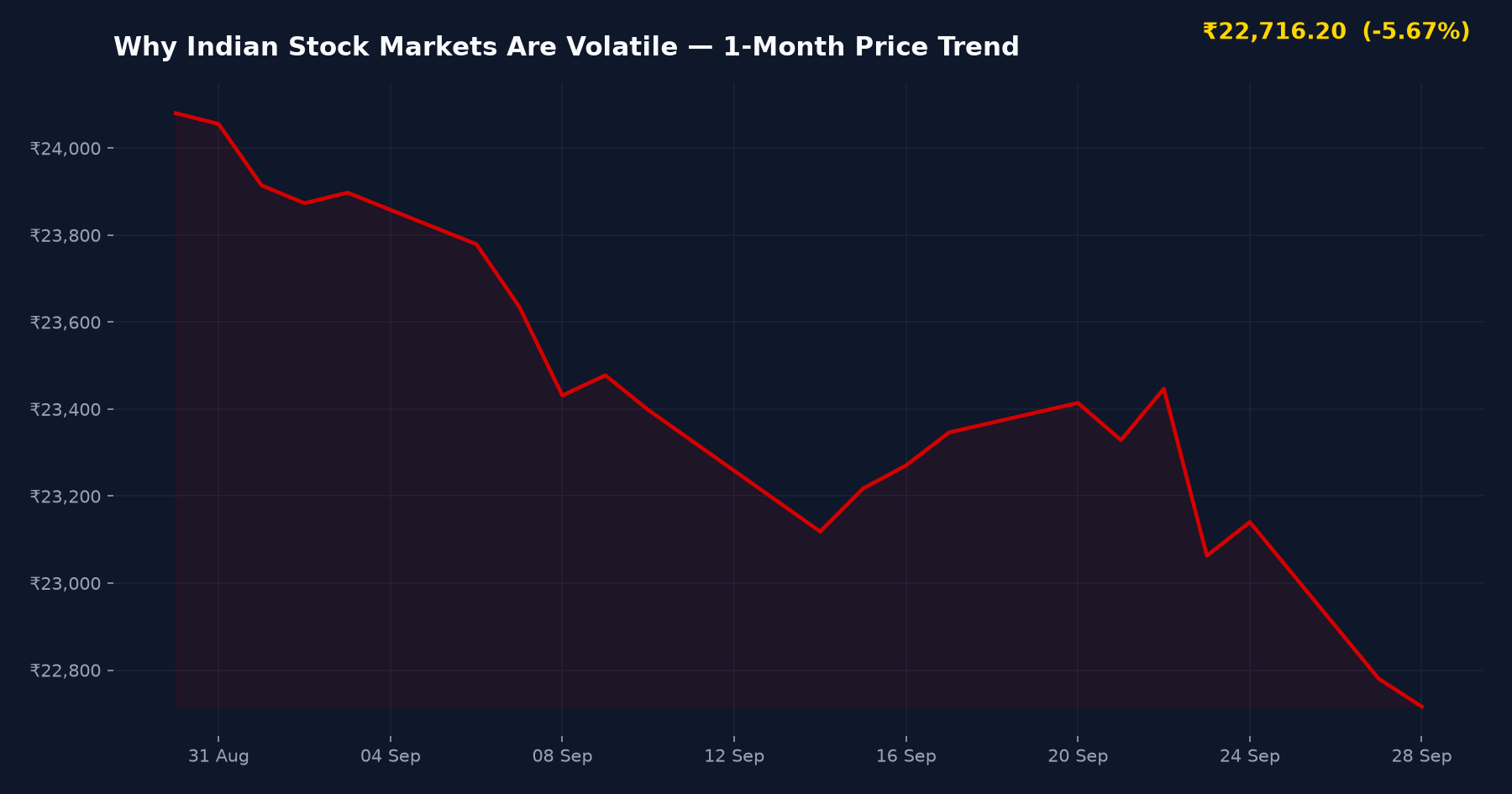
MUMBAI / NEW DELHI, SEPTEMBER 29, 2026 — During trading on Tuesday, September 29, 2026, Indian equity benchmarks witnessed sharp intraday turbulence, underscored by a dramatic 2% plunge in Nifty’s indicative price within a two-second window during the monthly expiry closing auction session. According to market data and institutional commentaries compiled across Moneycontrol, Livemint, and BSE filings, the sudden price distortion triggered widespread anxiety before a sharp recovery ensued. Analysts attribute the heightened volatility to an intersection of macroeconomic headwinds, including persistent foreign institutional investor (FII) capital outflows, escalating crude oil price fluctuations, high US Treasury yields, and heavy primary market fundraising liquidity absorption.
NIFTY 50
INDEX
▼ ₹424.30 (-1.83%)
Day Range: ₹22,569.65 – ₹22,753.25
52W Range: ₹22,182.55 – ₹26,373.20
● Real-Time Feed
Key Market Catalysts & Timeline Overview
| Event / Catalyst Milestone | Exact Calendar Date |
|---|---|
| Monthly Derivatives Expiry Closing Auction Volatility | September 29, 2026 |
| NSE Market Cap Enters Top 10 Indian Stocks | September 24, 2026 |
| ESDS Software Q1 Results & Lower Circuit Print | September 25, 2026 |
Decoding the Closing Auction Distortion and FII Pressures
The unexpected two-second downward spike in Nifty derivatives has renewed debates regarding algorithmic execution risks and liquidity depth during monthly expiry cycles. According to fundamental observations from Trendlyne and broker insights by Motilal Oswal and ICICIdirect, domestic institutional investors (DIIs) have largely absorbed selling pressure, offsetting continuous capital extraction by foreign funds.
Concurrently, primary market activity—highlighted by massive listings such as the National Stock Exchange (NSE) debut—has concentrated significant liquidity pools. Filings submitted to BSE and NSE India confirm that the exchange’s stellar post-listing valuation surge propelled it into the elite top 10 list of Indian listed corporations by market capitalization, briefly overshadowing established consumer giants like Hindustan Unilever (HUL).
Bull vs Bear Market Framework
Bullish Catalysts:
- Robust domestic retail and institutional inflows (SIP books exceeding record thresholds) providing structural market support.
- Strong corporate earnings growth across select banking, infrastructure, and capital goods sectors.
- High investor appetite for landmark primary issuances and exchange-traded equities.
Bearish Risks & Downside Triggers:
- Persistent foreign institutional investor (FII) capital flight driven by rising US bond yields and global macroeconomic uncertainty.
- Crude oil price volatility impacting India’s import bill, fiscal deficit, and currency stability.
- Technical anomalies and liquidity squeezes during high-stakes derivative expiry windows.
What to check before trading or investing
- Verify overall FII and DII cash market net flow data daily via NSE/BSE portals.
- Monitor global macroeconomic cues, including US Treasury yields and crude oil benchmarks.
- Review individual stock stop-losses and technical support levels before executing derivative trades.
Frequently Asked Questions
Why did Nifty plunge sharply during the closing auction on September 29, 2026?
The sudden 2% drop in Nifty’s indicative price during monthly expiry closing auctions was driven by heavy derivatives repositioning, algorithmic execution adjustments, and broader cautious sentiment amid foreign capital outflows.
How are FII outflows impacting overall Indian stock market momentum?
Continuous FII selling creates near-term valuation pressures across large-cap equities, although resilient domestic institutional inflows (DIIs) and robust retail participation via mutual funds have largely cushioned downside shocks.
Where can investors track verified market data and regulatory announcements?
Investors should rely directly on official regulatory filings hosted on the BSE India and NSE India websites, alongside analytical reports from established financial platforms like Moneycontrol, Livemint, and Screener.in.
SEBI Compliance & Statutory Disclaimer
The information and analysis presented on IPO Bulletin (ipobulletin.com) are for informational and educational purposes only and do not constitute financial, investment, or legal advice. Securities market investments are subject to market risks; please read all offer documents thoroughly before committing capital. Always consult a SEBI-registered investment advisor before making financial decisions.
Sources referenced: Economic Times, Moneycontrol, Livemint, BSE India filings, Screener.in, Trendlyne
Reusing this article or its images? Credit IPO Bulletin and link to https://ipobulletin.com/2026/09/why-indian-stock-markets-are-volatile-nifty-closing-auction-fii-flows.html. Content licence.